AffectiveAction

Because business has the heart to succeed

Menu

  • Home
  • Blog
  • General Management
  • Marketing
  • People Management
  • Innovation
  • Guest Bloggers
  • About
  • Enter your email address to follow this blog and receive notifications of new posts by email.

  • Recent Posts

    • Renewable Fuel for a Brilliant Life
    • How to Manage Women: Tips #2 and 3
    • How to Manage Women Tip # 1
    • Compassionate Capitalism
    • Stop That Focus Group!
    • To really change people’s behavior: Use the right word.
    • Is This the Coolest Company Ever?
  • Archive

  • Tags

    Affective Action B2B business business model career development career management cause marketing collaborate commercialization Conflict corporate responsibility customer networks demand generation Design Duarte Communications early sales Ecomagination effective communication Empathy employee engagement employee retention GE generative green marketing high performance high touch/low cost hiring HR human resources innovation innovative thinking Institute for the Future investment Jeff Immelt leadership lead generation management managing women market development marketing marketing automation marketing metrics motivation negotiate nurturing prospects outperform passion personalized marketing philanthropy philosophy philosophy and business Presentations product introductions project management project portfolio analysis project selection prospecting regulatory expansion results sales Santa Clara University social-media social entrepreneur social venture Social Venture incubator Strategy sustainability TEDx Presidio the buying process the customer view The Onion time to market time to ramp use case venture program
    • RSS - Posts
    • RSS - Comments
  • Subscribe in a reader

Browsing Category General Management

Is Business Good or Evil?

November 18, 2012 · by Taia Ergueta

You have to read this article:  “The Wrath of Putin”.   (By Masha Gessen, Vanity Fair, April 2012.  Link to online version below)

It is a riveting story about:

  • The life of the man, Mikahil Khodorkovski, who was the richest man in Russia in 2003.
  • The transformation of a man totally devoted to wealth to someone who put advocacy for commercial and governmental ethics above his own liberty
  • The astonishing ways in which multi-billion dollar deals and wealth transfers happened in Russia over the last two decades
  • The ongoing clash between this man and Vladimir Putin.

Read More →

Share this:

  • Email a link to a friend (Opens in new window) Email
  • Print (Opens in new window) Print
  • Share on Reddit (Opens in new window) Reddit
  • Share on Facebook (Opens in new window) Facebook
  • Share on Tumblr (Opens in new window) Tumblr
  • Share on X (Opens in new window) X
  • Share on Pinterest (Opens in new window) Pinterest
  • Share on LinkedIn (Opens in new window) LinkedIn
Like Loading...

Fast Company on Big Ideas

November 17, 2012 · by Taia Ergueta

In the November issue of Fast Company you’ll find “Why, with so many businesses thinking small, the World Needs Big Ideas”.  I love big ideas and, as a manager, often saw proof of the Goethe quote:

“Dream no small dreams for they have no power to move the hearts of men.”

Big idea projects also raise fascinating challenges for entrepreneurs and business people.

First, a few examples of inspiring Big Ideas sited in the Fast Company article:

  • Sage Bionetworks:   Accelerate biomedical discoveries by creating a system for open sourcing biomedical research data — thereby giving researchers access to thousands of times more data than they could collect on their own.
  • Waste Enterprisers: Turning human waste in to biofuel, solving huge widespread cost, environmental, time and dignity issues.
  • Terrapower: Unlimited safe energy from depleted uranium.

Read More →

Share this:

  • Email a link to a friend (Opens in new window) Email
  • Print (Opens in new window) Print
  • Share on Reddit (Opens in new window) Reddit
  • Share on Facebook (Opens in new window) Facebook
  • Share on Tumblr (Opens in new window) Tumblr
  • Share on X (Opens in new window) X
  • Share on Pinterest (Opens in new window) Pinterest
  • Share on LinkedIn (Opens in new window) LinkedIn
Like Loading...

Best Simple Operational Plan– Part 2

October 24, 2012 · by Taia Ergueta

The fun does not stop once the strategy summary is distributed and the initiatives list is complete!  Here is the second and last section of the Taia Ergueta Minimum Pain-Maximum Gain Operating Planning System.

This time the focus is on the last two parts:

  1. One Page Strategy Summary
  2. Operating Plan Initiatives List
  3. Operating Action Plans
  4. One Page Review Template

Step 3:  Operating Action Plans

This is where the functional or project teams lay out what they will actually do.  There will be groaning, but persevere.  Writing it down gives you a prayer of a chance that everyone is mobilized around a scope, a pace, and interim milestones that will actually achieve the desired outcomes.  Without this, it is really easy to go forward with all good intentions, have 3 quarters of highly upbeat review meetings at which actions taken are reported proudly, and then, in the 4th quarter, notice that we are not actually going to produce the results.  Explanations for the gap will abound.  The fact is, if you teams can’t describe at least one way to accomplish the objectives and let everyone see and critique that, your expected results have  a high chance of being road-kill.

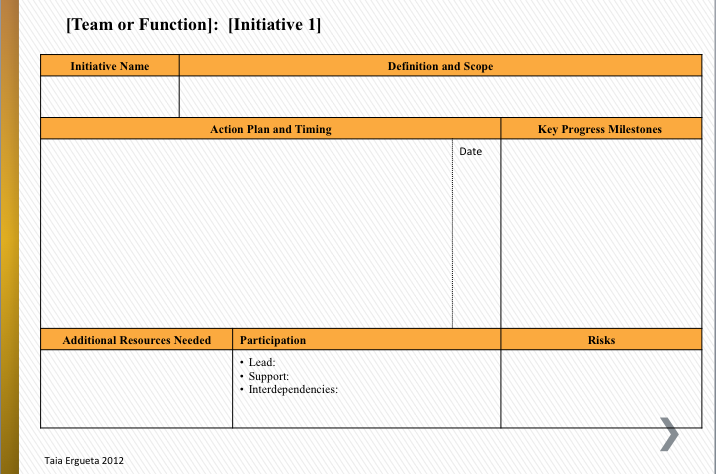
Here is a simple template for the action planning.  Each function or team fills one out for each major initiative.  The dates and milestones associated with the actions are the items that are reviewed at the progress review meetings.

Step 4.  One Page Review Template

That which gets measured gets done.  So you need to monitor the execution.  Quarterly is fine for the whole plan by the whole leadership team.  (Other reviews of key projects should happen with the right set of people as they go along and reach milestones.)  KEY POINT:  The operational plan reviews will be mind-numbing, time-wasting, and pretty much useless if you do not make them Exception-Reporting-based!  By this I mean, talk only about things that are at risk or off-track.  Do not make the reviews a show and tell about what is going fine.  Does this sound harsh?  Employees will actually be more engaged if they see that issues are surfaced and dealt with.  Just remember to be inspirational in the process and not to kill too many messengers.  ( See my other post on how to make all other communications more productive too.)

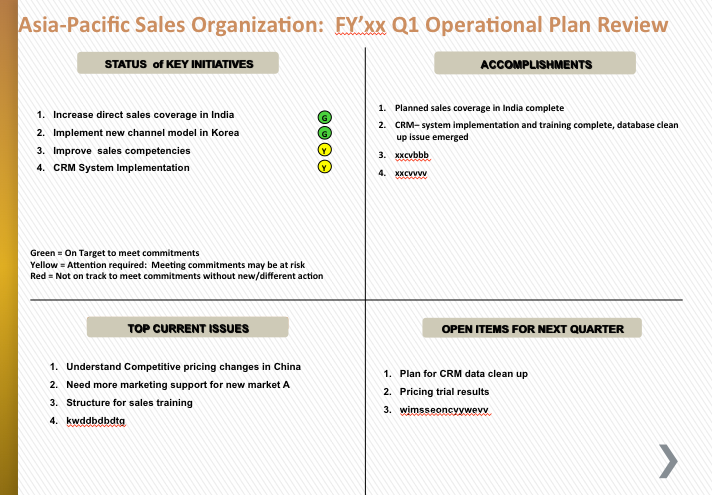
Here is a one page template for reviewing a function, or team operational plan.

The top left quadrant simply shows what is on track or off-track.  The top right gives highlights of what has actually been accomplished.  The bottom left indicates what issues are being addressed.  This should be a rich part of the discussion including troubleshooting what the team is doing to correct the problems, requests for assistance, etc.  The bottom right is a place for the team to note key things that will come up in the next quarter and/or the next review.

That is it.  

Who Benefits?

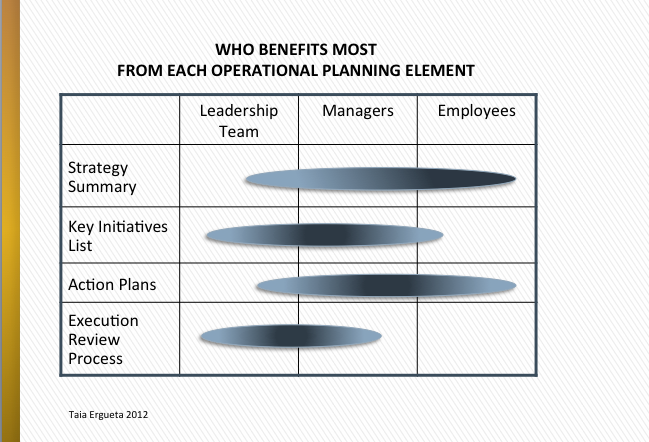
Here is how the 4 parts of the TEMPMGOPS serve different parts of your team.  The darker the shading, the more important the benefit.

Happy planning.

If you would like help with any of this, contact me at http://www.hourandawhiteboard.com

Share this:

  • Email a link to a friend (Opens in new window) Email
  • Print (Opens in new window) Print
  • Share on Reddit (Opens in new window) Reddit
  • Share on Facebook (Opens in new window) Facebook
  • Share on Tumblr (Opens in new window) Tumblr
  • Share on X (Opens in new window) X
  • Share on Pinterest (Opens in new window) Pinterest
  • Share on LinkedIn (Opens in new window) LinkedIn
Like Loading...

Best Simple Operational Planning –Just 4 Slides

October 21, 2012 · by Taia Ergueta

QZBJGG9HWXMN Everyone has a reason to hate operational planning. It takes too long. Worse, it takes all that time to do and is often forgotten. It gets confusing (“Isn’t this more of a strategy than an objective?” Argghhh!). And even when everyone manages to drag themselves through all that, reporting on and reviewing the execution of those plans gets so boring you wish you were the ones being executed.

These problems come to mind now because I am advising a small, but fast-growing company doing its first round of real planning.  The benefits are high. It is worth trying to reduce the costs.  So here it is, the Taia Ergueta Minimum Pain-Maximum Gain Operating Planning System.

The pieces:

  1. One Page Strategy Summary
  2. Operating Plan Initiatives List
  3. Operating Action Plans
  4. One Page Review Template

1. The One Page Strategy Summary

This assumes that you have done the strategy development already. If so, you have a ton of documents with options, analyses, dreams, obfuscations, spider diagrams, and assumption-laden spreadsheets to show for it. Now you just need all of that exquisitely distilled into one page. “Impossible!”, you say? We aren’t exactly talking Shakespeare here; it can be done. And it really has to be done.  Give every employee a single, digestible page that shows what needs to change and by how much and you dramatically increase your chances of accomplishing and exceeding that.

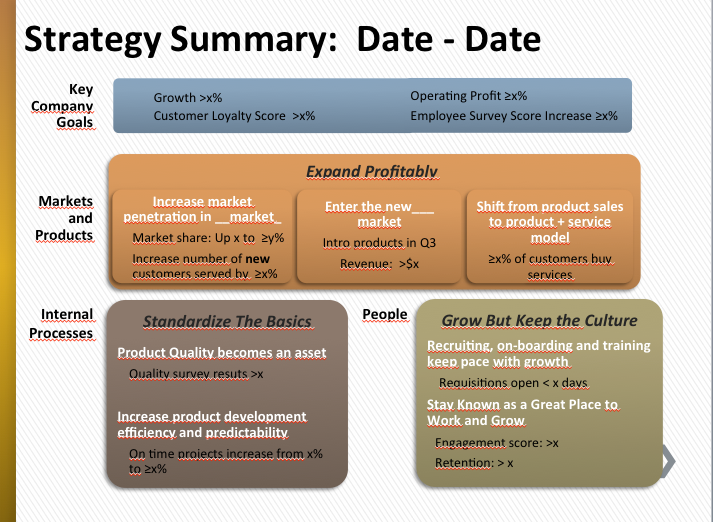
Here is an example of a 1 page strategy summary:

To be clear, it is not just about fitting stuff on one page.  The requirements for an effective one page strategy summary are:

1.  Whole Entity Goals. There should not be more than 6 of these. These should indicate the actual numeric goal that the entity will achieve by the end of the planning period (a year, or half year if you are in the midst of massive change). In this case I have suggested:

    • A growth goal
    • A profit goal
    • A customer satisfaction or loyalty goal, and
    • Some version of an employee satisfaction or engagement goal

2. Strategic Intent Blocks

No more than 5 strategy areas. In the example above I have 4 strategy blocks:

      • Markets and Products
      • Processes
      • Employees/Culture
      • Finance and Admin

Each one has:

      • A description of the key strategic intent. This is a pithy phrase that captures the key CHANGE that you will effect. If there is no change word (“increase” “eliminate”, “accelerate”, etc.), try again.  (Remember, these are not meant to cover everything that the organization will do.  They are the areas which require extra focus and will produce big impacts.)
      • The main tactical initiative areas.  Keep these broad enough and phrased as objectives; let your teams figure out how to accomplish them.  They will be more engaged, develop more, and are likely to do great things you would not have thought of!
      • The very few key metrics — and associated specific goals– that indicate the size of the change needed and that will tell if you accomplished the strategy.  Nota Bene:  Always define the goals as a minimum (i.e., “at least” or “less than”) rather than as a specific value.  Reseach shows that people will just meet a specific goal, but will consistently outperform that when the goal is open-ended.  Go figure.  Now you know how to increase your organizations output by 15% simply by learning how to type “<” and “>”.

2. Operating Plan Initiatives List

Once the strategy is clear, your teams or functional groups can go off and develop action plans. Warning, warning!:  This is where the strategy can get undermined if people pursue all the projects they like and fit the strategic initiatives in edgewise.  Negotiating to a 1-2 page list of all the major initiatives and their owners helps the management team drive focus and make clear trade offs.  You’ll end up with a succinct initiative list for each function or group that contains:

  • Initiatives directly in support of the strategies: These are the highest priority.
  • Initiatives for some ongoing obligations: Some of these are essential and some may need to be examined for potential dropping over time.
  • Other initiatives: If there are a lot of additional initiatives, it is worth checking to see if they are justified and if they can be done without jeopardizing the strategic items.

A simple slide like this can capture the key elements across all the entities involved.

Well, that’s enough for now.  The TEMPMGOPS, like wild boar, is best digested when consumed slowly.  In the next post I’ll give you the final 2 templates.

  • Operating Action Plans
  • Operational Plan Review Template

Cheers!

Inquiries and Comments Welcome.

If you would like help with your planning, contact me by clicking here.

Share this:

  • Email a link to a friend (Opens in new window) Email
  • Print (Opens in new window) Print
  • Share on Reddit (Opens in new window) Reddit
  • Share on Facebook (Opens in new window) Facebook
  • Share on Tumblr (Opens in new window) Tumblr
  • Share on X (Opens in new window) X
  • Share on Pinterest (Opens in new window) Pinterest
  • Share on LinkedIn (Opens in new window) LinkedIn
Like Loading...

Getting Great Customer Feedback on a New Technology

October 10, 2012 · by Taia Ergueta

You’ve got very cool new technology that thousands of labs will love. The product is ready. Rev up the Introduction Machine and sell, right? Senova Systems, a company for which I am consulting, is taking a different approach. Just before the full launch they have launched an Early Access Program. I thought you would find the concept and their decisions useful.

Senova has a developed a revolutionary new technology for measuring pH that takes time, risk, aggravation and cost and out of doing this very common measurement. (For more on this see their site: SenovaSystems.com)  Their first product is a handheld pH scanner called the “pHit scanner”, They have been testing the product internally all along and further testing is part of the manufacturing scale up and beta sites. But instead of launching it immediately in to the broad market, they are taking the time to do an Early Access Program (EAP).

 Why an EAP?

The CEO, Lee Leonard,  is a serial entrepreneur. He knows that his market comprises highly diverse applications and that there is no way for his team to test the product in all the ways that customers will use it.  He also knows that as great as the technology may be,  the user experience is just as important.  To ensure that they launch with the kind of confidence that only comes from deep customer knowledge, he is taking the time to do the Early Access Program.

How Many Customers to Involve

I have been involved with Early Access Programs before. An Early Access Program can take various forms. It can involve a small number of customers early in the development program, getting their input at critical junctures in the process. It can simply be a way of ensuring key customers that they will have the first units. In this case, Senova’s key objectives are to understand customer use cases thoroughly and to find any unknown corner case situations that stress some aspect of the product. For these purposes, the EAP will include a large (50) but selected set of customers. By selected, I mean that they will have customers apply and will choose a set that represents the broad range of applications that use pH measurement.

Nuts and Bolts: The Terms

Here are the 2 key parts of an EAP and the example of how Senova chose to accomplish them:

  • Incentive:  Just getting the chance to be among the first in their company or field to get their hands on a pHit is a big incentive for some customers to participate. But to ensure that the participants are real customers (not just curious technology aficionados), the Senova program is structured as a discounted Try and Buy: Each customer selected to be an Early Access Program participant, gets to purchase a pHit scanner at a 50% discount on the retail price of $1,650.00. (To give time for the “Try”, EAP customers won’t be billed until 30 days after delivery). These customers also get a money-back guarantee; if they are not fully satisfied with the scanner, they simply return it.

In addition, participating organizations will be publicly acknowledged as key influencers. (Customers can opt out of this if they prefer anonymity.)

  • Required Input From the Customer:  You need to be very specific about what you expect from customers in an EAP. It is common for customers to be eager to participate and then get too busy to do their part ( use the product, write an app note, or whatever else you have asked of them).

In return for the above, Senova asks its EAP customers to commit to the following:

    • Use the product under their normal laboratory conditions for 30 days.
    • Provide Senova with feedback on the user experience and technical performance through structured conversations and documents.

If you want a more complete example of how to describe or document such a  program, click here to see the Senova description and FAQs.

How to Choose the Customers

If you want participation during product development, you cannot afford to involve too many customers, so pick just a few from the most important target market(s). Your closest customers may not be the best participants.  For example don’t involve the most demanding customers if you want a minimum viable product market entry.  The intent is toto make sure you are meeting the target market’s needs solidly.

If you want to give some customers the first units either to establish key influencers or simply as reward or for their ego gratification, then your top customer list will drive the number involved.

If, like Senova, you want to experience a diversity of application areas deeply,  involve enough customers to  get a good sample of the full range. For example, Senova is taking applications from interested parties and will choose 50 customers that cover as broad a set of use scenarios as possible.

Bottom Line

Yes, conducting an EAP will require significant effort and attention. You may even postpone some revenue. But it is an investment in customer insight that will yield extremely high returns.

The rewards:

  • Additional product testing that can validate yours or find weaknesses early, when they are least costly to fix.
  • Develop close relationships with participating customers, leading to ongoing customer insight, potential influencing of other customers and maybe even longer term loyalty!
  • Usage information that can reveal additional needs, opportunities to improve design and user experience, opportunities to integrate activities or products that are upstream or downstream from your current product.
  • Service and self-service content.
  • Faster time-to-ramp based on more effective commercialization and sales efforts.
  • A more engaged internal team that gains the confidence and inspiration that only comes from close customer exposure.

Input Welcome

Have you done Early Access Programs?  If so, what has been your positive or negative experience with them.  If you want assistance with an EAP contact me by clicking here.

Share this:

  • Email a link to a friend (Opens in new window) Email
  • Print (Opens in new window) Print
  • Share on Reddit (Opens in new window) Reddit
  • Share on Facebook (Opens in new window) Facebook
  • Share on Tumblr (Opens in new window) Tumblr
  • Share on X (Opens in new window) X
  • Share on Pinterest (Opens in new window) Pinterest
  • Share on LinkedIn (Opens in new window) LinkedIn
Like Loading...

What is Capitalism? The answer is changing.

September 12, 2012 · by Taia Ergueta

I attended the TEDx Presidio, where the real question that speakers illuminated was:  What is capitalism becoming?  The theme was Reinventing Capitalism.  I have posted before about social ventures, which form one broad new sector (See here).   Here are some additional ideas from TEDx that you may find interesting and useful as you think about how to evolve your business model.  You are thinking about that, aren’t you?

1.  Share Economy

Speaker:  Van Jones, Founder and President of Rebuild the Dream

Van noted that changes in capital are coming from the bottom up.  That has been the source of the new Share Economy—spurred by tight budgets and also by enjoyment (“Sharing:  If you have to do it, it sucks.  If you get to share, then it feels good.”).  Examples:

  • Sharable cars, sofas, equipment
  • Crowdsourcing
  • Kiva, Kickstart

He noted that some of these are trendy “lifestyle” ventures and that as the trend matures it needs to increasingly tie in and serve people with very real needs.

This may seem remote from your business. You may even think that it would be foolish to encourage shared use of your product.  But what if a research center could afford a massive investment in scientific instruments by starting a service business for other departments or institutions?  It is twist on the shared economy that has worked well around the world.  There are probably others. Read More →

Share this:

  • Email a link to a friend (Opens in new window) Email
  • Print (Opens in new window) Print
  • Share on Reddit (Opens in new window) Reddit
  • Share on Facebook (Opens in new window) Facebook
  • Share on Tumblr (Opens in new window) Tumblr
  • Share on X (Opens in new window) X
  • Share on Pinterest (Opens in new window) Pinterest
  • Share on LinkedIn (Opens in new window) LinkedIn
Like Loading...

Design a Great Presentation

September 11, 2012 · by Taia Ergueta

Recently Duarte Communications generously instructed an elite set of social entrepreneurs* on how to design and deliver a truly great presentation.  And on the August 23 when that they all presented their business plans, every single presentation was visually appealing and commanded your interest!  Here I’ll share with you my take on just one of Duarte’s nuggets of wisdom and how it can shape a great business plan presentation.

The Nugget

Michael Duarte shared that their research indicated that great presentations have this pattern.

‘Nuf said for you super-intuitive types out there, right?

For those of you who need a bit more spelled out:  You grab and keep the audience by taking them through a series of lows and highs.  You, the presenter, orchestrate those downs and ups and become their hero by taking them on an interestingly suspenseful and ultimately uplifting, confidence-inspiring journey.

Read More →

Share this:

  • Email a link to a friend (Opens in new window) Email
  • Print (Opens in new window) Print
  • Share on Reddit (Opens in new window) Reddit
  • Share on Facebook (Opens in new window) Facebook
  • Share on Tumblr (Opens in new window) Tumblr
  • Share on X (Opens in new window) X
  • Share on Pinterest (Opens in new window) Pinterest
  • Share on LinkedIn (Opens in new window) LinkedIn
Like Loading...

Saving Customers Time Will Build Your Business

August 22, 2012 · by Taia Ergueta

The humor newspaper The Onion ran this front page headline: “Things Taking Entirely Too Long”. The accompanying photo showed a man staring at a microwave oven. Two minutes is the new Eternity.  People will put up with government gridlock, romantic betrayal and even cucumbers being put in their drinking water, but they will simply not tolerate having their time wasted. This all points to the big opportunity to distinguish yourself by saving your customers time.

The post “How to Spark Innovative Thinking” talked about many innovation directions.  Saving customers time is an exceptionally rich innovation strategy. Not only do customers value it but your sales people will love having a quantifiable personal benefit to offer. Have you thought of how you can do this? Here is a three-step process for finding the most innovative and profitable ideas.

Read More →

Share this:

  • Email a link to a friend (Opens in new window) Email
  • Print (Opens in new window) Print
  • Share on Reddit (Opens in new window) Reddit
  • Share on Facebook (Opens in new window) Facebook
  • Share on Tumblr (Opens in new window) Tumblr
  • Share on X (Opens in new window) X
  • Share on Pinterest (Opens in new window) Pinterest
  • Share on LinkedIn (Opens in new window) LinkedIn
Like Loading...

Winning Big Through Sustainability

August 12, 2012 · by Taia Ergueta

Opportunities Revealed

In the business world, “Sustainability” started out as Lunatic Fringe talk, then moved up to window-dressing for Corporate Responsibility sections of Annual Reports and subsequently got a new and sometimes tawdry life as a Green Marketing opportunity.  Now, setting a company’s sustainability agenda is one of the most important and valuable things that its executives must do.  And people at all levels can find great innovation ideas in sustainability.

Serious Business

I attended the Sustainable Brands conference in 2007 and it was a hive of excitement over the power of Green Marketing and adulation of cool campaigns and programs.  Just two years later, the same conference was astoundingly different:  It had become clear that both the issues and opportunities are much more fundamental and addressing them is no longer a matter of choice, it is an imperative.  Energy and water will be scarce and more expensive for everyone.  In addition, a combination of consumer awareness and regulatory expansion are making transparency – a lot of reporting of your sustainability practices – mandatory.   You can deal with these as burdens or you can try to find ways to create advantages for your company.  In addition to creating new obligations, these and related challenges are creating major opportunities for growth and effectiveness.

What to do? Read More →

Share this:

  • Email a link to a friend (Opens in new window) Email
  • Print (Opens in new window) Print
  • Share on Reddit (Opens in new window) Reddit
  • Share on Facebook (Opens in new window) Facebook
  • Share on Tumblr (Opens in new window) Tumblr
  • Share on X (Opens in new window) X
  • Share on Pinterest (Opens in new window) Pinterest
  • Share on LinkedIn (Opens in new window) LinkedIn
Like Loading...

Social Ventures for a Better World

July 31, 2012 · by Taia Ergueta

This is an invitation to be inspired and perhaps help change the world.  Are you familiar with Social Entrepreneurship?  Here is a glimpse into this uplifting and fast-growing part of the business world and two specific actors worth knowing.

On August 23 twenty international social ventures will present their plans to investors and interested members of the community in Silicon Valley.  Please read the information below and contact me if you are interested in attending.

WHAT IS THIS ALL ABOUT?

For over ten years Santa Clara University has run an international Social Venture incubator. They get over 200 applicants annually from which they choose 20 to participate in the program. The successful candidates are companies that have proven their model and are ready to scale up. Those 20 companies engage in a rigorous 5 month program of business planning exercises culminating in 2 weeks of on site instruction and workshops at the University in August. In other words, the University brings critical help to the companies that seem ready and capable of having a big significant impact on their region or the world.  Faculty, staff, and a band of Silicon Valley executives coach the entrepreneurs through learning and planning that has proven to increase their success as they scale.

What is a Social Venture?  It is a for-profit company that has a social good as its main mission.  Often, these companies focus on serving the bottom of the pyramid (BOP). Read More →

Share this:

  • Email a link to a friend (Opens in new window) Email
  • Print (Opens in new window) Print
  • Share on Reddit (Opens in new window) Reddit
  • Share on Facebook (Opens in new window) Facebook
  • Share on Tumblr (Opens in new window) Tumblr
  • Share on X (Opens in new window) X
  • Share on Pinterest (Opens in new window) Pinterest
  • Share on LinkedIn (Opens in new window) LinkedIn
Like Loading...
Page 2 of 4 « Previous 1 2 3 4 Next »
  • Blog at WordPress.com.
  • Subscribe Subscribed
    • AffectiveAction
    • Join 41 other subscribers
    • Already have a WordPress.com account? Log in now.
    • AffectiveAction
    • Subscribe Subscribed
    • Sign up
    • Log in
    • Report this content
    • View site in Reader
    • Manage subscriptions
    • Collapse this bar
 

Loading Comments...
 

    %d