AffectiveAction

Because business has the heart to succeed

Menu

  • Home
  • Blog
  • General Management
  • Marketing
  • People Management
  • Innovation
  • Guest Bloggers
  • About
  • Enter your email address to follow this blog and receive notifications of new posts by email.

  • Recent Posts

    • Renewable Fuel for a Brilliant Life
    • How to Manage Women: Tips #2 and 3
    • How to Manage Women Tip # 1
    • Compassionate Capitalism
    • Stop That Focus Group!
    • To really change people’s behavior: Use the right word.
    • Is This the Coolest Company Ever?
  • Archive

  • Tags

    Affective Action B2B business business model career development career management cause marketing collaborate commercialization Conflict corporate responsibility customer networks demand generation Design Duarte Communications early sales Ecomagination effective communication Empathy employee engagement employee retention GE generative green marketing high performance high touch/low cost hiring HR human resources innovation innovative thinking Institute for the Future investment Jeff Immelt leadership lead generation management managing women market development marketing marketing automation marketing metrics motivation negotiate nurturing prospects outperform passion personalized marketing philanthropy philosophy philosophy and business Presentations product introductions project management project portfolio analysis project selection prospecting regulatory expansion results sales Santa Clara University social-media social entrepreneur social venture Social Venture incubator Strategy sustainability TEDx Presidio the buying process the customer view The Onion time to market time to ramp use case venture program
    • RSS - Posts
    • RSS - Comments
  • Subscribe in a reader

Browsing Category General Management

What Can the Design World Contribute to Management?

May 28, 2012 · by Taia Ergueta


I recently saw a terrific documentary, “Objectified“, by Gary Huswit which is all about how things are designed and how design affects us.  (Available on Netflix — I highly recommend it for various reasons.)   When I heard the list of characteristics of Good Design put forth by Dieter Rams, it struck me that many of the elements of great design apply to management.

… should be Innovative.  In the case of management, it is not about a stream of new programs, but it is about being open to innovation and ensuring differentiation.

… should Make a Product Useful.  I think the important analogy here is that great management should maximize employee “usefulness” by enabling them to be engaged and productive.

… is Aesthetic design.   Just as a product’s look and feel feed our emotions and sense of value, a management system needs to be made visible and felt.  In fact, it is always visible and felt, but those impressions are not always the ones that management intends! 🙂

… will make a product Understandable.  It should be easy for people to understand how to get their jobs done, how the customer experience gets formed, and how to get decisions made.

… is Honest.   Enough said.

… is Unobtrusive.  It should feel like the system is serving the people, not the other way around.

… is Long-lived.  Things have to change super-fast, but every company has to build some fundamental principles that endure.

… is Consistent in every detail:  Well, there is a part of me that immediately rebels, with Emerson’s “a foolish consistency is the hobgoblin of little minds” as my shield.  But we’ve all experienced companies with big service messages that have rude representatives, or a great new product with no training for the sales force.  So yes, great management means focus for a critical mass of consistent implementation.

… is Environmentally Friendly:  Sustainability is no longer a matter of choice and it is definitely not a marketing message.  It is an inescapable set of forces that affect every business in the form of cost changes, voluntary and uncontrolled transparency, customer expectations and regulatory actions.

“Last but not least, good [management] is… as little [management] as possible.”  Whether we call it the self-organizing organization or the generative company, it is all about winning through “just enough” leadership and highly engaged employees. (See “Use the Force, Luke” post, April 2.)

The design world clearly offers a lot of catalysts for Affective Action.  I’m intrigued.  Are there other design principles or practices that you think can be used in management?

Share this:

  • Email a link to a friend (Opens in new window) Email
  • Print (Opens in new window) Print
  • Share on Reddit (Opens in new window) Reddit
  • Share on Facebook (Opens in new window) Facebook
  • Share on Tumblr (Opens in new window) Tumblr
  • Share on X (Opens in new window) X
  • Share on Pinterest (Opens in new window) Pinterest
  • Share on LinkedIn (Opens in new window) LinkedIn
Like Loading...

This Could Become Your Favorite Rule to Live By

May 28, 2012 · by Taia Ergueta

If you had to choose two key rules to live by and a classic movie star to have on a desert island with you, what/who would you choose?

May I suggest the Golden Rule, this one, and William Holden?  Regardless of what island, company or planet you inhabit, this post will help you change that world for the better.

The Core Idea

There are 4 “modes” of communication. Whenever we communicate we are doing so in one or more of the following :

    • The mode of Complaint
    • The mode of Information
    • The mode of Creation
    • The mode of Inspiration

Each has a different impact. If you learn those impacts and apply each mode correctly you can exceed your objectives dramatically with much less effort.

The Impact and Application of the Four Modes of Communication

1.  The mode of Complaint

      • Examples of things we communicate when using this Mode:  Our problems. Others’ failings. Past errors.
      • Impact:  Drains energy from the person communicating as well as his/her audience
      • Recommended Use:  None.  Avoid this like trans fats. Stop it when you see it.

2.  The mode of Information

      • Examples of things we communicate when using this Mode:  What we have done.  How we have done it.  Data.  Methodology.  Process.  Background.
      • Impact:  Provides valuable inputs but, on its own, doesn’t change anything
      • Recommended Use:   Do this off-line whenever possible. Summarize.  Do exception reporting. Draw or propose implications.

3.  The mode of Creation

      • Examples of things we communicate when using this Mode:  Joint problem-solving.  Options.  Evaluations.  Advocacy. Joint decision-making.
      • Impact:  Most productive mode because something is going to change as a result of the communication.
      • Recommended Use:  This is the mode in which you want to be as much of the time as possible, especially in meetings, because this is the mode that moves things forward.

4. The mode of Inspiration

      • Examples of things we communicate when using this Mode:  Big Goals.  Emotions/Passion.  Aspects of a desired future result.  Expressed confidence in ability to reach it.  Confidence in or admiration for people involved.
      • Impact: Expands people’s sense of the Possibilities. It leads to more than the expected happening.
      • Recommended Use: Build some element of this into all communications.

Putting it to Work

I’ve read and forgotten a boatload of teamwork/management stuff over the years and, in contrast, this 4 part communication rule has stayed with me.  It is the pasta of this space — easy, flexible and always hits the spot.  Here are a few application insights:

  • Moving information exchange out of meetings (e.g. shared electronically beforehand) ensures that scarce meeting time is used for the really productive modes of creation and inspiration.
  • Eliminating Complaint does not mean burying problems.  Anything that can be said in the mode of Complaint can be said in the mode of Creation:  Once you tune into that it is easy to make the shift without losing valuable candor and awareness of the issues.
  • When I first heard all this, the mode of Inspiration examples were President Kennedy’s Man on the Moon speech and Martin Luther King’s “I Have a Dream” speech.  This left me feeling that the mode of Inspiration was for monumental events and great orators, not for me.  But with more thought I realized that things such as expressing confidence in a colleague, team or employee, or reiterating the value of our goal provide inspiration.  And these things can be built into every communication.
  • I have occasionally shared this model with teams when a project is kicking off.  It seems to resonate and sets some efficient norms up front.

Input Welcome:  Do you think this model is useful?  Do you have other ideas for how to apply or improve on it?

Attribution: If I knew who originally came up with this modeI I would give full credit and send many accolades!  I was exposed to this at a company-wide management course at Agilent. Please write in if you know the source.

Share this:

  • Email a link to a friend (Opens in new window) Email
  • Print (Opens in new window) Print
  • Share on Reddit (Opens in new window) Reddit
  • Share on Facebook (Opens in new window) Facebook
  • Share on Tumblr (Opens in new window) Tumblr
  • Share on X (Opens in new window) X
  • Share on Pinterest (Opens in new window) Pinterest
  • Share on LinkedIn (Opens in new window) LinkedIn
Like Loading...

Thanks A Million, Kumar!

May 6, 2012 · by Taia Ergueta

Hopefully you have gotten a surprise gift at some point. How about one that you didn’t recognize as a gift? Mine came wrapped like this:

“I’d like to set up a time to meet with you, Taia. I am not sure that you are aware of what experience I bring from what I did before I joined Hewlett Packard and I’d also like to share with you where I would like to take my career. ”

With words to this effect, Kumar, set up a meeting that made me a better manager to many many other people.

Kumar worked for a manager who worked for me.  He had joined HP about two years before and I understood from his direct manager that he was doing well.  I must admit that I was more aware of the accomplishments of the group he was a part of than I was of Kumar’s specific performance.  I was a relatively new middle manager and nobody a couple of levels down from me had requested a meeting like this one, but I was glad to have the discussion. Oh let’s be honest, I was a young middle manager; I was probably just planning on getting through it and on to something about me.

My intent aside, I remember being very positively surprised by the impact of that brief meeting:

  1. He was right: When he went through his background with me I learned that I had had no idea who he really was:  He had a rich set of previous jobs and skills well beyond those he was immediately using.  Result: I effectively had “more resources” in my group and in the company:  He was still one person, but I now knew what flexibility he possessed if we needed it.
  2. With respect to the future, I learned that he had high ambitions and his interests.  Result:   I had an understood candidate for when new development or future job openings. Obviously, I was much more likely to think of him as those opportunities came up.
  3. Just by virtue of the conversation…I felt a sense of personal responsibility for his development. Result:  Per the HP model, he was still the main owner of his career, but he had created an interested and equipped ally in that process.

OK, so those were good one-time outcomes for the company and for him. But the “gift” in this story is this:  What I learned from that experience made me a better manager in each job since then. It taught me that having that kind of conversation with my employees could make a huge difference in how fully the company used their talents and also in how well we could meet their career needs.

Two Ways to Use This Insight

1.  Increasingly I have made it a point to provoke this discussion with employees. Depending on the size of your group, you may not be able to do this with every person. Where should you start?

  • First Priority Targets: Your best performing/high potential people are clearly where you want to focus your people-management time since they will produce the highest results and will also be the toughest to replace if you lose them.
  • Next Target Cohort: Strong employees who are quiet or shy. This population is often underutilized in companies. They may not readily self-promote and may need encouragement to seek or take on new opportunities. Some people are shy by nature. Other people may be quiet, career-conservative, or avoid self-promotion as a result of certain cultural norms, personal values or socialization. In the U.S., Asian, Hispanic, Indian and female employees, among others, sometimes fit this description.  I’m not stereotyping.  We have all known highly ambitious and self-promoting people in each of those groups.  But being sensitive to some common socialization patterns brings benefits.   You can get a huge return from making a special effort to give strong, but quiet employees comfortable and encouraging opportunities to:
    • Make their capabilities and aspirations known.
    • Consider development or job opportunities that will stretch them.

2.  As a manager or mentor, I often advise employees to do exactly what Kumar did:

  • Seek out someone who can be influential in your career (i.e., people who may someday control or know of jobs /opportunities you might like) and make sure that they know what skills and experience you bring to the party.
    • Let them know where you are headed with your career
    • Ask for nothing more their time to understand that and any advice that they may have immediately or in the future.

I don’t think I ran into Kumar after I left that job. Poor guy. If his ears really did itch every time I talked about his meeting request and the resulting insights, I caused him a lot of annoyance. He is one of many employees who taught me critical management lessons. It feels good to have a forum in which to thank him.

Is there and employee or co-worker who taught you something valuable who you want to thank? Write in and tell us – and them –about it. I’ll be glad to start a “Thanks A Million” section for posting  these.

Source of Bicyclist Photo:

Image: arztsamui / FreeDigitalPhotos.net

Share this:

  • Email a link to a friend (Opens in new window) Email
  • Print (Opens in new window) Print
  • Share on Reddit (Opens in new window) Reddit
  • Share on Facebook (Opens in new window) Facebook
  • Share on Tumblr (Opens in new window) Tumblr
  • Share on X (Opens in new window) X
  • Share on Pinterest (Opens in new window) Pinterest
  • Share on LinkedIn (Opens in new window) LinkedIn
Like Loading...

The Mother of All Metrics

May 2, 2012 · by Taia Ergueta

I nominate Achievement of Projected Sales Ramp Rate (Time to Ramp – “TTR”) as the single most important metric for your business.

To get resounding support for this, I’d better explain a few things.

First:  What is the Sales Ramp?

It is the projected pace and level of orders projected in the first year after a product is made available. (The number of years may differ depending on the level of innovation or industry.)

Why is it important?

There are both Financial and Effectiveness reasons. I got a big lesson in these in the PC business, where we had no more than 3 months after product introduction to make money on products that had taken 12-18 months to develop.  After three months, deep discounting would begin and you could abandon hope of making up the lost profits missed in those critical first months.  The PC case may be an extreme case, but many people seem to think they have all the time in the world to make money on a new product.  They don’t.  I love a good delusion as much as the next guy, but the cost of this one is way too high.

From a financial standpoint, if you miss that ramp timing, your competitive position, lifetime revenue, and return on investment are all severely damaged. If you expect to sell fifty units of a product in the first year and, instead, it takes two years to do it, the return on that R&D investment will be much lower than planned.  This is because of three unsympathetic and inescapable forces:

  • the time-value of money,
  • the impact of investing more money to get the same revenue, and
  • the fact that technology itself diminishes in competitiveness over time.

From an execution effectiveness standpoint, focusing on Time to Ramp ensures that you

  • Prepare the commercialization before introduction and
  • Identify and solve start-up problems early.

More on these topics below.

How is it Time to Ramp (TTR) different from Time to Market (TTM)?

Time to Market refers to time span from the start of development until the product will be introduced. The articulation is simple:  “We will introduce [the product] by [month] of [year].”

This metric became very popular as the value of being first to market and then the importance of fast product iteration became clear. Those are still very valid concepts, but a narrow focus on time to market has a dark side.

Figure 1

Time to Ramp measures the span from start of development to the time at which the initial targeted order rate is reached.

At the outset of a project this metric would read as follows:

“By [target date] we will have developed and introduced [the product] and will have achieved the following level of order dollars: [$______]. Projected ROI of the project: [____]”

On the designated target date, the metric report would state one of these:

    • “All Metrics achieved”, or
    • “TTR goal not met, new estimate for TTR is [ _____] Revised ROI: [____]”,
    • Or, in your case, “Metric exceeded by $_____, ROI exceeded by _____”

Figure 2 summarizes the benefits of this approach.

So you see, this isn’t really about the metric; it is about the behaviors that that metric brings to light and the positive behavior and process changes that it drives.  Some of those changes:

  • New introduction requirements that include more of what is actually necessary for the product to meet its early milestones
  • Ensuring that marketing and sales are aligned and investing in full commercialization rather than just introduction of the product
  • Elevating everyone’s position and engaging more of their talents by making them aware of and accountable for the project’s return on investment

So far I’ve highlighted the business benefits of adopting this metric, but among the most important benefits is that employees will be happier, broader and more confident in their future with the company.  I am sure that either as an employee or as a manager you have seen how much employees worry when they see important things that are not getting done.  They know or fear that those omissions will diminish the impact of their own hard work.  Adopting TTR metric not only shows that management “gets it”, it prompts employees to raise and address many common gaps.  Sure, that means more action items, but employees would rather have to prioritize from a full list of the actions that spell success than execute on a perilously incomplete list.  The more holistic view of project execution also requires functions to work together.  That kind of collaboration fuels employee development, flexibility and innovation.

Ok, I have to stop now before I find myself swearing that this metric can make your dog immortal or do away with world hunger.  Before I sign off:  Why the waterfall?  A great metric is like the land formation under a  waterfall.  Both naturally lead diverse sources of energy into a flow that has extraordinary power, reach and impact.

_____________________________________________________

Future posts:

  1. How to assess your Time to Ramp performance and solve key causes of underperformance.
  2. How to modify Product Introduction requirements to promote great TTR results.

[Waterfall photo by Kevin Connors ]

Share this:

  • Email a link to a friend (Opens in new window) Email
  • Print (Opens in new window) Print
  • Share on Reddit (Opens in new window) Reddit
  • Share on Facebook (Opens in new window) Facebook
  • Share on Tumblr (Opens in new window) Tumblr
  • Share on X (Opens in new window) X
  • Share on Pinterest (Opens in new window) Pinterest
  • Share on LinkedIn (Opens in new window) LinkedIn
Like Loading...

Artists & Activists

April 26, 2012 · by Taia Ergueta

Image: africa / FreeDigitalPhotos.net

View this document on Scribd

Share this:

  • Email a link to a friend (Opens in new window) Email
  • Print (Opens in new window) Print
  • Share on Reddit (Opens in new window) Reddit
  • Share on Facebook (Opens in new window) Facebook
  • Share on Tumblr (Opens in new window) Tumblr
  • Share on X (Opens in new window) X
  • Share on Pinterest (Opens in new window) Pinterest
  • Share on LinkedIn (Opens in new window) LinkedIn
Like Loading...

Use The Force, Luke

April 2, 2012 · by Taia Ergueta

*

Businesses and the people in them share a tension:  They want to succeed and feel woefully short of the time and money to do so.  They are so wound up, they hesitate to even imagine what they could do if they had access to a deep well of additional resources.  That source exists, though it is regularly ignored, avoided and underestimated.  It is the emotional motivation and energy of employees.

There is an immense quantifiable opportunity to create healthier, more successful businesses through affective action: Winning by engaging the hearts and spirits of employees, not just their hands and heads.

 WHY EXECUTIVES SHOULD CARE – A LOT

The Carrot: Free Money

 No other opportunity that can match the return on this.

The growing body of studies on just the value of employee engagement shows staggering numbers*:

    • At the national level: More than $370B annually just in the US
    • At the company level: A 27% increase in profit
    • At the personal level: 2x the likelihood of being a top performer and 43% less illness time

 All that money is just sitting there or, more accurately, blowing away. And it costs nothing to harvest it. In fact you save money while doing so.

In addition, unlike technology-based growth and profit drivers, this one is accessible to every organization and industry.

The Stick: Industrial Age model crashes and burns in the Information Age.

It has probably been over 10 years ago that I heard Gary Hamel note that the prevailing management models are based all too closely on the control systems set up for factories in the Industrial Revolution.  At this point I know you are off checking Wikipedia, so I’ll wait.  …Oh good, you’re back.  As you now know, this means that we are using 200-year-old models in the Information Age.  This must stop.  Industrial workers were often treated as extensions of machines and that control-oriented management migrated to offices as well.  Business management theory progressed — and became an industry in itself; but even so it usually still bears hallmarks of the factories of the 19th century:

  • Direction from the top executed by the middle and bottom
  • A belief in devising the “right” plan and executing on it more and more comprehensively over time.

In the Information Age, a management system in which small numbers of people direct large numbers of people to perform repetitive tasks in an ever more solidified strategy/infrastructure will surely fail.  What we need are systems in which all employees actively regenerate parts of the business as needed or opportune.

WHY EMPLOYEES SHOULD CARE

You do what a friend of mine calls “your highest and best work” in a work environment where you:

  • Feel inspired and emotionally engaged
  • Understand, use and expand your particular talents
  • Are expected to be an influential change agent.

Anything short of this is underutilizing you and your time.  Happily, individuals can help create these conditions for themselves and others.

USING “THE FORCE” OF AFFECTIVE ACTION

Future posts will explore useful tactics that individuals and managers use to create inspiring, engaging and generative work environments.  By “generative” I mean naturally generating and exploiting a stream of innovations that propel the company forward successfully in the face of continuous change.

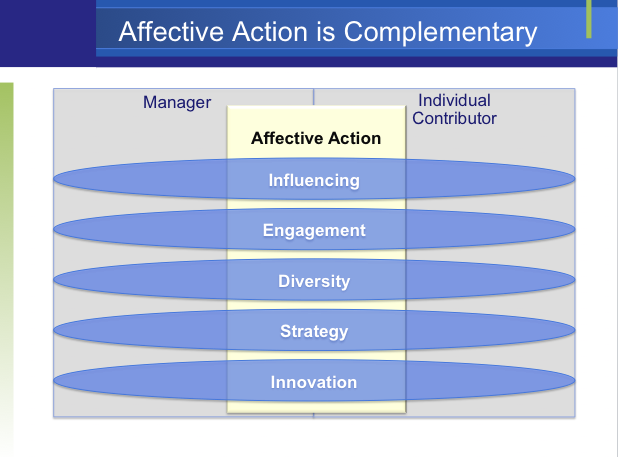
This topic is not entirely new or isolated.  As Figure 1 illustrates, it overlaps and complements several established management and individual development topics.  Many articles and books offer rich and valuable advice on those topics.

On this site I want to focus on going beyond improving within current norms.  We need to create and thrive with new models that match the possibilities of the 21st century.

Imagine what would be possible in a workplace if:

    • 100% of the employees were active and effective scouts for important opportunities for the company
    • Everyday communication created as much inspiration as information
    • Customers proactively shared all the information they have that is relevant to your decisions
    • Every initiative was executed with fervor, not just a sense of duty
    • Market uncertainty was a source of competitive advantage rather than a threat.

The dynamism demanded by the information age won’t come from extracting more bursts of brilliance and superhuman effort in the old model.  Luke Skywalker tapped into The Force.  We can tap into Affective Action, creating new, generative organizations by helping people find deep personal connections to their work and each other.

________________________________

* Source: These are extracts of statistics from ”99 Incredible Employee Engagement Statistics“, a very interesting document put together and made available by a company named Beyond Morale (beyondmorale.com).

Gallup poll:

  • The lost productivity of actively disengaged employees costs the US economy $370 BILLION annually.
  • Those business units in the top half of engagement scores had 27% higher profitability than those in the bottom half.

Watson Wyatt study:

  • Highly Engaged Employees are more than twice as likely to be top performers.
  • Highly engaged employees missed 43% fewer days of work due to illness.

Share this:

  • Email a link to a friend (Opens in new window) Email
  • Print (Opens in new window) Print
  • Share on Reddit (Opens in new window) Reddit
  • Share on Facebook (Opens in new window) Facebook
  • Share on Tumblr (Opens in new window) Tumblr
  • Share on X (Opens in new window) X
  • Share on Pinterest (Opens in new window) Pinterest
  • Share on LinkedIn (Opens in new window) LinkedIn
Like Loading...
Page 4 of 4 « Previous 1 2 3 4
  • Blog at WordPress.com.
  • Subscribe Subscribed
    • AffectiveAction
    • Join 41 other subscribers
    • Already have a WordPress.com account? Log in now.
    • AffectiveAction
    • Subscribe Subscribed
    • Sign up
    • Log in
    • Report this content
    • View site in Reader
    • Manage subscriptions
    • Collapse this bar
 

Loading Comments...
 

    %d