AffectiveAction

Because business has the heart to succeed

Menu

  • Home
  • Blog
  • General Management
  • Marketing
  • People Management
  • Innovation
  • Guest Bloggers
  • About
  • Enter your email address to follow this blog and receive notifications of new posts by email.

  • Recent Posts

    • Renewable Fuel for a Brilliant Life
    • How to Manage Women: Tips #2 and 3
    • How to Manage Women Tip # 1
    • Compassionate Capitalism
    • Stop That Focus Group!
    • To really change people’s behavior: Use the right word.
    • Is This the Coolest Company Ever?
  • Archive

  • Tags

    Affective Action B2B business business model career development career management cause marketing collaborate commercialization Conflict corporate responsibility customer networks demand generation Design Duarte Communications early sales Ecomagination effective communication Empathy employee engagement employee retention GE generative green marketing high performance high touch/low cost hiring HR human resources innovation innovative thinking Institute for the Future investment Jeff Immelt leadership lead generation management managing women market development marketing marketing automation marketing metrics motivation negotiate nurturing prospects outperform passion personalized marketing philanthropy philosophy philosophy and business Presentations product introductions project management project portfolio analysis project selection prospecting regulatory expansion results sales Santa Clara University social-media social entrepreneur social venture Social Venture incubator Strategy sustainability TEDx Presidio the buying process the customer view The Onion time to market time to ramp use case venture program
    • RSS - Posts
    • RSS - Comments
  • Subscribe in a reader

Browsing Category Marketing

Compassionate Capitalism

May 5, 2013 · by Taia Ergueta
cash mob

Cash Mob in Action

Economic policy affects our business and private life daily. But most people avoid thinking about it.  Many bigger picture economic theories can seem impractical, extreme, or so complicated that people sometimes retreat to overly simple reasoning. John Tomasi’s work proposes an alternative approach.  It is good food for thought about our personal and business decision making. **

Read More →

Share this:

  • Email a link to a friend (Opens in new window) Email
  • Print (Opens in new window) Print
  • Share on Reddit (Opens in new window) Reddit
  • Share on Facebook (Opens in new window) Facebook
  • Share on Tumblr (Opens in new window) Tumblr
  • Share on X (Opens in new window) X
  • Share on Pinterest (Opens in new window) Pinterest
  • Share on LinkedIn (Opens in new window) LinkedIn
Like Loading...

Stop That Focus Group!

May 3, 2013 · by Taia Ergueta
snickers_focus_group_new_30_03

Source: Snickers Ad

The only thing worse than not having an understanding of customer needs is having an incorrect understanding of customer needs. If you think that you avoid that by going straight to the source and asking them…think again.

Here is a surprising insight from those who study the psychology of decision making.  Radiolab* reports that Professor Tim Wilson of UVA did the following experiment as part of his research on choice:

Students were given the opportunity to take a free poster home:  Either the well-known Cat Clinging to a Bar poster, or a poster of an impressionist painting. Half of the students could simply take the poster and half of them were also asked to write a brief description of why they chose the poster. Six months later, they were asked if they still liked their chosen poster.

Read More →

Share this:

  • Email a link to a friend (Opens in new window) Email
  • Print (Opens in new window) Print
  • Share on Reddit (Opens in new window) Reddit
  • Share on Facebook (Opens in new window) Facebook
  • Share on Tumblr (Opens in new window) Tumblr
  • Share on X (Opens in new window) X
  • Share on Pinterest (Opens in new window) Pinterest
  • Share on LinkedIn (Opens in new window) LinkedIn
Like Loading...

Getting Great Customer Feedback on a New Technology

October 10, 2012 · by Taia Ergueta

You’ve got very cool new technology that thousands of labs will love. The product is ready. Rev up the Introduction Machine and sell, right? Senova Systems, a company for which I am consulting, is taking a different approach. Just before the full launch they have launched an Early Access Program. I thought you would find the concept and their decisions useful.

Senova has a developed a revolutionary new technology for measuring pH that takes time, risk, aggravation and cost and out of doing this very common measurement. (For more on this see their site: SenovaSystems.com)  Their first product is a handheld pH scanner called the “pHit scanner”, They have been testing the product internally all along and further testing is part of the manufacturing scale up and beta sites. But instead of launching it immediately in to the broad market, they are taking the time to do an Early Access Program (EAP).

 Why an EAP?

The CEO, Lee Leonard,  is a serial entrepreneur. He knows that his market comprises highly diverse applications and that there is no way for his team to test the product in all the ways that customers will use it.  He also knows that as great as the technology may be,  the user experience is just as important.  To ensure that they launch with the kind of confidence that only comes from deep customer knowledge, he is taking the time to do the Early Access Program.

How Many Customers to Involve

I have been involved with Early Access Programs before. An Early Access Program can take various forms. It can involve a small number of customers early in the development program, getting their input at critical junctures in the process. It can simply be a way of ensuring key customers that they will have the first units. In this case, Senova’s key objectives are to understand customer use cases thoroughly and to find any unknown corner case situations that stress some aspect of the product. For these purposes, the EAP will include a large (50) but selected set of customers. By selected, I mean that they will have customers apply and will choose a set that represents the broad range of applications that use pH measurement.

Nuts and Bolts: The Terms

Here are the 2 key parts of an EAP and the example of how Senova chose to accomplish them:

  • Incentive:  Just getting the chance to be among the first in their company or field to get their hands on a pHit is a big incentive for some customers to participate. But to ensure that the participants are real customers (not just curious technology aficionados), the Senova program is structured as a discounted Try and Buy: Each customer selected to be an Early Access Program participant, gets to purchase a pHit scanner at a 50% discount on the retail price of $1,650.00. (To give time for the “Try”, EAP customers won’t be billed until 30 days after delivery). These customers also get a money-back guarantee; if they are not fully satisfied with the scanner, they simply return it.

In addition, participating organizations will be publicly acknowledged as key influencers. (Customers can opt out of this if they prefer anonymity.)

  • Required Input From the Customer:  You need to be very specific about what you expect from customers in an EAP. It is common for customers to be eager to participate and then get too busy to do their part ( use the product, write an app note, or whatever else you have asked of them).

In return for the above, Senova asks its EAP customers to commit to the following:

    • Use the product under their normal laboratory conditions for 30 days.
    • Provide Senova with feedback on the user experience and technical performance through structured conversations and documents.

If you want a more complete example of how to describe or document such a  program, click here to see the Senova description and FAQs.

How to Choose the Customers

If you want participation during product development, you cannot afford to involve too many customers, so pick just a few from the most important target market(s). Your closest customers may not be the best participants.  For example don’t involve the most demanding customers if you want a minimum viable product market entry.  The intent is toto make sure you are meeting the target market’s needs solidly.

If you want to give some customers the first units either to establish key influencers or simply as reward or for their ego gratification, then your top customer list will drive the number involved.

If, like Senova, you want to experience a diversity of application areas deeply,  involve enough customers to  get a good sample of the full range. For example, Senova is taking applications from interested parties and will choose 50 customers that cover as broad a set of use scenarios as possible.

Bottom Line

Yes, conducting an EAP will require significant effort and attention. You may even postpone some revenue. But it is an investment in customer insight that will yield extremely high returns.

The rewards:

  • Additional product testing that can validate yours or find weaknesses early, when they are least costly to fix.
  • Develop close relationships with participating customers, leading to ongoing customer insight, potential influencing of other customers and maybe even longer term loyalty!
  • Usage information that can reveal additional needs, opportunities to improve design and user experience, opportunities to integrate activities or products that are upstream or downstream from your current product.
  • Service and self-service content.
  • Faster time-to-ramp based on more effective commercialization and sales efforts.
  • A more engaged internal team that gains the confidence and inspiration that only comes from close customer exposure.

Input Welcome

Have you done Early Access Programs?  If so, what has been your positive or negative experience with them.  If you want assistance with an EAP contact me by clicking here.

Share this:

  • Email a link to a friend (Opens in new window) Email
  • Print (Opens in new window) Print
  • Share on Reddit (Opens in new window) Reddit
  • Share on Facebook (Opens in new window) Facebook
  • Share on Tumblr (Opens in new window) Tumblr
  • Share on X (Opens in new window) X
  • Share on Pinterest (Opens in new window) Pinterest
  • Share on LinkedIn (Opens in new window) LinkedIn
Like Loading...

Design a Great Presentation

September 11, 2012 · by Taia Ergueta

Recently Duarte Communications generously instructed an elite set of social entrepreneurs* on how to design and deliver a truly great presentation.  And on the August 23 when that they all presented their business plans, every single presentation was visually appealing and commanded your interest!  Here I’ll share with you my take on just one of Duarte’s nuggets of wisdom and how it can shape a great business plan presentation.

The Nugget

Michael Duarte shared that their research indicated that great presentations have this pattern.

‘Nuf said for you super-intuitive types out there, right?

For those of you who need a bit more spelled out:  You grab and keep the audience by taking them through a series of lows and highs.  You, the presenter, orchestrate those downs and ups and become their hero by taking them on an interestingly suspenseful and ultimately uplifting, confidence-inspiring journey.

Read More →

Share this:

  • Email a link to a friend (Opens in new window) Email
  • Print (Opens in new window) Print
  • Share on Reddit (Opens in new window) Reddit
  • Share on Facebook (Opens in new window) Facebook
  • Share on Tumblr (Opens in new window) Tumblr
  • Share on X (Opens in new window) X
  • Share on Pinterest (Opens in new window) Pinterest
  • Share on LinkedIn (Opens in new window) LinkedIn
Like Loading...

Saving Customers Time Will Build Your Business

August 22, 2012 · by Taia Ergueta

The humor newspaper The Onion ran this front page headline: “Things Taking Entirely Too Long”. The accompanying photo showed a man staring at a microwave oven. Two minutes is the new Eternity.  People will put up with government gridlock, romantic betrayal and even cucumbers being put in their drinking water, but they will simply not tolerate having their time wasted. This all points to the big opportunity to distinguish yourself by saving your customers time.

The post “How to Spark Innovative Thinking” talked about many innovation directions.  Saving customers time is an exceptionally rich innovation strategy. Not only do customers value it but your sales people will love having a quantifiable personal benefit to offer. Have you thought of how you can do this? Here is a three-step process for finding the most innovative and profitable ideas.

Read More →

Share this:

  • Email a link to a friend (Opens in new window) Email
  • Print (Opens in new window) Print
  • Share on Reddit (Opens in new window) Reddit
  • Share on Facebook (Opens in new window) Facebook
  • Share on Tumblr (Opens in new window) Tumblr
  • Share on X (Opens in new window) X
  • Share on Pinterest (Opens in new window) Pinterest
  • Share on LinkedIn (Opens in new window) LinkedIn
Like Loading...

Winning Big Through Sustainability

August 12, 2012 · by Taia Ergueta

Opportunities Revealed

In the business world, “Sustainability” started out as Lunatic Fringe talk, then moved up to window-dressing for Corporate Responsibility sections of Annual Reports and subsequently got a new and sometimes tawdry life as a Green Marketing opportunity.  Now, setting a company’s sustainability agenda is one of the most important and valuable things that its executives must do.  And people at all levels can find great innovation ideas in sustainability.

Serious Business

I attended the Sustainable Brands conference in 2007 and it was a hive of excitement over the power of Green Marketing and adulation of cool campaigns and programs.  Just two years later, the same conference was astoundingly different:  It had become clear that both the issues and opportunities are much more fundamental and addressing them is no longer a matter of choice, it is an imperative.  Energy and water will be scarce and more expensive for everyone.  In addition, a combination of consumer awareness and regulatory expansion are making transparency – a lot of reporting of your sustainability practices – mandatory.   You can deal with these as burdens or you can try to find ways to create advantages for your company.  In addition to creating new obligations, these and related challenges are creating major opportunities for growth and effectiveness.

What to do? Read More →

Share this:

  • Email a link to a friend (Opens in new window) Email
  • Print (Opens in new window) Print
  • Share on Reddit (Opens in new window) Reddit
  • Share on Facebook (Opens in new window) Facebook
  • Share on Tumblr (Opens in new window) Tumblr
  • Share on X (Opens in new window) X
  • Share on Pinterest (Opens in new window) Pinterest
  • Share on LinkedIn (Opens in new window) LinkedIn
Like Loading...

Social Ventures for a Better World

July 31, 2012 · by Taia Ergueta

This is an invitation to be inspired and perhaps help change the world.  Are you familiar with Social Entrepreneurship?  Here is a glimpse into this uplifting and fast-growing part of the business world and two specific actors worth knowing.

On August 23 twenty international social ventures will present their plans to investors and interested members of the community in Silicon Valley.  Please read the information below and contact me if you are interested in attending.

WHAT IS THIS ALL ABOUT?

For over ten years Santa Clara University has run an international Social Venture incubator. They get over 200 applicants annually from which they choose 20 to participate in the program. The successful candidates are companies that have proven their model and are ready to scale up. Those 20 companies engage in a rigorous 5 month program of business planning exercises culminating in 2 weeks of on site instruction and workshops at the University in August. In other words, the University brings critical help to the companies that seem ready and capable of having a big significant impact on their region or the world.  Faculty, staff, and a band of Silicon Valley executives coach the entrepreneurs through learning and planning that has proven to increase their success as they scale.

What is a Social Venture?  It is a for-profit company that has a social good as its main mission.  Often, these companies focus on serving the bottom of the pyramid (BOP). Read More →

Share this:

  • Email a link to a friend (Opens in new window) Email
  • Print (Opens in new window) Print
  • Share on Reddit (Opens in new window) Reddit
  • Share on Facebook (Opens in new window) Facebook
  • Share on Tumblr (Opens in new window) Tumblr
  • Share on X (Opens in new window) X
  • Share on Pinterest (Opens in new window) Pinterest
  • Share on LinkedIn (Opens in new window) LinkedIn
Like Loading...

Your Marketing Needs Four Pillars Too

July 23, 2012 · by Taia Ergueta

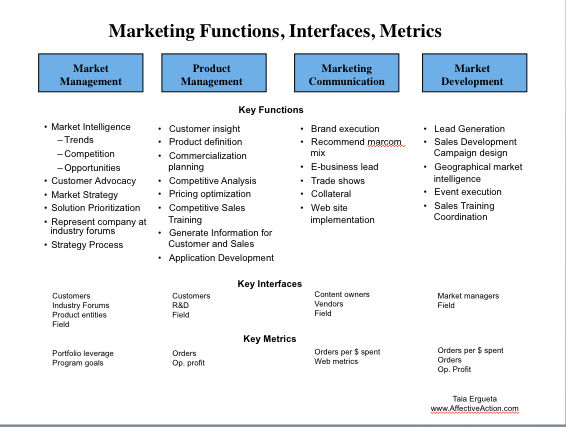
Most tech businesses have product marketing.  Sometimes Marketing starts and stops there.  If you build it they will come, right?  Or, as one manager told me when I suggested that we work on messaging, “Taia, the product IS the message”.   Even among the more enlightened, Marketing is a lot like South America:  People know the outline, but don’t ask them about the number or position  of the countries.

So here it a short and sweet starting point for you.   The four pillars of marketing.  What functions fall under each.  With whom they need to work most closely. And the key metrics for each.  It can be you very own Arch of Triumph.  Some assembly required.

Note:

  • This model surrounds Product Management with the important things that they often cannot do either because of the skills or time needed.  With the addition of the Market (vertical) Management, full Marcom and Market Development you can address true customer needs and do modern demand generation.  This is true commercialization.
  • From left to right, the key interfaces shift from Customers to Internal partners to Sales (“Field”).  If you have a small team these interfaces can happen more easily.  With large teams, you’ll need to actively manage this to ensure the right collaboration.

Download the above document:   Linked Doc

Input Welcome

Are there key functions missing?

Do you have a better model of marketing?

Share this:

  • Email a link to a friend (Opens in new window) Email
  • Print (Opens in new window) Print
  • Share on Reddit (Opens in new window) Reddit
  • Share on Facebook (Opens in new window) Facebook
  • Share on Tumblr (Opens in new window) Tumblr
  • Share on X (Opens in new window) X
  • Share on Pinterest (Opens in new window) Pinterest
  • Share on LinkedIn (Opens in new window) LinkedIn
Like Loading...

Speed Up Your Sales Improvement Time

July 20, 2012 · by Taia Ergueta

Sales are below plan. Does the blame game begin, or do both Marketing and Sales know what to do NOW to make a difference?

I was in a business where a sales shortfall triggered a “Performance Improvement Plan”.  The afflicted business unit would go off to investigate the problem and conjure up a convincing plan for fixing it.  Then implementation of that plan would begin. If someone happened to get pregnant at the beginning of this process, they had their child about the same time that we were seeing the results of this process.  And those sales results were not always good.  There had to be a better way.

There is. Here is a way to reduce the response time and increase the confidence in the fix.

Model What You Intend to Do

Many business development/intro plans are this:

  1. The sales goal(s)
  2. The list of a bunch of things that everyone will do.

Basically, there is a big collective hope that the latter will produce the former.  The dynamics of how that is expected to happen aren’t specified; so when the sales don’t materialize, nobody knows what failed. Not enough “things” done? Price wrong?

The better way: “The Magic Formula”.  Estimate values for these three key drivers of sales performance and then track them as metrics:

Average sales price  +  Length of the sales cycle  +  Win rate

 At the beginning, you may not have much to go on to set these. Not a problem. Make an educated guess (you’ll refine that over time as you get more data). Use those estimated values to model how you will get your sales goal.

Example

Here is a model for a hypothetical business projecting $500K of sales in 12 months:

 Magic Formula:  Average sales price $30K,  4 month sale cycle,  25% win rate

  1. Given the average sales price, you need $500K/30K , 17 sales in 12 months
  2. At a 25% win rate you need to engage 17 x 4 qualified leads: 68 total
  3. Given the 4 month sales cycle, you need to have engaged seriously with those 68 qualified leads  in the next 8 months.
  4. If you know half of those already, then you need to generate 32 qualified leads.  Let’s say you need 7 prospects for every qualified lead: In this case you need to generate 32 x 7 prospects – a total of 224 prospects to generate and qualify in the next 8 months.

This approach focuses Marketing and Sales on the right level and types of activities needed to meet the goal.  It makes the market development or time-to-ramp commitments much more solid.  It also requires the two functions to work together to set these formula value estimates and refine them.  Those discussions often surface hidden concerns, alignment gaps and expectations, reducing later issues and forging good relationships.

How Using This Can Speed Your Reaction Time

Ok, back to the scenario in which the order rate is below expectations.  Instead of flailing at causes and fixes, go to your data. Which Formula factors are not as you estimated?

  • Is the average sales price below your estimate while the other metrics are holding? Then look to either your discount level or the configurations that people are buying.
  • Is the win rate lower than you expected? See if the sales force needs more training and check the competitive positioning.

The relevant issues and fixes will be specific to your business of course.  The point is that this approach gives you built in diagnostics. Now when sales are down you do not start with a blank slate on which people write their excuses.  Instead, you have focus and this gets everyone into effective and affective action, fast.  Finger-pointing and delays in turning sales back up are de-motivators; quick iterations that also add to the collective knowledge base on sales generation are big motivators.

Input Welcome

Share this:

  • Email a link to a friend (Opens in new window) Email
  • Print (Opens in new window) Print
  • Share on Reddit (Opens in new window) Reddit
  • Share on Facebook (Opens in new window) Facebook
  • Share on Tumblr (Opens in new window) Tumblr
  • Share on X (Opens in new window) X
  • Share on Pinterest (Opens in new window) Pinterest
  • Share on LinkedIn (Opens in new window) LinkedIn
Like Loading...

How and Why to Optimize Your Relate:Create Ratio

July 2, 2012 · by Taia Ergueta

Can you think of anyone who succeeds by focusing exclusively on the subject matter of his/her work?  Yes, some artists who labor alone do achieve wild posthumous success, but I have yet to meet anyone with that as his/her goal.  Most of us recognize that we have to work with and through others.  This post is about turning that general awareness into a actions that will help your career development and your real results.

Why do it

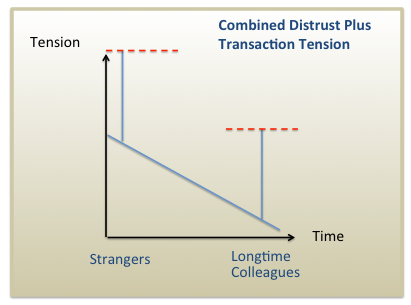
Here is another one of those Keys to Life (see May 28 post) that I have found exceedingly useful since I heard it sometime in the 20th century.  (I would attribute it but I have no idea who was the wise spirit who originated it.)   It is captured in a diagram which describes the potential states of a work relationship.

  1. The horizontal axis is Time. It measures how long the two people have known each other and interacted.
  2. The vertical axis is Tension. It measures the level of relationship Tension coming from two potential sources: Distrust and Transactions.

Distrust. When people first meet they don’t know what to expect from each other. Their level of trust is low. Accordingly the relationship tension is high. Over time, people get to know each other and, unless those interactions abound in deceit and treachery, the level of trust between them tends to increase: Logically, the level of distrust-driven tension goes down.

Transactions. Each time we want something from the other person or vice a versa we engage in a transaction, and each transaction creates some tension. If you have a small easy request to make of the other person, the tension created by that request will be very low. On the other hand, if you have a proposal that imposes a major cost on the other person (e.g., it conflicts with their plans, requires a lot of time or significantly inconveniences them) then the transaction-driven tension level created may be quite high.

So far so good.  Now here is the key:   Put these together and you will see why trying to do a major transaction with someone you barely know is so difficult.  The high distrust-driven tension coupled with the high transaction-driven tension adds up to a vertigo-evoking level of overall tension.  If instead, you attempt the same transaction with someone after you have established a relationship of trust, you have almost half the level of tension to deal with and the likelihood of success soars.

Ok, What To Do?

The take-away is:  Get down that distrust curve as fast as possible with all the key people with whom you need to collaborate or negotiate.  Important:  This is not a cynical tip meant to turn you into Machiavelli!  Groucho Marx said, “Sincerity is everything. If you can fake sincerity, you have it made.”  No, no, no.   We’re talking about effective communication and relationship building:

  • Seeking the person out
  • Listening to them
  • Being helpful when you can
  • Letting them know how you think and what drives you
  • Introducing them to your ideas early
  • Maintaining a dialogue

You get the picture.

Getting down that trust curve takes more time and effort than most of us think it does.  Which brings me back to the title of this post. Most people like to — and think they are paid to — work on the Create side of that ratio; that is where their passion is and they spend as much of their time as possible on it assuming/hoping that that will win the day.  So “Optimizing the Relate:Create ratio” usually requires shifting time spent on the substance behind those transactions to time spent on the relationships that will enable the real results.

You may be able to make that shift naturally just by being more aware of this. The rest of us mere mortals need to take a more structured approach, at least at first:  Picking key people with whom to deepen a relationship and then setting aside time explicitly for that.

As a manager this is a huge area of additional opportunities for creating an affective action culture and a high performance organization: I will cover these in my next post.

Input Welcome

  • Have you changed your Relate: Create ratio profitably?
  • Have you found ways to help your employees do this better?

Share this:

  • Email a link to a friend (Opens in new window) Email
  • Print (Opens in new window) Print
  • Share on Reddit (Opens in new window) Reddit
  • Share on Facebook (Opens in new window) Facebook
  • Share on Tumblr (Opens in new window) Tumblr
  • Share on X (Opens in new window) X
  • Share on Pinterest (Opens in new window) Pinterest
  • Share on LinkedIn (Opens in new window) LinkedIn
Like Loading...
Page 1 of 2 1 2 Next »
  • Blog at WordPress.com.
  • Subscribe Subscribed
    • AffectiveAction
    • Join 41 other subscribers
    • Already have a WordPress.com account? Log in now.
    • AffectiveAction
    • Subscribe Subscribed
    • Sign up
    • Log in
    • Report this content
    • View site in Reader
    • Manage subscriptions
    • Collapse this bar
 

Loading Comments...
 

    %d