AffectiveAction

Because business has the heart to succeed

Menu

  • Home
  • Blog
  • General Management
  • Marketing
  • People Management
  • Innovation
  • Guest Bloggers
  • About
  • Enter your email address to follow this blog and receive notifications of new posts by email.

  • Recent Posts

    • Renewable Fuel for a Brilliant Life
    • How to Manage Women: Tips #2 and 3
    • How to Manage Women Tip # 1
    • Compassionate Capitalism
    • Stop That Focus Group!
    • To really change people’s behavior: Use the right word.
    • Is This the Coolest Company Ever?
  • Archive

  • Tags

    Affective Action B2B business business model career development career management cause marketing collaborate commercialization Conflict corporate responsibility customer networks demand generation Design Duarte Communications early sales Ecomagination effective communication Empathy employee engagement employee retention GE generative green marketing high performance high touch/low cost hiring HR human resources innovation innovative thinking Institute for the Future investment Jeff Immelt leadership lead generation management managing women market development marketing marketing automation marketing metrics motivation negotiate nurturing prospects outperform passion personalized marketing philanthropy philosophy philosophy and business Presentations product introductions project management project portfolio analysis project selection prospecting regulatory expansion results sales Santa Clara University social-media social entrepreneur social venture Social Venture incubator Strategy sustainability TEDx Presidio the buying process the customer view The Onion time to market time to ramp use case venture program
    • RSS - Posts
    • RSS - Comments
  • Subscribe in a reader

Browsing Category Uncategorized

The 60 Second Pitch that Will Get you 2-3 Minutes of Attention: Maybe more!

June 18, 2012 · by Taia Ergueta

People decide in 30-60 seconds whether they will pay the slightest bit of attention to you. If you slay that dragon, and they decide to tune in, you get ~3 minutes (their attention span) to possibly earn an additional smidgen of their interest.

This is a “formula” for the 30-60 seconds. I will not do it justice. Its creator is communication expert, Sam Horn (http://www.intrigueagency.com/). She is extraordinary and I strongly recommend that you to try to hear her talk or buy her materials. In any case, I willshare my paraphrase of her ingenious and flexible formula for describing anything to anyone.

The power of the formula is that it engages the listener, tells your differentiation in that context, and gives the listener reasons to believe you. You are still You, just more Interesting. I think you’ll like You this way.

The Specifics and An Example

I will use the example of a startup company that I am mentoring, named salaUno. It is a Mexican eye clinic. Not excited by that description? Read on.
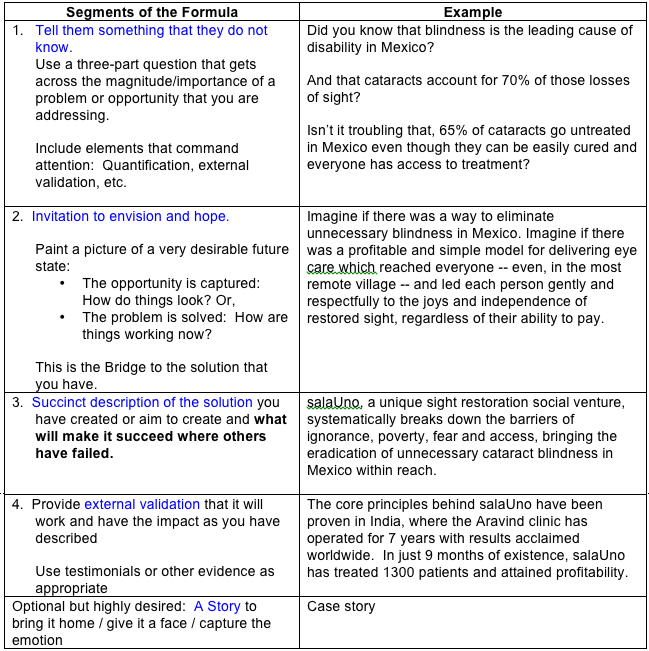
As Sam notes: This formula works whether you are answering the question, “What do you do?” at a cocktail party, or pitching your company at the biggest funding opportunity of your life.

What to Remember if You Don’t Remember the Formula

The formula works because it conforms to the human nature of the listener rather than the knowledge and ego of the speaker:

  • Our self-absorption halts briefly in response to new, surprising information.
  • Injecting an inspirational vision engages a different and valuable part of the brain. Factual small ideas may inform but they won’t attract or motivate.
  • The impact of a thing is always more interesting than the thing itself.
  • Dude, it’s not that you aren’t credible, but, well, bring external validation.

Input Welcome

          • Have you tried this with success? Send an example
          • Do you have suggested additions or modifications to this approach?

Share this:

  • Email a link to a friend (Opens in new window) Email
  • Print (Opens in new window) Print
  • Share on Reddit (Opens in new window) Reddit
  • Share on Facebook (Opens in new window) Facebook
  • Share on Tumblr (Opens in new window) Tumblr
  • Share on X (Opens in new window) X
  • Share on Pinterest (Opens in new window) Pinterest
  • Share on LinkedIn (Opens in new window) LinkedIn
Like Loading...

What Can the Design World Contribute to Management?

May 28, 2012 · by Taia Ergueta


I recently saw a terrific documentary, “Objectified“, by Gary Huswit which is all about how things are designed and how design affects us.  (Available on Netflix — I highly recommend it for various reasons.)   When I heard the list of characteristics of Good Design put forth by Dieter Rams, it struck me that many of the elements of great design apply to management.

… should be Innovative.  In the case of management, it is not about a stream of new programs, but it is about being open to innovation and ensuring differentiation.

… should Make a Product Useful.  I think the important analogy here is that great management should maximize employee “usefulness” by enabling them to be engaged and productive.

… is Aesthetic design.   Just as a product’s look and feel feed our emotions and sense of value, a management system needs to be made visible and felt.  In fact, it is always visible and felt, but those impressions are not always the ones that management intends! 🙂

… will make a product Understandable.  It should be easy for people to understand how to get their jobs done, how the customer experience gets formed, and how to get decisions made.

… is Honest.   Enough said.

… is Unobtrusive.  It should feel like the system is serving the people, not the other way around.

… is Long-lived.  Things have to change super-fast, but every company has to build some fundamental principles that endure.

… is Consistent in every detail:  Well, there is a part of me that immediately rebels, with Emerson’s “a foolish consistency is the hobgoblin of little minds” as my shield.  But we’ve all experienced companies with big service messages that have rude representatives, or a great new product with no training for the sales force.  So yes, great management means focus for a critical mass of consistent implementation.

… is Environmentally Friendly:  Sustainability is no longer a matter of choice and it is definitely not a marketing message.  It is an inescapable set of forces that affect every business in the form of cost changes, voluntary and uncontrolled transparency, customer expectations and regulatory actions.

“Last but not least, good [management] is… as little [management] as possible.”  Whether we call it the self-organizing organization or the generative company, it is all about winning through “just enough” leadership and highly engaged employees. (See “Use the Force, Luke” post, April 2.)

The design world clearly offers a lot of catalysts for Affective Action.  I’m intrigued.  Are there other design principles or practices that you think can be used in management?

Share this:

  • Email a link to a friend (Opens in new window) Email
  • Print (Opens in new window) Print
  • Share on Reddit (Opens in new window) Reddit
  • Share on Facebook (Opens in new window) Facebook
  • Share on Tumblr (Opens in new window) Tumblr
  • Share on X (Opens in new window) X
  • Share on Pinterest (Opens in new window) Pinterest
  • Share on LinkedIn (Opens in new window) LinkedIn
Like Loading...

This Could Become Your Favorite Rule to Live By

May 28, 2012 · by Taia Ergueta

If you had to choose two key rules to live by and a classic movie star to have on a desert island with you, what/who would you choose?

May I suggest the Golden Rule, this one, and William Holden?  Regardless of what island, company or planet you inhabit, this post will help you change that world for the better.

The Core Idea

There are 4 “modes” of communication. Whenever we communicate we are doing so in one or more of the following :

    • The mode of Complaint
    • The mode of Information
    • The mode of Creation
    • The mode of Inspiration

Each has a different impact. If you learn those impacts and apply each mode correctly you can exceed your objectives dramatically with much less effort.

The Impact and Application of the Four Modes of Communication

1.  The mode of Complaint

      • Examples of things we communicate when using this Mode:  Our problems. Others’ failings. Past errors.
      • Impact:  Drains energy from the person communicating as well as his/her audience
      • Recommended Use:  None.  Avoid this like trans fats. Stop it when you see it.

2.  The mode of Information

      • Examples of things we communicate when using this Mode:  What we have done.  How we have done it.  Data.  Methodology.  Process.  Background.
      • Impact:  Provides valuable inputs but, on its own, doesn’t change anything
      • Recommended Use:   Do this off-line whenever possible. Summarize.  Do exception reporting. Draw or propose implications.

3.  The mode of Creation

      • Examples of things we communicate when using this Mode:  Joint problem-solving.  Options.  Evaluations.  Advocacy. Joint decision-making.
      • Impact:  Most productive mode because something is going to change as a result of the communication.
      • Recommended Use:  This is the mode in which you want to be as much of the time as possible, especially in meetings, because this is the mode that moves things forward.

4. The mode of Inspiration

      • Examples of things we communicate when using this Mode:  Big Goals.  Emotions/Passion.  Aspects of a desired future result.  Expressed confidence in ability to reach it.  Confidence in or admiration for people involved.
      • Impact: Expands people’s sense of the Possibilities. It leads to more than the expected happening.
      • Recommended Use: Build some element of this into all communications.

Putting it to Work

I’ve read and forgotten a boatload of teamwork/management stuff over the years and, in contrast, this 4 part communication rule has stayed with me.  It is the pasta of this space — easy, flexible and always hits the spot.  Here are a few application insights:

  • Moving information exchange out of meetings (e.g. shared electronically beforehand) ensures that scarce meeting time is used for the really productive modes of creation and inspiration.
  • Eliminating Complaint does not mean burying problems.  Anything that can be said in the mode of Complaint can be said in the mode of Creation:  Once you tune into that it is easy to make the shift without losing valuable candor and awareness of the issues.
  • When I first heard all this, the mode of Inspiration examples were President Kennedy’s Man on the Moon speech and Martin Luther King’s “I Have a Dream” speech.  This left me feeling that the mode of Inspiration was for monumental events and great orators, not for me.  But with more thought I realized that things such as expressing confidence in a colleague, team or employee, or reiterating the value of our goal provide inspiration.  And these things can be built into every communication.
  • I have occasionally shared this model with teams when a project is kicking off.  It seems to resonate and sets some efficient norms up front.

Input Welcome:  Do you think this model is useful?  Do you have other ideas for how to apply or improve on it?

Attribution: If I knew who originally came up with this modeI I would give full credit and send many accolades!  I was exposed to this at a company-wide management course at Agilent. Please write in if you know the source.

Share this:

  • Email a link to a friend (Opens in new window) Email
  • Print (Opens in new window) Print
  • Share on Reddit (Opens in new window) Reddit
  • Share on Facebook (Opens in new window) Facebook
  • Share on Tumblr (Opens in new window) Tumblr
  • Share on X (Opens in new window) X
  • Share on Pinterest (Opens in new window) Pinterest
  • Share on LinkedIn (Opens in new window) LinkedIn
Like Loading...
  • Blog at WordPress.com.
  • Subscribe Subscribed
    • AffectiveAction
    • Join 41 other subscribers
    • Already have a WordPress.com account? Log in now.
    • AffectiveAction
    • Subscribe Subscribed
    • Sign up
    • Log in
    • Report this content
    • View site in Reader
    • Manage subscriptions
    • Collapse this bar
 

Loading Comments...
 

    %d