AffectiveAction

Because business has the heart to succeed

Menu

  • Home
  • Blog
  • General Management
  • Marketing
  • People Management
  • Innovation
  • Guest Bloggers
  • About
  • Enter your email address to follow this blog and receive notifications of new posts by email.

  • Recent Posts

    • Renewable Fuel for a Brilliant Life
    • How to Manage Women: Tips #2 and 3
    • How to Manage Women Tip # 1
    • Compassionate Capitalism
    • Stop That Focus Group!
    • To really change people’s behavior: Use the right word.
    • Is This the Coolest Company Ever?
  • Archive

  • Tags

    Affective Action B2B business business model career development career management cause marketing collaborate commercialization Conflict corporate responsibility customer networks demand generation Design Duarte Communications early sales Ecomagination effective communication Empathy employee engagement employee retention GE generative green marketing high performance high touch/low cost hiring HR human resources innovation innovative thinking Institute for the Future investment Jeff Immelt leadership lead generation management managing women market development marketing marketing automation marketing metrics motivation negotiate nurturing prospects outperform passion personalized marketing philanthropy philosophy philosophy and business Presentations product introductions project management project portfolio analysis project selection prospecting regulatory expansion results sales Santa Clara University social-media social entrepreneur social venture Social Venture incubator Strategy sustainability TEDx Presidio the buying process the customer view The Onion time to market time to ramp use case venture program
    • RSS - Posts
    • RSS - Comments
  • Subscribe in a reader

Browsing Tags Affective Action

To really change people’s behavior: Use the right word.

December 16, 2012 · by Taia Ergueta

geese flying 72 dpiYou are only leading if they are following — i.e., acting on your ideas.  Here is a surprising and extremely simple way to dramatically increase the actual behavior changes you effect.

In a study described in the Stanford University Center for Social Innovation, all  the people involved were asked to  perform the same task but some were told it would be impossible for the researchers to know “whether you are cheating,” while others were told it would be impossible to know “whether you’re a cheater”.  The first  group (who got the instructions referencing “cheating”) cheated far more than the latter  group ( who got the instructions referencing being a “cheater”).  Similarly, in the recent election season, appeals to citizens to “be a voter” had much more impact on behavior than did exhortations to “vote”.

The choice of wording makes all the difference in the resulting behavior!

woman shades hero sizeWhat these examples indicate:  We act on self-image.  In other words we all want to have a positive identity.  If you paint people a picture of a undesirable self, they are likely to stop doing the negative action as associated with it.  Similarly,  if you paint them a positive image of a person, they are likely to adopt the positive behaviors associated with that image.  In contrast, people are much less likely to change their behavior if you just describe the behavior in question.

Apply This Finding to be Help People be Fantastic 

When trying to influence a change in behavior, describe an identity (nouns), not actions (verbs).  For example:

  • Speak to people about “being an innovator”, not about innovating.
  • Remind someone preparing an important presentation to “be an inspirational speaker”, not to speak inspirationally.
  • Set a ground rule that everyone on a team will “be a punctual member”, not that everyone should be on time.
  • Tell yourself that today you will be “a paragon of focus”, not that you’ll really try to not be an email-slave

A Corollary

For many years I have used a related approach.  There’s no Stanford study behind this one, but here it is anyway:  I find that if you treat people as if they were their best selves, they shift their behavior more in that direction.   (As you can imagine, this definitely does not work on sociopaths.  Consequently,  it is a pretty good sociopath diagnostic.)

Have a great day.  And remember:  Be an Influencer!

Click here for the Article from the Center on Social Innovation.

Click here for the abstract of the actual “cheating/cheater” study.

Share this:

  • Email a link to a friend (Opens in new window) Email
  • Print (Opens in new window) Print
  • Share on Reddit (Opens in new window) Reddit
  • Share on Facebook (Opens in new window) Facebook
  • Share on Tumblr (Opens in new window) Tumblr
  • Share on X (Opens in new window) X
  • Share on Pinterest (Opens in new window) Pinterest
  • Share on LinkedIn (Opens in new window) LinkedIn
Like Loading...

Five Change Management Key Success Factors

November 24, 2012 · by Taia Ergueta

Who is NOT trying to make change happen faster? Managers want employees to take up the banner of [fill in the blank: More Innovation? Fewer missed deadlines?].  Employees want managers to take off the blinders and [fill in the blank: Call fewer meetings and reports? Stick to a set of priorities for more than a month?].   Regardless of your change agenda, I think you’ll come up with good change management ideas from this unusual source.

The Source

Unilever is taking sustainability seriously. A recent Triple Pundit article notes, “the company’s target is to halve its carbon footprint by 2020”. Fine, what is impressive is that their carbon footprint calculation includes the carbon usage by consumers of their products. In fact, they estimate that “68 percent of it comes from consumer use of Unilever’s products” and they are tackling the task of getting people to reduce that dramatically. First target:  Getting consumers to reduce food waste. This is a fascinating change management project and I encourage you to read more about it, but something that caught my attention was their use of “Five Levers of Change”. I think they apply regardless of the kind of change you are trying to drive.

Read More →

Share this:

  • Email a link to a friend (Opens in new window) Email
  • Print (Opens in new window) Print
  • Share on Reddit (Opens in new window) Reddit
  • Share on Facebook (Opens in new window) Facebook
  • Share on Tumblr (Opens in new window) Tumblr
  • Share on X (Opens in new window) X
  • Share on Pinterest (Opens in new window) Pinterest
  • Share on LinkedIn (Opens in new window) LinkedIn
Like Loading...

Fast Company on Big Ideas

November 17, 2012 · by Taia Ergueta

In the November issue of Fast Company you’ll find “Why, with so many businesses thinking small, the World Needs Big Ideas”.  I love big ideas and, as a manager, often saw proof of the Goethe quote:

“Dream no small dreams for they have no power to move the hearts of men.”

Big idea projects also raise fascinating challenges for entrepreneurs and business people.

First, a few examples of inspiring Big Ideas sited in the Fast Company article:

  • Sage Bionetworks:   Accelerate biomedical discoveries by creating a system for open sourcing biomedical research data — thereby giving researchers access to thousands of times more data than they could collect on their own.
  • Waste Enterprisers: Turning human waste in to biofuel, solving huge widespread cost, environmental, time and dignity issues.
  • Terrapower: Unlimited safe energy from depleted uranium.

Read More →

Share this:

  • Email a link to a friend (Opens in new window) Email
  • Print (Opens in new window) Print
  • Share on Reddit (Opens in new window) Reddit
  • Share on Facebook (Opens in new window) Facebook
  • Share on Tumblr (Opens in new window) Tumblr
  • Share on X (Opens in new window) X
  • Share on Pinterest (Opens in new window) Pinterest
  • Share on LinkedIn (Opens in new window) LinkedIn
Like Loading...

Design a Great Presentation

September 11, 2012 · by Taia Ergueta

Recently Duarte Communications generously instructed an elite set of social entrepreneurs* on how to design and deliver a truly great presentation.  And on the August 23 when that they all presented their business plans, every single presentation was visually appealing and commanded your interest!  Here I’ll share with you my take on just one of Duarte’s nuggets of wisdom and how it can shape a great business plan presentation.

The Nugget

Michael Duarte shared that their research indicated that great presentations have this pattern.

‘Nuf said for you super-intuitive types out there, right?

For those of you who need a bit more spelled out:  You grab and keep the audience by taking them through a series of lows and highs.  You, the presenter, orchestrate those downs and ups and become their hero by taking them on an interestingly suspenseful and ultimately uplifting, confidence-inspiring journey.

Read More →

Share this:

  • Email a link to a friend (Opens in new window) Email
  • Print (Opens in new window) Print
  • Share on Reddit (Opens in new window) Reddit
  • Share on Facebook (Opens in new window) Facebook
  • Share on Tumblr (Opens in new window) Tumblr
  • Share on X (Opens in new window) X
  • Share on Pinterest (Opens in new window) Pinterest
  • Share on LinkedIn (Opens in new window) LinkedIn
Like Loading...

Winning Big Through Sustainability

August 12, 2012 · by Taia Ergueta

Opportunities Revealed

In the business world, “Sustainability” started out as Lunatic Fringe talk, then moved up to window-dressing for Corporate Responsibility sections of Annual Reports and subsequently got a new and sometimes tawdry life as a Green Marketing opportunity.  Now, setting a company’s sustainability agenda is one of the most important and valuable things that its executives must do.  And people at all levels can find great innovation ideas in sustainability.

Serious Business

I attended the Sustainable Brands conference in 2007 and it was a hive of excitement over the power of Green Marketing and adulation of cool campaigns and programs.  Just two years later, the same conference was astoundingly different:  It had become clear that both the issues and opportunities are much more fundamental and addressing them is no longer a matter of choice, it is an imperative.  Energy and water will be scarce and more expensive for everyone.  In addition, a combination of consumer awareness and regulatory expansion are making transparency – a lot of reporting of your sustainability practices – mandatory.   You can deal with these as burdens or you can try to find ways to create advantages for your company.  In addition to creating new obligations, these and related challenges are creating major opportunities for growth and effectiveness.

What to do? Read More →

Share this:

  • Email a link to a friend (Opens in new window) Email
  • Print (Opens in new window) Print
  • Share on Reddit (Opens in new window) Reddit
  • Share on Facebook (Opens in new window) Facebook
  • Share on Tumblr (Opens in new window) Tumblr
  • Share on X (Opens in new window) X
  • Share on Pinterest (Opens in new window) Pinterest
  • Share on LinkedIn (Opens in new window) LinkedIn
Like Loading...

Social Ventures for a Better World

July 31, 2012 · by Taia Ergueta

This is an invitation to be inspired and perhaps help change the world.  Are you familiar with Social Entrepreneurship?  Here is a glimpse into this uplifting and fast-growing part of the business world and two specific actors worth knowing.

On August 23 twenty international social ventures will present their plans to investors and interested members of the community in Silicon Valley.  Please read the information below and contact me if you are interested in attending.

WHAT IS THIS ALL ABOUT?

For over ten years Santa Clara University has run an international Social Venture incubator. They get over 200 applicants annually from which they choose 20 to participate in the program. The successful candidates are companies that have proven their model and are ready to scale up. Those 20 companies engage in a rigorous 5 month program of business planning exercises culminating in 2 weeks of on site instruction and workshops at the University in August. In other words, the University brings critical help to the companies that seem ready and capable of having a big significant impact on their region or the world.  Faculty, staff, and a band of Silicon Valley executives coach the entrepreneurs through learning and planning that has proven to increase their success as they scale.

What is a Social Venture?  It is a for-profit company that has a social good as its main mission.  Often, these companies focus on serving the bottom of the pyramid (BOP). Read More →

Share this:

  • Email a link to a friend (Opens in new window) Email
  • Print (Opens in new window) Print
  • Share on Reddit (Opens in new window) Reddit
  • Share on Facebook (Opens in new window) Facebook
  • Share on Tumblr (Opens in new window) Tumblr
  • Share on X (Opens in new window) X
  • Share on Pinterest (Opens in new window) Pinterest
  • Share on LinkedIn (Opens in new window) LinkedIn
Like Loading...

Speed Up Your Sales Improvement Time

July 20, 2012 · by Taia Ergueta

Sales are below plan. Does the blame game begin, or do both Marketing and Sales know what to do NOW to make a difference?

I was in a business where a sales shortfall triggered a “Performance Improvement Plan”.  The afflicted business unit would go off to investigate the problem and conjure up a convincing plan for fixing it.  Then implementation of that plan would begin. If someone happened to get pregnant at the beginning of this process, they had their child about the same time that we were seeing the results of this process.  And those sales results were not always good.  There had to be a better way.

There is. Here is a way to reduce the response time and increase the confidence in the fix.

Model What You Intend to Do

Many business development/intro plans are this:

  1. The sales goal(s)
  2. The list of a bunch of things that everyone will do.

Basically, there is a big collective hope that the latter will produce the former.  The dynamics of how that is expected to happen aren’t specified; so when the sales don’t materialize, nobody knows what failed. Not enough “things” done? Price wrong?

The better way: “The Magic Formula”.  Estimate values for these three key drivers of sales performance and then track them as metrics:

Average sales price  +  Length of the sales cycle  +  Win rate

 At the beginning, you may not have much to go on to set these. Not a problem. Make an educated guess (you’ll refine that over time as you get more data). Use those estimated values to model how you will get your sales goal.

Example

Here is a model for a hypothetical business projecting $500K of sales in 12 months:

 Magic Formula:  Average sales price $30K,  4 month sale cycle,  25% win rate

  1. Given the average sales price, you need $500K/30K , 17 sales in 12 months
  2. At a 25% win rate you need to engage 17 x 4 qualified leads: 68 total
  3. Given the 4 month sales cycle, you need to have engaged seriously with those 68 qualified leads  in the next 8 months.
  4. If you know half of those already, then you need to generate 32 qualified leads.  Let’s say you need 7 prospects for every qualified lead: In this case you need to generate 32 x 7 prospects – a total of 224 prospects to generate and qualify in the next 8 months.

This approach focuses Marketing and Sales on the right level and types of activities needed to meet the goal.  It makes the market development or time-to-ramp commitments much more solid.  It also requires the two functions to work together to set these formula value estimates and refine them.  Those discussions often surface hidden concerns, alignment gaps and expectations, reducing later issues and forging good relationships.

How Using This Can Speed Your Reaction Time

Ok, back to the scenario in which the order rate is below expectations.  Instead of flailing at causes and fixes, go to your data. Which Formula factors are not as you estimated?

  • Is the average sales price below your estimate while the other metrics are holding? Then look to either your discount level or the configurations that people are buying.
  • Is the win rate lower than you expected? See if the sales force needs more training and check the competitive positioning.

The relevant issues and fixes will be specific to your business of course.  The point is that this approach gives you built in diagnostics. Now when sales are down you do not start with a blank slate on which people write their excuses.  Instead, you have focus and this gets everyone into effective and affective action, fast.  Finger-pointing and delays in turning sales back up are de-motivators; quick iterations that also add to the collective knowledge base on sales generation are big motivators.

Input Welcome

Share this:

  • Email a link to a friend (Opens in new window) Email
  • Print (Opens in new window) Print
  • Share on Reddit (Opens in new window) Reddit
  • Share on Facebook (Opens in new window) Facebook
  • Share on Tumblr (Opens in new window) Tumblr
  • Share on X (Opens in new window) X
  • Share on Pinterest (Opens in new window) Pinterest
  • Share on LinkedIn (Opens in new window) LinkedIn
Like Loading...

Defusing Difficult Conversations

July 10, 2012 · by Taia Ergueta

Second post in the “Thanks A Million” series on great things that I have learned from employees or colleagues.

I was on the Board of Directors of an excellent job training non-profit, JobTrain,some years ago. At one point, the Director, a fellow Board member and I were discussing the need to address a staff member’s performance problem. The Director anticipated that the person might react negatively. My fellow board member was Roy Clay. I already knew how accomplished and respected he is in Silicon Valley (more on Roy below). I then learned how wise he is.

Roy asserted that there would be no problem as a result of addressing the performance matter with the employee. It was a matter or how the message was delivered.  I remember he said:

“ You can say anything to anyone, if you say it with love”.

His words have come to mind countless times since then,  and led me to find better ways to deal with a range of tough situations. It is the epitome of applied Affective Action– combining an understanding of how people feel as well as how they think, to achieve higher outcomes, employee engagement and management effectiveness.

Here are three examples:

1.  Performance management.

I used to hate giving corrective feedback to my employees.  Even though I rarely get headaches, I would always get one on those days. Using Roy’s maxim I changed how I prepared for those discussions.  I still made sure that I could be clear about the issue and what needed to change.  But instead of preparing to deliver unwelcome news I prepared to help the employee increase their success and pride.  An expression of a deficit became an expression of caring.

The results?  Impressive:

    •  The employees left aware and motivated
    •  Our relationship seemed strengthened instead of strained
    • I was left feeling confident that change would happen and … remarkably headache-free before, during and after!

Just a small shift in my own definition of my intent changed the dynamic and outcomes.  Here’s my dissection of why it works:

    • Instead of sensing the manager’s tension, the employee senses goodwill. This puts him/her in a receptive rather than defensive mode.
    • Since the conversation is about enabling them to perform at their potential it is much more likely to be a collaborative dialogue.  This  produces better ideas about how to make progress and leads to more ownership by the employee.
    • For the same reason, it is also a discussion that the employee looks forward to continue having.  This is huge since giving them more feedback over time is much more likely to produce the desired result than a one-time one-way issue dump.

2.  Communicating Budget Decisions.

As General Manager or team manager you frequently have to make tough resource allocation trade-offs.  There are many legitimate needs that affect your people acutely that simply are not as critical as other needs.  The problem is that you need high performance from people on both the winning and losing parts of the budget.  When communicating the funding decisions, you can talk about the fact that fiscal discipline is key, that business is about tough choices, blah, blah, blah. But that does nothing to keep the people on the losing parts of the budget from feeling disaffected.  Heck, it leaves even the budget “winners” feeling like they are part of an under-resourced family.  I found that “saying it with love” works here too but means something different.

    • Communicate Acknowledgement and Empathy.  People will accept a decision if they feel that their need was understood and not just ignored.  And let there be no mistake:  They will assume that you did not understand or consider their need unless you actually express that you do/did.  Remember, parents and managers are always judged to be clueless until proven otherwise.

Even if you show that you know everything about the thing that you are not funding, you may miss a key point:  People want to know that you recognize their “pain” and feel bad about the negative impact they are bearing. Astoundingly, the quarterly “I know you are all working very hard” statement and the “THANKS!” slide aren’t enough.  But if you can mention specific areas that are tight or unavoidably understaffed and how people are making do, you reach hearts, which are far more open than minds.

    • Communicate the Tie to the Shared Underlying Strategy.  Ok, if there is no strategy or if it is not already shared, there is work to be done.  But when you do have one, reiterating it lets people know why the investments are being directed as they are and what the team expects to get “in exchange” for their sacrifice.  People know or can imagine (or hope) that they will benefit if the strategy gets successfully implemented and the whole business does well.

3. Conflict.

Do you have a hypercompetitive colleague? Is another group not collaborating with one of your teams?  Let’s face it, there are endless sources of conflict at work.  I expanded on Roy’s maxim to deal with these. Here is what I advised people to do:

a. Think about what makes your adversary lovable.  I know: this sounds truly weird. But you can’t act ‘with love” if you do not see them as a lovable person. Think now. Somebody must love them; what could have inspired that? Once you identify something, really appreciate that about them–no matter what you think of their other traits.

b. Before meeting with him/her, bring that sense of the person to mind. Once again, this sounds weird. But it works – though perhaps not the way you anticipate. Mentally bestowing your goodwill on them makes you feel powerful and benevolent. Your body language will unavoidably communicate this feeling. More than likely, you will be calmer, more in control and more influential. At best, the other person senses all this and it puts your conversation on a different course and plane. If nothing else, it confuses them. ☺

I have tried to make this practical and a bit humorous because I know that, in the business world, it is easy to dismiss anything involving the word “love” as incompatible with being serious-minded. But it is the most powerful force driving humans, trumping even the drive for self-preservation.  Not harnessing it in business is serious mismanagement.

Input Welcome

– Have you used similar approaches?

– Are there other situations in which you think this works?

FYI: Silicon Valley Engineering Council Bio of Roy Clay

Share this:

  • Email a link to a friend (Opens in new window) Email
  • Print (Opens in new window) Print
  • Share on Reddit (Opens in new window) Reddit
  • Share on Facebook (Opens in new window) Facebook
  • Share on Tumblr (Opens in new window) Tumblr
  • Share on X (Opens in new window) X
  • Share on Pinterest (Opens in new window) Pinterest
  • Share on LinkedIn (Opens in new window) LinkedIn
Like Loading...

How to Spark Innovative Thinking

June 13, 2012 · by Taia Ergueta

A process for innovative thinking sounds like an oxymoron, I know:   It veers dangerously close to Dilbert territory.  But it is risky to rely on individual brilliant ideas to surface at the right time and pace.  So catalyzing everyone’s informed intuition and creative genius is very worthwhile.  Free-thinkers and confirmed Analyticals alike can find something to like in this approach to coming up with innovations (something that is both new and useful).  Last week I heard Bill O’Connor, Corporate Strategy and Engagement at Autodesk, describe it.

The Core Concept

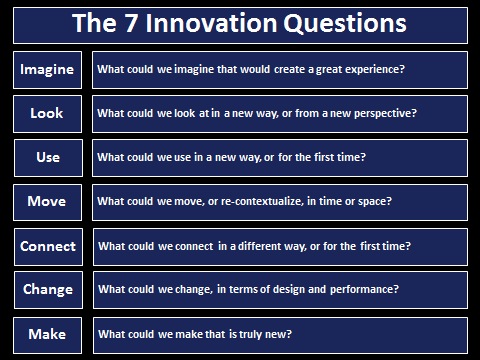
Bill leads the very snappily named “Innovation Genome Project’ which is working on reverse-engineering innovation by examining 1000 significant innovations throughout history.  (A cadre of MBAs may be harmed in the collection of this data, but that is the price of insight.)  They are examining what kind of change from the status quo is involved in each of those innovations:  So far, they have found that 7 kinds of changes account for most of the innovations.  Bill is graciously sharing his insights.  His team turned those 7 kinds of changes into  set of 7 questions that anyone can use to catalyze innovative ideas on any topic.

Since Satisfaction is the difference between Expectations and Experience, here are a few expectation-setting observations of my own about what this tool is and is not.

  1. Asking oneself these questions will not ensure good innovation ideas.  After all it is just a process; the quality of the ideas will depend on the people involved.  But it is a way to channel and spur people’s thinking in directions in which they might not normally go.
  2. It is a way to structure a discussion, which can be useful, particularly in groups. It prevents a discussion that is so broad-ranging that nobody builds on or works off each other’s ideas.  It provides focus while keeping each change domain (question area) is still large enough to evoke many different ideas.
  3. It is an aid for coming up with innovative ideas.  It does not claim to address the all-important implementation stage.
  4. It is a checklist to feel comfortable that you have not neglected a significant dimension of potential innovation.  Clearly, it is not a guarantee that you have actually considered all the potential innovations available to your business.

More detailed article by Bill O’Connor on this project and the questions can be found at:  http://www.innovationexcellence.com/blog/2012/01/09/the-innovation-genome-project/

An article by another Autodesk employee whose team came up with a successful innovative product/service using the tool can be found at:  http://www.fastcoexist.com/1679231/the-6-questions-that-lead-to-new-innovations

Retain and Develop Yourself / Your Employees

Inc. Magazine listed “Opportunities for Innovation”  as one of the top 10 things that employees want from job.  Founder Space lists “Feeling in on things” as #2 on the list of what employees say will make them happy at a job.  These facts highlight how important it is to engage all employees in innovation.  This is easy with naturally vocal and confidently creative people, or with those employees to like to start things rather than implement them.  But I’ve found that some of the best innovative ideas have come from very conservative and implementation-focused people once they perceived a commitment to following through on innovation and were given the opportunity to contribute.  A tool like the 7 Questions is a way to encourage and accommodate diverse employee participation in innovation at many levels.

Input Welcome

Would you use this approach?

Do you have better  or complementary approaches that have the same impact?

Share this:

  • Email a link to a friend (Opens in new window) Email
  • Print (Opens in new window) Print
  • Share on Reddit (Opens in new window) Reddit
  • Share on Facebook (Opens in new window) Facebook
  • Share on Tumblr (Opens in new window) Tumblr
  • Share on X (Opens in new window) X
  • Share on Pinterest (Opens in new window) Pinterest
  • Share on LinkedIn (Opens in new window) LinkedIn
Like Loading...

Ask This at the Outset of Any Initiative

June 8, 2012 · by Taia Ergueta

Preparing to launch an initiative?  Avoid common and costly errors by asking one question at the outset:  Process Task or Talent Task?  This is a simple way to make everyone more confident in the outcome.  I learned this from Peter Drucker and have used it often to troubleshoot how to address a problem.  I thought it would be good to share with you because it is effective and also boosts employee motivation in a subtle but important way.

The  Point

Drucker described that there are some problems/opportunities that can only be addressed by putting together a small team of people with specific talents:  This is a Talent Task.  He noted that there are other problems /opportunities -– usually those that where the answer must be implemented through lots of people at various levels of knowledge – where you need a process:  This is a Process Task.

Ok, this is logical and everyone is probably nodding or even nodding off at this point.  But wait.  The important insight is this:

When you try to solve a Talent Task with a process, or try to solve a Process Task with talent, you fail.  Aspirin is great, but not when what you really need is penicillin.

Example 1:  Strategic planning.  At HP in the 90’s strategic planning was a highly structured and well-documented process.  Each year, massive numbers of large meetings were held to ensure that everyone was involved and bought in to the strategy.  It was the “thundering herd” approach to strategy development.  Huts were leveled, large distances were covered, the process was followed, but the correctness of the end-point was, well, mixed.  Strategy is a Talent Task.  There is a need for information and engagement from many people and solid processes for that should exist.  But the critical framing of the strategic issues, the evaluation of alternatives, and the ultimate application of informed intuition to choose a truly strategic and competitive strategy should be done by a small set of people with those skills and responsibility.  Good strategies do not automatically pop out the end of a process.

Example 2:  Contract Review Team.  My company had decided to offer a new service:  Third party maintenance.  Since it would require new responsibilities in the field, management hired experienced field managers to review and approve contracts before we accepted them.  Soon, there was a bottleneck of contracts pending approval.  Why? The processes for delivering the new services were incomplete and there was no established way of building them, so the contract reviewers were not approving any for delivery.  The Talent applied was necessary but not sufficient.  The real problem was a Process Task:  Establish a process for building balanced sales and delivery capabilities to serve an increasing number of attractive contracts.

Watch for It

Once you start thinking in these terms you see the mismatches around you.  How many times have you seen a big, systemic problem addressed by the naming of one person who “will focus on it”?  One feels of them.  How many times have you seen a recurring problem tackled by successive internal task forces that clearly could use (or be replaced by) an injection of talent — someone who is a real expert on the matter?  As a colleague, Tom Redder, used to say “You don’t get wisdom by pooling ignorance”.

Which gets me to the Affective Action part of this.  I’ve noticed that employees intuitively understand this Talent Task vs. Process Task difference.  They are demoralized when opportunities and issues are not addressed with the right approach.  Their own careers or products and in the balance.  For this reason, employees buy in more readily and whole-heartedly if they see the right approach being used even if it means that they are not as directly involved.

Input Welcome

Are there other examples of cases where you have seen the Talent approach is better, but Process used – or vice a versa?

Share this:

  • Email a link to a friend (Opens in new window) Email
  • Print (Opens in new window) Print
  • Share on Reddit (Opens in new window) Reddit
  • Share on Facebook (Opens in new window) Facebook
  • Share on Tumblr (Opens in new window) Tumblr
  • Share on X (Opens in new window) X
  • Share on Pinterest (Opens in new window) Pinterest
  • Share on LinkedIn (Opens in new window) LinkedIn
Like Loading...
Page 1 of 2 1 2 Next »
  • Blog at WordPress.com.
  • Subscribe Subscribed
    • AffectiveAction
    • Join 41 other subscribers
    • Already have a WordPress.com account? Log in now.
    • AffectiveAction
    • Subscribe Subscribed
    • Sign up
    • Log in
    • Report this content
    • View site in Reader
    • Manage subscriptions
    • Collapse this bar
 

Loading Comments...
 

    %d