AffectiveAction

Because business has the heart to succeed

Menu

  • Home
  • Blog
  • General Management
  • Marketing
  • People Management
  • Innovation
  • Guest Bloggers
  • About
  • Enter your email address to follow this blog and receive notifications of new posts by email.

  • Recent Posts

    • Renewable Fuel for a Brilliant Life
    • How to Manage Women: Tips #2 and 3
    • How to Manage Women Tip # 1
    • Compassionate Capitalism
    • Stop That Focus Group!
    • To really change people’s behavior: Use the right word.
    • Is This the Coolest Company Ever?
  • Archive

  • Tags

    Affective Action B2B business business model career development career management cause marketing collaborate commercialization Conflict corporate responsibility customer networks demand generation Design Duarte Communications early sales Ecomagination effective communication Empathy employee engagement employee retention GE generative green marketing high performance high touch/low cost hiring HR human resources innovation innovative thinking Institute for the Future investment Jeff Immelt leadership lead generation management managing women market development marketing marketing automation marketing metrics motivation negotiate nurturing prospects outperform passion personalized marketing philanthropy philosophy philosophy and business Presentations product introductions project management project portfolio analysis project selection prospecting regulatory expansion results sales Santa Clara University social-media social entrepreneur social venture Social Venture incubator Strategy sustainability TEDx Presidio the buying process the customer view The Onion time to market time to ramp use case venture program
    • RSS - Posts
    • RSS - Comments
  • Subscribe in a reader

Browsing Tags career management

How to Manage Women: Tips #2 and 3

May 20, 2013 · by Taia Ergueta

tv calibration

Tune Your Performance Assessment Meter

As the evolved leader you are, I am sure that when you assess performance you try to use an objective standard and objective observations of how people perform against that standard and their commitments. But signals from your employees can color your assessment. Here are two female tendencies that may erroneously skew your view of their performance and potential.

Tendency A:  “I Should Have…”

Say the product does not meet the customer need. Or maybe the reorganization wasn’t implemented well and productivity is taking a nose dive. Perhaps the company you were about to buy is now part of your gloating competitor. Whatever the details, an initiative has gone south and there is definitely “no joy in Mudville.” One or more people will come out of this with something between a smudge and a big black mark on their scorecard.

The stories that people tell around a failed project have a big impact on how they are remembered and evaluated. In this context, women tend to do themselves a disservice. Read More →

Share this:

  • Email a link to a friend (Opens in new window) Email
  • Print (Opens in new window) Print
  • Share on Reddit (Opens in new window) Reddit
  • Share on Facebook (Opens in new window) Facebook
  • Share on Tumblr (Opens in new window) Tumblr
  • Share on X (Opens in new window) X
  • Share on Pinterest (Opens in new window) Pinterest
  • Share on LinkedIn (Opens in new window) LinkedIn
Like Loading...

How to Manage Women Tip # 1

May 17, 2013 · by Taia Ergueta

hero_heroine_by_dancellamadance-d31vdp2This post is not about why you should focus on how to manage women better.  OK, maybe just one sentence on that: Whether you are a first time manager or a seasoned executive, you can make a major contribution to your company and your career by managing women better. There is a lot of data on why that is true.  There is less info on how to do it.

objectionOutrage Deflector:  Yes, we are all individuals.  And..yes, many of these ideas apply to men as well.  And… no, not all apply to all women.   All that being said, there are patterns that apply to women disproportionally. and bosses who learn them and manage accordingly reap huge benefits.  Notice I did not say “men who learn them”;  women don’t magically think of this stuff either!

Read More →

Share this:

  • Email a link to a friend (Opens in new window) Email
  • Print (Opens in new window) Print
  • Share on Reddit (Opens in new window) Reddit
  • Share on Facebook (Opens in new window) Facebook
  • Share on Tumblr (Opens in new window) Tumblr
  • Share on X (Opens in new window) X
  • Share on Pinterest (Opens in new window) Pinterest
  • Share on LinkedIn (Opens in new window) LinkedIn
Like Loading...

Got Demoted? It’s an Opportunity

November 21, 2012 · by Taia Ergueta

A youngish friend, let’s call him Matt, got a great job with an exciting and inspirational start up right out of college.  He was part of the core management team and, although the work load was extremely heavy, he was delighted by the opportunity to grow and contribute at such a high level so early in his career.  The feeling was mutual:  Matt got many accolades from his boss, the CEO,  for his strong performance and great attitude.

Trouble in Paradise

Recently Matt called and was very disheartened.  He had just been told that his boss had decided to hire a manager who would now be Matt’s boss.  The CEO explained that he himself doesn’t have the expertise in Matt’s function, so he had decided to hire someone with deep expertise.  Matt’s CEO emphasized that the new manager would be much better equipped to help Matt develop.

Read More →

Share this:

  • Email a link to a friend (Opens in new window) Email
  • Print (Opens in new window) Print
  • Share on Reddit (Opens in new window) Reddit
  • Share on Facebook (Opens in new window) Facebook
  • Share on Tumblr (Opens in new window) Tumblr
  • Share on X (Opens in new window) X
  • Share on Pinterest (Opens in new window) Pinterest
  • Share on LinkedIn (Opens in new window) LinkedIn
Like Loading...

Winning Big Through Sustainability

August 12, 2012 · by Taia Ergueta

Opportunities Revealed

In the business world, “Sustainability” started out as Lunatic Fringe talk, then moved up to window-dressing for Corporate Responsibility sections of Annual Reports and subsequently got a new and sometimes tawdry life as a Green Marketing opportunity.  Now, setting a company’s sustainability agenda is one of the most important and valuable things that its executives must do.  And people at all levels can find great innovation ideas in sustainability.

Serious Business

I attended the Sustainable Brands conference in 2007 and it was a hive of excitement over the power of Green Marketing and adulation of cool campaigns and programs.  Just two years later, the same conference was astoundingly different:  It had become clear that both the issues and opportunities are much more fundamental and addressing them is no longer a matter of choice, it is an imperative.  Energy and water will be scarce and more expensive for everyone.  In addition, a combination of consumer awareness and regulatory expansion are making transparency – a lot of reporting of your sustainability practices – mandatory.   You can deal with these as burdens or you can try to find ways to create advantages for your company.  In addition to creating new obligations, these and related challenges are creating major opportunities for growth and effectiveness.

What to do? Read More →

Share this:

  • Email a link to a friend (Opens in new window) Email
  • Print (Opens in new window) Print
  • Share on Reddit (Opens in new window) Reddit
  • Share on Facebook (Opens in new window) Facebook
  • Share on Tumblr (Opens in new window) Tumblr
  • Share on X (Opens in new window) X
  • Share on Pinterest (Opens in new window) Pinterest
  • Share on LinkedIn (Opens in new window) LinkedIn
Like Loading...

How and Why to Optimize Your Relate:Create Ratio

July 2, 2012 · by Taia Ergueta

Can you think of anyone who succeeds by focusing exclusively on the subject matter of his/her work?  Yes, some artists who labor alone do achieve wild posthumous success, but I have yet to meet anyone with that as his/her goal.  Most of us recognize that we have to work with and through others.  This post is about turning that general awareness into a actions that will help your career development and your real results.

Why do it

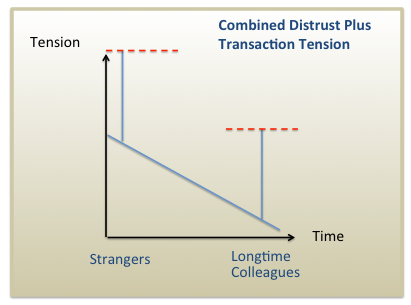
Here is another one of those Keys to Life (see May 28 post) that I have found exceedingly useful since I heard it sometime in the 20th century.  (I would attribute it but I have no idea who was the wise spirit who originated it.)   It is captured in a diagram which describes the potential states of a work relationship.

  1. The horizontal axis is Time. It measures how long the two people have known each other and interacted.
  2. The vertical axis is Tension. It measures the level of relationship Tension coming from two potential sources: Distrust and Transactions.

Distrust. When people first meet they don’t know what to expect from each other. Their level of trust is low. Accordingly the relationship tension is high. Over time, people get to know each other and, unless those interactions abound in deceit and treachery, the level of trust between them tends to increase: Logically, the level of distrust-driven tension goes down.

Transactions. Each time we want something from the other person or vice a versa we engage in a transaction, and each transaction creates some tension. If you have a small easy request to make of the other person, the tension created by that request will be very low. On the other hand, if you have a proposal that imposes a major cost on the other person (e.g., it conflicts with their plans, requires a lot of time or significantly inconveniences them) then the transaction-driven tension level created may be quite high.

So far so good.  Now here is the key:   Put these together and you will see why trying to do a major transaction with someone you barely know is so difficult.  The high distrust-driven tension coupled with the high transaction-driven tension adds up to a vertigo-evoking level of overall tension.  If instead, you attempt the same transaction with someone after you have established a relationship of trust, you have almost half the level of tension to deal with and the likelihood of success soars.

Ok, What To Do?

The take-away is:  Get down that distrust curve as fast as possible with all the key people with whom you need to collaborate or negotiate.  Important:  This is not a cynical tip meant to turn you into Machiavelli!  Groucho Marx said, “Sincerity is everything. If you can fake sincerity, you have it made.”  No, no, no.   We’re talking about effective communication and relationship building:

  • Seeking the person out
  • Listening to them
  • Being helpful when you can
  • Letting them know how you think and what drives you
  • Introducing them to your ideas early
  • Maintaining a dialogue

You get the picture.

Getting down that trust curve takes more time and effort than most of us think it does.  Which brings me back to the title of this post. Most people like to — and think they are paid to — work on the Create side of that ratio; that is where their passion is and they spend as much of their time as possible on it assuming/hoping that that will win the day.  So “Optimizing the Relate:Create ratio” usually requires shifting time spent on the substance behind those transactions to time spent on the relationships that will enable the real results.

You may be able to make that shift naturally just by being more aware of this. The rest of us mere mortals need to take a more structured approach, at least at first:  Picking key people with whom to deepen a relationship and then setting aside time explicitly for that.

As a manager this is a huge area of additional opportunities for creating an affective action culture and a high performance organization: I will cover these in my next post.

Input Welcome

  • Have you changed your Relate: Create ratio profitably?
  • Have you found ways to help your employees do this better?

Share this:

  • Email a link to a friend (Opens in new window) Email
  • Print (Opens in new window) Print
  • Share on Reddit (Opens in new window) Reddit
  • Share on Facebook (Opens in new window) Facebook
  • Share on Tumblr (Opens in new window) Tumblr
  • Share on X (Opens in new window) X
  • Share on Pinterest (Opens in new window) Pinterest
  • Share on LinkedIn (Opens in new window) LinkedIn
Like Loading...

What if you met people’s deepest need: Recognition?

June 28, 2012 · by deanmherman
by Dean M. Herman, Ph.D.
http://www.hermanconsulting.com/
Have you ever noticed how hard your colleagues work just to be recognized?  Think of how much effort they expend to achieve a particular status, or perhaps to acquire a certain possession that announces, “I’m a success.”  Have you thought about what really underlies all this exertion?  Do you realize it’s primarily just the desire to be seen?  Rather than labeling this as “egotistical,” consider whether it might actually be a fundamental human need – one that you possess as well.  Indeed, this need is likely operating at the very highest levels of your organization.

Through my work as a psychologist for executives, I have found that when people feel truly seen, sometimes for the first time in their lives, old patterns they’ve been clinging to for decades suddenly begin to drop away.

What do you imagine might happen if you put a quarter as much effort into recognizing others that they (or you) put into trying to get that recognition?  If that intrigues you, consider these tips:

  • Notice the positive characteristics that make each of your colleagues special – and give a voice to them. They’ll often be qualities they don’t even recognize themselves.   Remember: Nearly everyone struggles with feeling “not good enough.” When you truly see your coworkers, you’ll help them realize their gifts so that they can start giving them.
  • Your “seeing” need not only be through words.  You can also provide it through quietly making eye contact and intently listening.
  • Beware of lapsing into judgment when you inevitably encounter people very needy for recognition.  Perhaps they’ve hungered for this for a very long time and went wanting in ways you can’t even imagine.  When people have such a hunger, feed them.  Then stay alert and watch what happens.

Observe closely and you will find that virtually everyone has a deep need to be seen.  When you meet that need for them, your relationships and your impact will grow dramatically.

Copyright (c) 2011 Dean M. Herman, Ph.D. All rights reserved.

Share this:

  • Email a link to a friend (Opens in new window) Email
  • Print (Opens in new window) Print
  • Share on Reddit (Opens in new window) Reddit
  • Share on Facebook (Opens in new window) Facebook
  • Share on Tumblr (Opens in new window) Tumblr
  • Share on X (Opens in new window) X
  • Share on Pinterest (Opens in new window) Pinterest
  • Share on LinkedIn (Opens in new window) LinkedIn
Like Loading...

Is Your Plan Bold Enough to be Safe?

June 24, 2012 · by Taia Ergueta

Careers and companies rise and fall based on being right about how much innovation to take on at any given time.  Reach too far and you risk ridicule, delays in time to market, and slow market development.  Not surprisingly, it often seemed safer to stick to the middle ground:  Investments in product enhancements or business extension for which there is strong supporting data.  But today, you shun the lunatic fringe at your own peril.  A small leap may not put you on firm ground.

 (The view straight down from High Bridge over Eagle Creek in the Columbia River Gorge)

A Case and Lessons Learned

I recently attended an EMBS talk on the latest scanning, parametrics, and 3-D printing developments.  The speaker was Scott Summit.  His company, Bespoke Innovations makes functionally and esthetically personalized prosthetic leg coverings.  For the coverings to achieve their first objective – restoring visual symmetry to the wearer’s body – they need an accurate digital scan of the person’s body.  What he recounted about the recent history of body scanning technology is a warning to all of us in any industry:

  • Approximately 3 years ago, to get a body scan he needed to take the customer to a lab that had a 1M machine and would provide scans at $800/scan.
  • Shortly thereafter, there were hand-held devices that cost $40,000 to $60,000 a piece and were very tricky to use.
  • Scott’s company developed their own scanner but it was soon overtaken in price/performance by…
  • A scanner that Microsoft developed. Shortly after that product became available…
  • Autodesk announced that anyone could download their 123D Catch software product for free. This enables anyone with a digital camera to take photos that the software then stitches together to create a 3-D model. For free.

Just hearing about this drop — from $1M to $0 in approximately 3 years —  is dizzying.  Can you imagine how each of those obviated product providers felt?  There are Five Stages of Grief, and I have seen Four Stages of Losing this kind of competitive fight:

  1. Denial:  “It’s a much less powerful product. “ “We only see them in Germany.”  “Our customers will never accept that.”
  2. More Enhancement:  “We will have better [fill in the blank: Specs? Bathrooms? You Tube videos?]”
  3. Capitulation:  “We have other more strategic businesses on which to focus”
  4. Rationalization:  “Sheila never invested enough in it.”  “Joe wasn’t the right person to lead it.”

The lessons that people take away from competitive failures are not always right.  Maybe there were other issues, but maybe the real lesson is this:  “We lost by playing it safe.  We did not target a big enough change; as a result, our investments went toward enhancements while others produced a much bigger leap in value for customers.”

There are definitely still situations that call for investments in minimally or moderately innovative projects.  But my point is that there are fewer of them now than before.  At the current pace of change and competition, many medium-impact projects simply do not make sense:  They will be rendered irrelevant soon or even before they are out the gate.

Implications:  How to Win in This Environment

  1. Become the voice, in your head and in your company, for the “Is it bold enough to be safe?” investment criterion.
  2. Become expert in  the techniques for evaluating bold ideas.  For every bold idea that is wildly successful there are 17 that turn out to be just wild.  More on this in future posts.
  3. Become expert in the techniques for implementing bold ideas in ways that manage risk.  More on this in future posts.

Input Welcome

Have you changed your project selection to match a faster pace of change?

How have you mitigated the higher risk associated with bigger leaps in contribution?

Share this:

  • Email a link to a friend (Opens in new window) Email
  • Print (Opens in new window) Print
  • Share on Reddit (Opens in new window) Reddit
  • Share on Facebook (Opens in new window) Facebook
  • Share on Tumblr (Opens in new window) Tumblr
  • Share on X (Opens in new window) X
  • Share on Pinterest (Opens in new window) Pinterest
  • Share on LinkedIn (Opens in new window) LinkedIn
Like Loading...

How (and Why) to Describe “Potential”

June 3, 2012 · by Taia Ergueta

Who advances in the business world often depends on management’s assessment of people’s “potential”.  But what constitutes potential is often not clearly described.  As a result, employees can’t work on it and managers can’t be consistent in their assessment of it.

The Cost

Managers often feel embarrassed about not being able to describe this rather intangible trait, so they act as if it is not a real evaluation criterion.  As a result, work is a game with rules that are posted and other rules that the judges actually use.  Very capable people can end up puzzled, pointing to their 100%-met hard metrics as others sail by them into higher positions based on this unspoken evaluation factor, potential.  Valuable people sometimes leave, seeking a company where the rules are clearer.  Others stay, but commit less to a system that does not seem to work for them.

The Upside

Getting specific about Potential and helping people to envision and become their best, highest potential selves is inspirational.  Just talking about it with employees is an affective action that is appreciated.  And just talking about it with specifics puts people in an energized and more confident state of mind.  People relax and outperform when the advancement criteria are real and understood.

A Tool

Here is a tool that I have refined over the years.  It is a list of Indicators of Individual Potential for exceptional contribution and for continued growth.

  • Personally develops valuable new proposals and ideas
  • Inclination and ability to interact effectively with the world outside of the Company
  • Generative: Sees next steps. Anticipates. Makes more out of things than others. 
  • Track record of Personal development & growth — eager to learn/grow
  • Proven to be able and willing to take on new roles
  • Demonstrated leadership of peers. Commands respect in the organization. Influential.
  • Able to mobilize an organization/team to effect change
  • Explicitly seeks out development opportunities: Actively learns from each experience
  • Takes initiative to perform beyond current task/job responsibilities
  • Willingly takes on greater responsibilities & broader assignments
  • Demonstrates creativity/initiative in problem solving, flexible, develops new approaches
  • Takes multiple perspectives. Is open. Is constructive
  • Sensitive to organizational dynamics required to get things done
  • Able to assess global, big-picture issues
  • Actively seeks opportunities to learn about industries, markets, technologies and trends relevant to the company
  • Able to work effectively across functions & organizational boundaries
  • Strong in many transferable skills (transferrable across roles or functions)
  • Clear adherence to a set of personal values
  • Proven track record of results
  • Demonstrates passion for the business.

For Employees

You do not have to exhibit all of these traits!  Here is my suggestion for how to sort this list and use it practically

1.  Identify which of these are most important.

I have marked the ones that I think are most universally important in green.  But I am not writing your evaluations.  (Too bad, because I am beginning to realize that you have unlimited potential!)  Find out which ones are most important to the people who are evaluating you and are in a position to propose you for rewards and promotions.  Use this list and ask them to pick their top criteria.  It is a great conversation to initiate since it is a high-potential act in itself:  You are showing ambition and dedication to growth, and you are contributing to the management toolset.  You are giving a professional gift while getting info that is critical to fueling your meteoric rise.

2.  Identify which of these  require your attention.

 If one of the indicators in green or one of the indicators that your managers have picked as very important is a real strength of yours, then develop at least 10 things you can do to make that strength have bigger impact on the business.  Read that again.  Notice that you start with your strengths, not your weaknesses.  I heard Peter Druker speak once – an intense experience — and he said that he managed his executives so that their strengths were so blinding that their weaknesses did not matter.  You could do a lot worse than adopting his management style for yourself.  The key is that those strengths will always be your strengths and consequently that is how you can make the biggest contributions.  Make sure you use your strengths fully instead of trying to do everything as well.

That being said, if one of the high important traits is an area of true weakness for you, then by all means develop a list of at least ten things that you can do to improve your performance and reputation in that area.  While that trait may never become what you are known for, you can make sure that that is not a big liability either.

Finally, you may already have these desired traits, but they may not be visible to the people that matter.  That is just like not having the trait.  No whining: Justice always needs your help.  As distasteful as it may seem to you, make a list of at least 10 things you could do to make your virtue visible.  Most of them should be things that you do as an ongoing part of your job.  A meeting with your boss that lays out your relevant past actions and accomplishments will be valuable ( See the May 6 post, “Thanks a Million, Kumar”), but you have to develop the skill of monitoring and managing your visibility on an ongoing basis.

To be sure that you are on the mark about your strengths and weaknesses, and also about how visible they are, you need input. Ask bosses, colleagues and friends.

3.  Implement at least 3 of the actions you came up with for a chosen indicator conscientiously for 4 months.  Look at them every week and assess whether you really did more of whatever you chose that week.   Re-up after 4 months or pick something new if you feel you have established desired habits around your first chosen indicator.

For Managers

Possible ways to use this list:

  • Edit it to show your priorities.
  • Share the list with your teams (edited or not).  It is a quick way to show support for their development.
  • Use this list at evaluation time to help you pinpoint and communicate specific behaviors to compliment or to suggest.

Input Welcome:

What do you think is the most important indicator of potential?

Do you have other behaviors that you look for when evaluating potential?

Share this:

  • Email a link to a friend (Opens in new window) Email
  • Print (Opens in new window) Print
  • Share on Reddit (Opens in new window) Reddit
  • Share on Facebook (Opens in new window) Facebook
  • Share on Tumblr (Opens in new window) Tumblr
  • Share on X (Opens in new window) X
  • Share on Pinterest (Opens in new window) Pinterest
  • Share on LinkedIn (Opens in new window) LinkedIn
Like Loading...

Marketing is Sales, Sales is Marketing

April 27, 2012 · by Taia Ergueta

Source: Africapic.com

Previously clear lines between Marketing and Sales are gone:  Instead there is now a Marketing-Sales Continuum. The technology, sociology and economics of B-to-B Marketing and Sales functions have changed fundamentally.  As a result either function can take over much of the ground of the other.  By all means, do panic a bit – and then, relax. Extinction is not at hand. In fact, the new realities offer new glory for people in both functions.  You can go get it.

FIRST:  WHY YOU NEED TO REBUILD THE PLANE IN MID-FLIGHT

Technology shifts. The noble and oh-so-loved Brochure cannot begin to compete with something like a multi-level micro-site with rich modular video content supplemented by a strong user forum.  Likewise, the continuous marketing din that surrounds every customer portends a sad fate for anyone doing one perfectly crafted Email Blast when his competitor is using marketing automation to do 5 orchestrated customer “touches” for the same price and effort.  Finally, social media is just hitting stride and has already created and destroyed businesses and sales models on a large scale.

The sociological shifts are as big and cross-generational.

  • Place:  Last Year’s Trade Shows are not where the majority of the world’s new young customers are getting and exchanging advice daily on what to see and buy.
  • Demographics are destiny.  Your geographic mix almost surely needs adjusting: Most people keep investing disproportionately in their past markets instead of the important new ones. And, yes, it will take a lot more work, because your biggest problem is not that your new customers are foreign to you, it is that you are foreign to them.
  • The dynamic of evaluation and decision-making have changed.  There is a network rather than a path to your customer.  How do you find out who is your desired customer’s most influential acquaintance and what and where he/she wants to know about your product?  Social media are the important new facilitators and accelerators of the primacy of customer communities.

The financial shifts are well known.  Corporations expect a steady rate of productivity improvement.  Sales forces are relatively expensive but efforts to limit them face the fact that those resources are difficult to leverage across geographies and product lines.  The picture is no rosier on the marketing side.  The effectiveness of Marketing spending often faces skepticism.

HOW IS MARKETING NOW SALES?

Marketing departments stagnate or decline if they do not get tangibly related to and accountable for creating real sales.  In the past it was safe for Marketing to create information and sales tools and then rely on the sales force to use them to reach and influence customers.  Marketing can now reach out very specifically and directly to the very people who were previously only contacted by Sales. OK, they can.  But should they?  Yes, yes, for at least two reasons:

  1. Because there is no alternative. The buying process has clearly changed and customers now conduct much of their product investigation and evaluation on line or in person with people other than a sales person. If Marketing does not understand that buying process thoroughly and get its company’s messages where the customers are conducting their investigations, those customers will be lost to the competition.
  2. Because generic information and sales tools have decreasing value. Customers don’t have the time or patience to figure out if or how your product meets their needs. Similarly, sales forces don’t have the time or knowledge to take all prospects through that process.  To surmount these barriers, information, messages, sales tools and communication channels must be very specific to each target market segment.

HOW IS SALES NOW MARKETING?

How does an experienced sales person meet a quota that goes up 12% with products that don’t increase in net price? Note that I said, “experienced”.  This isn’t a matter of learning to do the sales job.  You have become more effective over time and yes, you have cut into your personal time more and more to meet or exceed your quotas to date.  Now what?

The current sales force automation tools provide some of great capabilities including pipeline visibility, activity tracking and some outreach capabilities.  But progressive sales people need information and capabilities beyond that.   For example:

  • A CRM tool fully loaded with existing customers does nothing to expand the list of qualified prospects a sales person can address.  For that, there are services that mine public sources and can give you detailed information about what customers are doing, which products they currently use, etc.  But mining these sources requires a strategic marketing approach to sales development.
  • The capability to send automated check-in messages to customers does not provide the stratification and value added content that is really needed to evoke action or a response.  For that you need to:  1. Know your high priority customer segments and  2. Develop and offer each set of target customers a continuous stream of relevant content and non-transactional engagement opportunities.

Whether the sales objective is bringing in new customers (“hunting”) or building deeper buying from existing customers (“increasing share-of-wallet” or “gathering”), to reach the required new heights of their quotas, sales people need to apply focused marketing techniques.

RIDING THE MARKETING-SALES CONTINUUM WAVES 

As with all major changes, the technological, sociological and economic shifts described create waves of great opportunity for people who tune into them and act — and sogginess for those who don’t.  Here are three ways to ensure that you surf to success.

New You.

Each function had reached the point at which it’s productivity gains were slowing or coming heavily at the expense of the personal lives of its employees.  New marketing and sales automation and social media technologies are making large productivity and effectiveness leaps possible.  But you’ll only get their real value if you identify with the whole Continuum—not as a Marketing or Sales person, but as a Sales Development leader.

Through that lens you will see beyond arbitrary function boundaries and you will change your world.  You’ll probably become relentless about making tight, clear links from upstream of what you do through downstream of your actions, all the way to the ultimate results, sales.  Find the gaps and fill them — or make noise until someone else does so.

New Us:  Better Together

Marketing and Sales activities are often very loosely aligned. Everyone assumes that someone else is ensuring their disparate efforts and assumptions are adding up to the desired results.  Despite each group working very hard, relations between them often run from apathy to mutual sympathy to barely muffled acrimony.  Growth often falls far short of what can happen if both functions put collective effort into focused, aligned and technology-enabled sales development initiatives.

Marketing and sales teams can work together differently for higher aggressiveness and effectiveness.  Marketing can provide additional value added that feeds into a jointly developed blueprint for sales generation.  Sales can drive those sales generation blueprints that include:

    • Appropriate market goals tied to segment-specific customer intelligence,
    • An action plan with needed marketing and customer engagement tactics regardless of who does them and
    • The capture of leading metrics so that the marketing/sales effort can be adjusted frequently.

New.  Period.  Frontiers for Pioneers in both Functions

Find out what new inputs and outputs are possible by looking at competitors and, even more importantly, by looking at companies in other industries.  Learn and standout in your company by becoming a champion for a pilot in one new initiative every 6 months.  A few examples:

In the world of Big Data, many Marketing-Sales teams will soon be able to know every potential customer for their product and other relevant facts about them. Which function will make greater practical use of this capability?

Using Social Media, companies will truly be able to act as the “peer” and “partner” that they have always wanted to be for their customers. Which function will do so to create the highest quantifiable results?

The biggest value creators on Wall Street are now mathematicians whose algorithms exploit existing information in new ways to make profitable trades; is there analogous gold in your company’s customer information?

The future of your function is exciting — and it looks a lot like you.

Share this:

  • Email a link to a friend (Opens in new window) Email
  • Print (Opens in new window) Print
  • Share on Reddit (Opens in new window) Reddit
  • Share on Facebook (Opens in new window) Facebook
  • Share on Tumblr (Opens in new window) Tumblr
  • Share on X (Opens in new window) X
  • Share on Pinterest (Opens in new window) Pinterest
  • Share on LinkedIn (Opens in new window) LinkedIn
Like Loading...
  • Blog at WordPress.com.
  • Subscribe Subscribed
    • AffectiveAction
    • Join 41 other subscribers
    • Already have a WordPress.com account? Log in now.
    • AffectiveAction
    • Subscribe Subscribed
    • Sign up
    • Log in
    • Report this content
    • View site in Reader
    • Manage subscriptions
    • Collapse this bar
 

Loading Comments...
 

    %d