AffectiveAction

Because business has the heart to succeed

Menu

  • Home
  • Blog
  • General Management
  • Marketing
  • People Management
  • Innovation
  • Guest Bloggers
  • About
  • Enter your email address to follow this blog and receive notifications of new posts by email.

  • Recent Posts

    • Renewable Fuel for a Brilliant Life
    • How to Manage Women: Tips #2 and 3
    • How to Manage Women Tip # 1
    • Compassionate Capitalism
    • Stop That Focus Group!
    • To really change people’s behavior: Use the right word.
    • Is This the Coolest Company Ever?
  • Archive

  • Tags

    Affective Action B2B business business model career development career management cause marketing collaborate commercialization Conflict corporate responsibility customer networks demand generation Design Duarte Communications early sales Ecomagination effective communication Empathy employee engagement employee retention GE generative green marketing high performance high touch/low cost hiring HR human resources innovation innovative thinking Institute for the Future investment Jeff Immelt leadership lead generation management managing women market development marketing marketing automation marketing metrics motivation negotiate nurturing prospects outperform passion personalized marketing philanthropy philosophy philosophy and business Presentations product introductions project management project portfolio analysis project selection prospecting regulatory expansion results sales Santa Clara University social-media social entrepreneur social venture Social Venture incubator Strategy sustainability TEDx Presidio the buying process the customer view The Onion time to market time to ramp use case venture program
    • RSS - Posts
    • RSS - Comments
  • Subscribe in a reader

Browsing Tags demand generation

Your Marketing Needs Four Pillars Too

July 23, 2012 · by Taia Ergueta

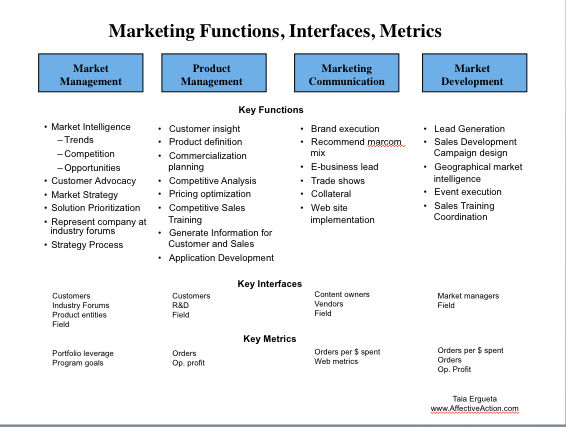
Most tech businesses have product marketing.  Sometimes Marketing starts and stops there.  If you build it they will come, right?  Or, as one manager told me when I suggested that we work on messaging, “Taia, the product IS the message”.   Even among the more enlightened, Marketing is a lot like South America:  People know the outline, but don’t ask them about the number or position  of the countries.

So here it a short and sweet starting point for you.   The four pillars of marketing.  What functions fall under each.  With whom they need to work most closely. And the key metrics for each.  It can be you very own Arch of Triumph.  Some assembly required.

Note:

  • This model surrounds Product Management with the important things that they often cannot do either because of the skills or time needed.  With the addition of the Market (vertical) Management, full Marcom and Market Development you can address true customer needs and do modern demand generation.  This is true commercialization.
  • From left to right, the key interfaces shift from Customers to Internal partners to Sales (“Field”).  If you have a small team these interfaces can happen more easily.  With large teams, you’ll need to actively manage this to ensure the right collaboration.

Download the above document:   Linked Doc

Input Welcome

Are there key functions missing?

Do you have a better model of marketing?

Share this:

  • Email a link to a friend (Opens in new window) Email
  • Print (Opens in new window) Print
  • Share on Reddit (Opens in new window) Reddit
  • Share on Facebook (Opens in new window) Facebook
  • Share on Tumblr (Opens in new window) Tumblr
  • Share on X (Opens in new window) X
  • Share on Pinterest (Opens in new window) Pinterest
  • Share on LinkedIn (Opens in new window) LinkedIn
Like Loading...

Speed Up Your Sales Improvement Time

July 20, 2012 · by Taia Ergueta

Sales are below plan. Does the blame game begin, or do both Marketing and Sales know what to do NOW to make a difference?

I was in a business where a sales shortfall triggered a “Performance Improvement Plan”.  The afflicted business unit would go off to investigate the problem and conjure up a convincing plan for fixing it.  Then implementation of that plan would begin. If someone happened to get pregnant at the beginning of this process, they had their child about the same time that we were seeing the results of this process.  And those sales results were not always good.  There had to be a better way.

There is. Here is a way to reduce the response time and increase the confidence in the fix.

Model What You Intend to Do

Many business development/intro plans are this:

  1. The sales goal(s)
  2. The list of a bunch of things that everyone will do.

Basically, there is a big collective hope that the latter will produce the former.  The dynamics of how that is expected to happen aren’t specified; so when the sales don’t materialize, nobody knows what failed. Not enough “things” done? Price wrong?

The better way: “The Magic Formula”.  Estimate values for these three key drivers of sales performance and then track them as metrics:

Average sales price  +  Length of the sales cycle  +  Win rate

 At the beginning, you may not have much to go on to set these. Not a problem. Make an educated guess (you’ll refine that over time as you get more data). Use those estimated values to model how you will get your sales goal.

Example

Here is a model for a hypothetical business projecting $500K of sales in 12 months:

 Magic Formula:  Average sales price $30K,  4 month sale cycle,  25% win rate

  1. Given the average sales price, you need $500K/30K , 17 sales in 12 months
  2. At a 25% win rate you need to engage 17 x 4 qualified leads: 68 total
  3. Given the 4 month sales cycle, you need to have engaged seriously with those 68 qualified leads  in the next 8 months.
  4. If you know half of those already, then you need to generate 32 qualified leads.  Let’s say you need 7 prospects for every qualified lead: In this case you need to generate 32 x 7 prospects – a total of 224 prospects to generate and qualify in the next 8 months.

This approach focuses Marketing and Sales on the right level and types of activities needed to meet the goal.  It makes the market development or time-to-ramp commitments much more solid.  It also requires the two functions to work together to set these formula value estimates and refine them.  Those discussions often surface hidden concerns, alignment gaps and expectations, reducing later issues and forging good relationships.

How Using This Can Speed Your Reaction Time

Ok, back to the scenario in which the order rate is below expectations.  Instead of flailing at causes and fixes, go to your data. Which Formula factors are not as you estimated?

  • Is the average sales price below your estimate while the other metrics are holding? Then look to either your discount level or the configurations that people are buying.
  • Is the win rate lower than you expected? See if the sales force needs more training and check the competitive positioning.

The relevant issues and fixes will be specific to your business of course.  The point is that this approach gives you built in diagnostics. Now when sales are down you do not start with a blank slate on which people write their excuses.  Instead, you have focus and this gets everyone into effective and affective action, fast.  Finger-pointing and delays in turning sales back up are de-motivators; quick iterations that also add to the collective knowledge base on sales generation are big motivators.

Input Welcome

Share this:

  • Email a link to a friend (Opens in new window) Email
  • Print (Opens in new window) Print
  • Share on Reddit (Opens in new window) Reddit
  • Share on Facebook (Opens in new window) Facebook
  • Share on Tumblr (Opens in new window) Tumblr
  • Share on X (Opens in new window) X
  • Share on Pinterest (Opens in new window) Pinterest
  • Share on LinkedIn (Opens in new window) LinkedIn
Like Loading...

Why Would It Make Sense to Generate the Same Lead Over and Over?

May 30, 2012 · by Taia Ergueta

A product marketing manager asked me if we were just wasting money and time on lead generation:  The sales force had just informed him that they already knew all the customers that his lead generation campaign had produced.  Here is why generating the same lead repeatedly through Nurturing Demand Generation can be a very good use of money.

A customer in your target market is anyone who could use your product. A “lead” is someone who has the inclination and ability to buy your product in the near future.  A customer goes in and out of that “lead” state over time as their needs and ability to buy emerge, get met, and eventually re-emerge.

If you are new to the target market, then your lead generation objective is to find people new to your company who should get to know you before making a decision.  In contrast, if you have been in the market for a while you may have encountered many (maybe all) of the customers for your product.  In this case, you have additional lead generation objectives:  You want to make sure that you are top of mind and aware every time that they go into lead mode.  Since customers are not always shopping with intent to buy, lead generation efforts are well worth the money if they:

  1. Tip customers into “lead-dom” by stimulating an appetite for a new product
  2. Make you aware when a customer you may already know, has become an active shopper – a real lead rather than a passive customer.

In the past, it was the sales force’s job to keep your product top of mind during the times when a customer was not ready to buy.  Sales  was expected to know when a customer became an active lead/buyer by staying in constant touch.  Reality: This kind of “nurturing” was rarely practical outside of top accounts.  Today, most sales forces don’t have the time or access for this level of intimacy across the needed number of prospects.  Enter Marketing.

Marketing is the Cyrano de Bergerac to Sales’ Christian.  By keeping in contact with customers, giving them a range of enticing offers to which to respond and carefully assessing their responses, marketing can precipitate and detect when a customer turns into an active lead.  It is estimated that you need to communicate with a customer an average of 5 to 7 times before they are ready to buy from you.  Marketing automation makes this kind of Nurturing Demand Generation possible.

Just as Cyrano provided the poetry, marketing can use automation to provide the attentiveness and relevancy that customers seek. In this world, Marketing’s gift to Sales is not a new name, it is the gift of high efficiency — a stream of old and new customers who are informed, intrigued and feel cared for and ready to be influenced and buy.

Input welcome: I’ve met so many customers who complained that they felt ignored by the industry. Similarly, marketing and sales people always get a big motivation boost from getting to know customers better and meeting their relationship needs. The possibility of High Touch/Low Cost personalized marketing and customer relationship management is finally here.  It is in its early stage.  What has been your experience with this?

Share this:

  • Email a link to a friend (Opens in new window) Email
  • Print (Opens in new window) Print
  • Share on Reddit (Opens in new window) Reddit
  • Share on Facebook (Opens in new window) Facebook
  • Share on Tumblr (Opens in new window) Tumblr
  • Share on X (Opens in new window) X
  • Share on Pinterest (Opens in new window) Pinterest
  • Share on LinkedIn (Opens in new window) LinkedIn
Like Loading...
  • Blog at WordPress.com.
  • Subscribe Subscribed
    • AffectiveAction
    • Join 41 other subscribers
    • Already have a WordPress.com account? Log in now.
    • AffectiveAction
    • Subscribe Subscribed
    • Sign up
    • Log in
    • Report this content
    • View site in Reader
    • Manage subscriptions
    • Collapse this bar
 

Loading Comments...
 

    %d