AffectiveAction

Because business has the heart to succeed

Menu

  • Home
  • Blog
  • General Management
  • Marketing
  • People Management
  • Innovation
  • Guest Bloggers
  • About
  • Enter your email address to follow this blog and receive notifications of new posts by email.

  • Recent Posts

    • Renewable Fuel for a Brilliant Life
    • How to Manage Women: Tips #2 and 3
    • How to Manage Women Tip # 1
    • Compassionate Capitalism
    • Stop That Focus Group!
    • To really change people’s behavior: Use the right word.
    • Is This the Coolest Company Ever?
  • Archive

  • Tags

    Affective Action B2B business business model career development career management cause marketing collaborate commercialization Conflict corporate responsibility customer networks demand generation Design Duarte Communications early sales Ecomagination effective communication Empathy employee engagement employee retention GE generative green marketing high performance high touch/low cost hiring HR human resources innovation innovative thinking Institute for the Future investment Jeff Immelt leadership lead generation management managing women market development marketing marketing automation marketing metrics motivation negotiate nurturing prospects outperform passion personalized marketing philanthropy philosophy philosophy and business Presentations product introductions project management project portfolio analysis project selection prospecting regulatory expansion results sales Santa Clara University social-media social entrepreneur social venture Social Venture incubator Strategy sustainability TEDx Presidio the buying process the customer view The Onion time to market time to ramp use case venture program
    • RSS - Posts
    • RSS - Comments
  • Subscribe in a reader

Browsing Tags employee retention

How to Manage Women: Tips #2 and 3

May 20, 2013 · by Taia Ergueta

tv calibration

Tune Your Performance Assessment Meter

As the evolved leader you are, I am sure that when you assess performance you try to use an objective standard and objective observations of how people perform against that standard and their commitments. But signals from your employees can color your assessment. Here are two female tendencies that may erroneously skew your view of their performance and potential.

Tendency A:  “I Should Have…”

Say the product does not meet the customer need. Or maybe the reorganization wasn’t implemented well and productivity is taking a nose dive. Perhaps the company you were about to buy is now part of your gloating competitor. Whatever the details, an initiative has gone south and there is definitely “no joy in Mudville.” One or more people will come out of this with something between a smudge and a big black mark on their scorecard.

The stories that people tell around a failed project have a big impact on how they are remembered and evaluated. In this context, women tend to do themselves a disservice. Read More →

Share this:

  • Email a link to a friend (Opens in new window) Email
  • Print (Opens in new window) Print
  • Share on Reddit (Opens in new window) Reddit
  • Share on Facebook (Opens in new window) Facebook
  • Share on Tumblr (Opens in new window) Tumblr
  • Share on X (Opens in new window) X
  • Share on Pinterest (Opens in new window) Pinterest
  • Share on LinkedIn (Opens in new window) LinkedIn
Like Loading...

How to Manage Women Tip # 1

May 17, 2013 · by Taia Ergueta

hero_heroine_by_dancellamadance-d31vdp2This post is not about why you should focus on how to manage women better.  OK, maybe just one sentence on that: Whether you are a first time manager or a seasoned executive, you can make a major contribution to your company and your career by managing women better. There is a lot of data on why that is true.  There is less info on how to do it.

objectionOutrage Deflector:  Yes, we are all individuals.  And..yes, many of these ideas apply to men as well.  And… no, not all apply to all women.   All that being said, there are patterns that apply to women disproportionally. and bosses who learn them and manage accordingly reap huge benefits.  Notice I did not say “men who learn them”;  women don’t magically think of this stuff either!

Read More →

Share this:

  • Email a link to a friend (Opens in new window) Email
  • Print (Opens in new window) Print
  • Share on Reddit (Opens in new window) Reddit
  • Share on Facebook (Opens in new window) Facebook
  • Share on Tumblr (Opens in new window) Tumblr
  • Share on X (Opens in new window) X
  • Share on Pinterest (Opens in new window) Pinterest
  • Share on LinkedIn (Opens in new window) LinkedIn
Like Loading...

Got Demoted? It’s an Opportunity

November 21, 2012 · by Taia Ergueta

A youngish friend, let’s call him Matt, got a great job with an exciting and inspirational start up right out of college.  He was part of the core management team and, although the work load was extremely heavy, he was delighted by the opportunity to grow and contribute at such a high level so early in his career.  The feeling was mutual:  Matt got many accolades from his boss, the CEO,  for his strong performance and great attitude.

Trouble in Paradise

Recently Matt called and was very disheartened.  He had just been told that his boss had decided to hire a manager who would now be Matt’s boss.  The CEO explained that he himself doesn’t have the expertise in Matt’s function, so he had decided to hire someone with deep expertise.  Matt’s CEO emphasized that the new manager would be much better equipped to help Matt develop.

Read More →

Share this:

  • Email a link to a friend (Opens in new window) Email
  • Print (Opens in new window) Print
  • Share on Reddit (Opens in new window) Reddit
  • Share on Facebook (Opens in new window) Facebook
  • Share on Tumblr (Opens in new window) Tumblr
  • Share on X (Opens in new window) X
  • Share on Pinterest (Opens in new window) Pinterest
  • Share on LinkedIn (Opens in new window) LinkedIn
Like Loading...

What if you met people’s deepest need: Recognition?

June 28, 2012 · by deanmherman
by Dean M. Herman, Ph.D.
http://www.hermanconsulting.com/
Have you ever noticed how hard your colleagues work just to be recognized?  Think of how much effort they expend to achieve a particular status, or perhaps to acquire a certain possession that announces, “I’m a success.”  Have you thought about what really underlies all this exertion?  Do you realize it’s primarily just the desire to be seen?  Rather than labeling this as “egotistical,” consider whether it might actually be a fundamental human need – one that you possess as well.  Indeed, this need is likely operating at the very highest levels of your organization.

Through my work as a psychologist for executives, I have found that when people feel truly seen, sometimes for the first time in their lives, old patterns they’ve been clinging to for decades suddenly begin to drop away.

What do you imagine might happen if you put a quarter as much effort into recognizing others that they (or you) put into trying to get that recognition?  If that intrigues you, consider these tips:

  • Notice the positive characteristics that make each of your colleagues special – and give a voice to them. They’ll often be qualities they don’t even recognize themselves.   Remember: Nearly everyone struggles with feeling “not good enough.” When you truly see your coworkers, you’ll help them realize their gifts so that they can start giving them.
  • Your “seeing” need not only be through words.  You can also provide it through quietly making eye contact and intently listening.
  • Beware of lapsing into judgment when you inevitably encounter people very needy for recognition.  Perhaps they’ve hungered for this for a very long time and went wanting in ways you can’t even imagine.  When people have such a hunger, feed them.  Then stay alert and watch what happens.

Observe closely and you will find that virtually everyone has a deep need to be seen.  When you meet that need for them, your relationships and your impact will grow dramatically.

Copyright (c) 2011 Dean M. Herman, Ph.D. All rights reserved.

Share this:

  • Email a link to a friend (Opens in new window) Email
  • Print (Opens in new window) Print
  • Share on Reddit (Opens in new window) Reddit
  • Share on Facebook (Opens in new window) Facebook
  • Share on Tumblr (Opens in new window) Tumblr
  • Share on X (Opens in new window) X
  • Share on Pinterest (Opens in new window) Pinterest
  • Share on LinkedIn (Opens in new window) LinkedIn
Like Loading...

How to Spark Innovative Thinking

June 13, 2012 · by Taia Ergueta

A process for innovative thinking sounds like an oxymoron, I know:   It veers dangerously close to Dilbert territory.  But it is risky to rely on individual brilliant ideas to surface at the right time and pace.  So catalyzing everyone’s informed intuition and creative genius is very worthwhile.  Free-thinkers and confirmed Analyticals alike can find something to like in this approach to coming up with innovations (something that is both new and useful).  Last week I heard Bill O’Connor, Corporate Strategy and Engagement at Autodesk, describe it.

The Core Concept

Bill leads the very snappily named “Innovation Genome Project’ which is working on reverse-engineering innovation by examining 1000 significant innovations throughout history.  (A cadre of MBAs may be harmed in the collection of this data, but that is the price of insight.)  They are examining what kind of change from the status quo is involved in each of those innovations:  So far, they have found that 7 kinds of changes account for most of the innovations.  Bill is graciously sharing his insights.  His team turned those 7 kinds of changes into  set of 7 questions that anyone can use to catalyze innovative ideas on any topic.
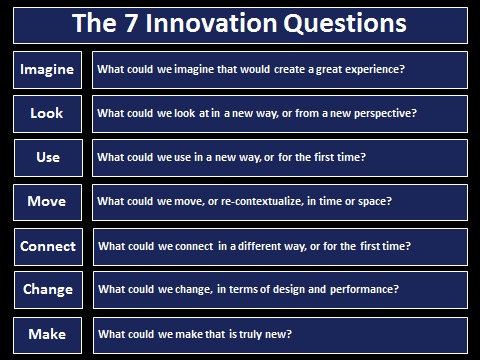
Since Satisfaction is the difference between Expectations and Experience, here are a few expectation-setting observations of my own about what this tool is and is not.

  1. Asking oneself these questions will not ensure good innovation ideas.  After all it is just a process; the quality of the ideas will depend on the people involved.  But it is a way to channel and spur people’s thinking in directions in which they might not normally go.
  2. It is a way to structure a discussion, which can be useful, particularly in groups. It prevents a discussion that is so broad-ranging that nobody builds on or works off each other’s ideas.  It provides focus while keeping each change domain (question area) is still large enough to evoke many different ideas.
  3. It is an aid for coming up with innovative ideas.  It does not claim to address the all-important implementation stage.
  4. It is a checklist to feel comfortable that you have not neglected a significant dimension of potential innovation.  Clearly, it is not a guarantee that you have actually considered all the potential innovations available to your business.

More detailed article by Bill O’Connor on this project and the questions can be found at:  http://www.innovationexcellence.com/blog/2012/01/09/the-innovation-genome-project/

An article by another Autodesk employee whose team came up with a successful innovative product/service using the tool can be found at:  http://www.fastcoexist.com/1679231/the-6-questions-that-lead-to-new-innovations

Retain and Develop Yourself / Your Employees

Inc. Magazine listed “Opportunities for Innovation”  as one of the top 10 things that employees want from job.  Founder Space lists “Feeling in on things” as #2 on the list of what employees say will make them happy at a job.  These facts highlight how important it is to engage all employees in innovation.  This is easy with naturally vocal and confidently creative people, or with those employees to like to start things rather than implement them.  But I’ve found that some of the best innovative ideas have come from very conservative and implementation-focused people once they perceived a commitment to following through on innovation and were given the opportunity to contribute.  A tool like the 7 Questions is a way to encourage and accommodate diverse employee participation in innovation at many levels.

Input Welcome

Would you use this approach?

Do you have better  or complementary approaches that have the same impact?

Share this:

  • Email a link to a friend (Opens in new window) Email
  • Print (Opens in new window) Print
  • Share on Reddit (Opens in new window) Reddit
  • Share on Facebook (Opens in new window) Facebook
  • Share on Tumblr (Opens in new window) Tumblr
  • Share on X (Opens in new window) X
  • Share on Pinterest (Opens in new window) Pinterest
  • Share on LinkedIn (Opens in new window) LinkedIn
Like Loading...
  • Blog at WordPress.com.
  • Subscribe Subscribed
    • AffectiveAction
    • Join 41 other subscribers
    • Already have a WordPress.com account? Log in now.
    • AffectiveAction
    • Subscribe Subscribed
    • Sign up
    • Log in
    • Report this content
    • View site in Reader
    • Manage subscriptions
    • Collapse this bar
 

Loading Comments...
 

    %d