AffectiveAction

Because business has the heart to succeed

Menu

  • Home
  • Blog
  • General Management
  • Marketing
  • People Management
  • Innovation
  • Guest Bloggers
  • About
  • Enter your email address to follow this blog and receive notifications of new posts by email.

  • Recent Posts

    • Renewable Fuel for a Brilliant Life
    • How to Manage Women: Tips #2 and 3
    • How to Manage Women Tip # 1
    • Compassionate Capitalism
    • Stop That Focus Group!
    • To really change people’s behavior: Use the right word.
    • Is This the Coolest Company Ever?
  • Archive

  • Tags

    Affective Action B2B business business model career development career management cause marketing collaborate commercialization Conflict corporate responsibility customer networks demand generation Design Duarte Communications early sales Ecomagination effective communication Empathy employee engagement employee retention GE generative green marketing high performance high touch/low cost hiring HR human resources innovation innovative thinking Institute for the Future investment Jeff Immelt leadership lead generation management managing women market development marketing marketing automation marketing metrics motivation negotiate nurturing prospects outperform passion personalized marketing philanthropy philosophy philosophy and business Presentations product introductions project management project portfolio analysis project selection prospecting regulatory expansion results sales Santa Clara University social-media social entrepreneur social venture Social Venture incubator Strategy sustainability TEDx Presidio the buying process the customer view The Onion time to market time to ramp use case venture program
    • RSS - Posts
    • RSS - Comments
  • Subscribe in a reader

Browsing Tags high performance

Five Change Management Key Success Factors

November 24, 2012 · by Taia Ergueta

Who is NOT trying to make change happen faster? Managers want employees to take up the banner of [fill in the blank: More Innovation? Fewer missed deadlines?].  Employees want managers to take off the blinders and [fill in the blank: Call fewer meetings and reports? Stick to a set of priorities for more than a month?].   Regardless of your change agenda, I think you’ll come up with good change management ideas from this unusual source.

The Source

Unilever is taking sustainability seriously. A recent Triple Pundit article notes, “the company’s target is to halve its carbon footprint by 2020”. Fine, what is impressive is that their carbon footprint calculation includes the carbon usage by consumers of their products. In fact, they estimate that “68 percent of it comes from consumer use of Unilever’s products” and they are tackling the task of getting people to reduce that dramatically. First target:  Getting consumers to reduce food waste. This is a fascinating change management project and I encourage you to read more about it, but something that caught my attention was their use of “Five Levers of Change”. I think they apply regardless of the kind of change you are trying to drive.

Read More →

Share this:

  • Email a link to a friend (Opens in new window) Email
  • Print (Opens in new window) Print
  • Share on Reddit (Opens in new window) Reddit
  • Share on Facebook (Opens in new window) Facebook
  • Share on Tumblr (Opens in new window) Tumblr
  • Share on X (Opens in new window) X
  • Share on Pinterest (Opens in new window) Pinterest
  • Share on LinkedIn (Opens in new window) LinkedIn
Like Loading...

Best Simple Operational Plan– Part 2

October 24, 2012 · by Taia Ergueta

The fun does not stop once the strategy summary is distributed and the initiatives list is complete!  Here is the second and last section of the Taia Ergueta Minimum Pain-Maximum Gain Operating Planning System.

This time the focus is on the last two parts:

  1. One Page Strategy Summary
  2. Operating Plan Initiatives List
  3. Operating Action Plans
  4. One Page Review Template

Step 3:  Operating Action Plans

This is where the functional or project teams lay out what they will actually do.  There will be groaning, but persevere.  Writing it down gives you a prayer of a chance that everyone is mobilized around a scope, a pace, and interim milestones that will actually achieve the desired outcomes.  Without this, it is really easy to go forward with all good intentions, have 3 quarters of highly upbeat review meetings at which actions taken are reported proudly, and then, in the 4th quarter, notice that we are not actually going to produce the results.  Explanations for the gap will abound.  The fact is, if you teams can’t describe at least one way to accomplish the objectives and let everyone see and critique that, your expected results have  a high chance of being road-kill.

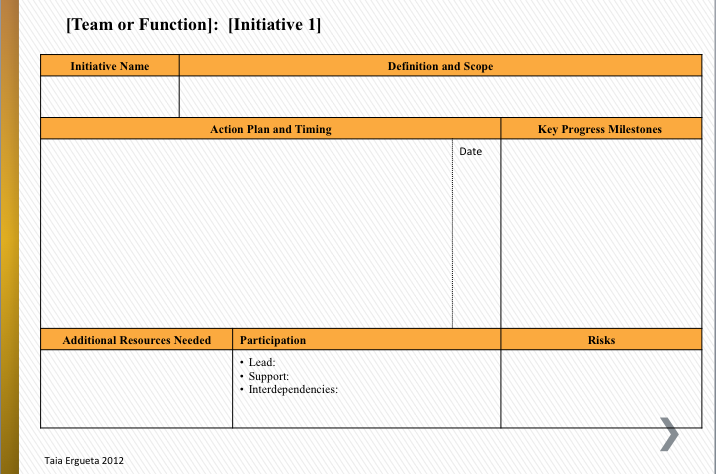
Here is a simple template for the action planning.  Each function or team fills one out for each major initiative.  The dates and milestones associated with the actions are the items that are reviewed at the progress review meetings.

Step 4.  One Page Review Template

That which gets measured gets done.  So you need to monitor the execution.  Quarterly is fine for the whole plan by the whole leadership team.  (Other reviews of key projects should happen with the right set of people as they go along and reach milestones.)  KEY POINT:  The operational plan reviews will be mind-numbing, time-wasting, and pretty much useless if you do not make them Exception-Reporting-based!  By this I mean, talk only about things that are at risk or off-track.  Do not make the reviews a show and tell about what is going fine.  Does this sound harsh?  Employees will actually be more engaged if they see that issues are surfaced and dealt with.  Just remember to be inspirational in the process and not to kill too many messengers.  ( See my other post on how to make all other communications more productive too.)

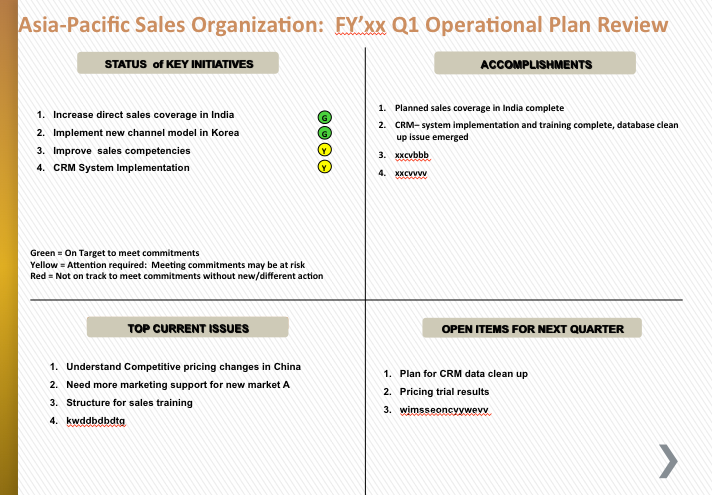
Here is a one page template for reviewing a function, or team operational plan.

The top left quadrant simply shows what is on track or off-track.  The top right gives highlights of what has actually been accomplished.  The bottom left indicates what issues are being addressed.  This should be a rich part of the discussion including troubleshooting what the team is doing to correct the problems, requests for assistance, etc.  The bottom right is a place for the team to note key things that will come up in the next quarter and/or the next review.

That is it.  

Who Benefits?

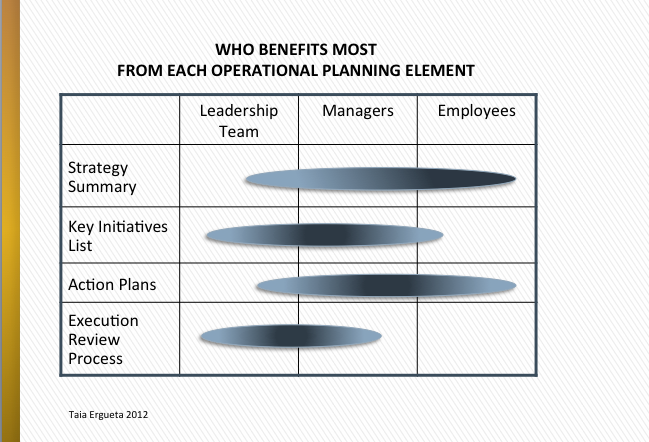
Here is how the 4 parts of the TEMPMGOPS serve different parts of your team.  The darker the shading, the more important the benefit.

Happy planning.

If you would like help with any of this, contact me at http://www.hourandawhiteboard.com

Share this:

  • Email a link to a friend (Opens in new window) Email
  • Print (Opens in new window) Print
  • Share on Reddit (Opens in new window) Reddit
  • Share on Facebook (Opens in new window) Facebook
  • Share on Tumblr (Opens in new window) Tumblr
  • Share on X (Opens in new window) X
  • Share on Pinterest (Opens in new window) Pinterest
  • Share on LinkedIn (Opens in new window) LinkedIn
Like Loading...

Best Simple Operational Planning –Just 4 Slides

October 21, 2012 · by Taia Ergueta

QZBJGG9HWXMN Everyone has a reason to hate operational planning. It takes too long. Worse, it takes all that time to do and is often forgotten. It gets confusing (“Isn’t this more of a strategy than an objective?” Argghhh!). And even when everyone manages to drag themselves through all that, reporting on and reviewing the execution of those plans gets so boring you wish you were the ones being executed.

These problems come to mind now because I am advising a small, but fast-growing company doing its first round of real planning.  The benefits are high. It is worth trying to reduce the costs.  So here it is, the Taia Ergueta Minimum Pain-Maximum Gain Operating Planning System.

The pieces:

  1. One Page Strategy Summary
  2. Operating Plan Initiatives List
  3. Operating Action Plans
  4. One Page Review Template

1. The One Page Strategy Summary

This assumes that you have done the strategy development already. If so, you have a ton of documents with options, analyses, dreams, obfuscations, spider diagrams, and assumption-laden spreadsheets to show for it. Now you just need all of that exquisitely distilled into one page. “Impossible!”, you say? We aren’t exactly talking Shakespeare here; it can be done. And it really has to be done.  Give every employee a single, digestible page that shows what needs to change and by how much and you dramatically increase your chances of accomplishing and exceeding that.

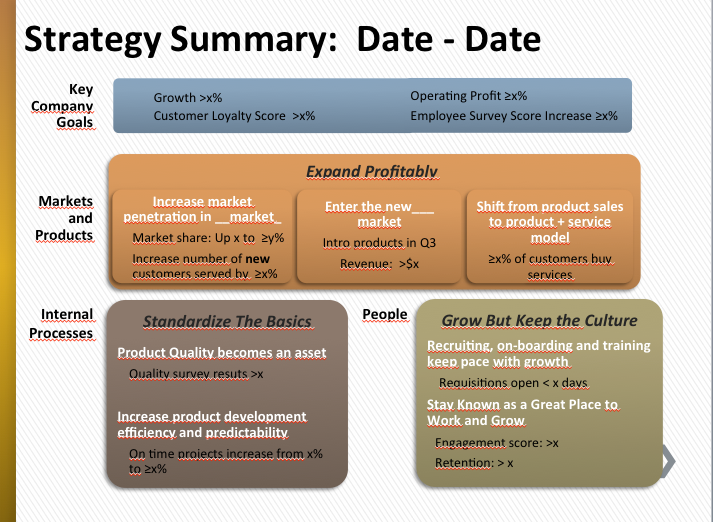
Here is an example of a 1 page strategy summary:

To be clear, it is not just about fitting stuff on one page.  The requirements for an effective one page strategy summary are:

1.  Whole Entity Goals. There should not be more than 6 of these. These should indicate the actual numeric goal that the entity will achieve by the end of the planning period (a year, or half year if you are in the midst of massive change). In this case I have suggested:

    • A growth goal
    • A profit goal
    • A customer satisfaction or loyalty goal, and
    • Some version of an employee satisfaction or engagement goal

2. Strategic Intent Blocks

No more than 5 strategy areas. In the example above I have 4 strategy blocks:

      • Markets and Products
      • Processes
      • Employees/Culture
      • Finance and Admin

Each one has:

      • A description of the key strategic intent. This is a pithy phrase that captures the key CHANGE that you will effect. If there is no change word (“increase” “eliminate”, “accelerate”, etc.), try again.  (Remember, these are not meant to cover everything that the organization will do.  They are the areas which require extra focus and will produce big impacts.)
      • The main tactical initiative areas.  Keep these broad enough and phrased as objectives; let your teams figure out how to accomplish them.  They will be more engaged, develop more, and are likely to do great things you would not have thought of!
      • The very few key metrics — and associated specific goals– that indicate the size of the change needed and that will tell if you accomplished the strategy.  Nota Bene:  Always define the goals as a minimum (i.e., “at least” or “less than”) rather than as a specific value.  Reseach shows that people will just meet a specific goal, but will consistently outperform that when the goal is open-ended.  Go figure.  Now you know how to increase your organizations output by 15% simply by learning how to type “<” and “>”.

2. Operating Plan Initiatives List

Once the strategy is clear, your teams or functional groups can go off and develop action plans. Warning, warning!:  This is where the strategy can get undermined if people pursue all the projects they like and fit the strategic initiatives in edgewise.  Negotiating to a 1-2 page list of all the major initiatives and their owners helps the management team drive focus and make clear trade offs.  You’ll end up with a succinct initiative list for each function or group that contains:

  • Initiatives directly in support of the strategies: These are the highest priority.
  • Initiatives for some ongoing obligations: Some of these are essential and some may need to be examined for potential dropping over time.
  • Other initiatives: If there are a lot of additional initiatives, it is worth checking to see if they are justified and if they can be done without jeopardizing the strategic items.

A simple slide like this can capture the key elements across all the entities involved.

Well, that’s enough for now.  The TEMPMGOPS, like wild boar, is best digested when consumed slowly.  In the next post I’ll give you the final 2 templates.

  • Operating Action Plans
  • Operational Plan Review Template

Cheers!

Inquiries and Comments Welcome.

If you would like help with your planning, contact me by clicking here.

Share this:

  • Email a link to a friend (Opens in new window) Email
  • Print (Opens in new window) Print
  • Share on Reddit (Opens in new window) Reddit
  • Share on Facebook (Opens in new window) Facebook
  • Share on Tumblr (Opens in new window) Tumblr
  • Share on X (Opens in new window) X
  • Share on Pinterest (Opens in new window) Pinterest
  • Share on LinkedIn (Opens in new window) LinkedIn
Like Loading...

Defusing Difficult Conversations

July 10, 2012 · by Taia Ergueta

Second post in the “Thanks A Million” series on great things that I have learned from employees or colleagues.

I was on the Board of Directors of an excellent job training non-profit, JobTrain,some years ago. At one point, the Director, a fellow Board member and I were discussing the need to address a staff member’s performance problem. The Director anticipated that the person might react negatively. My fellow board member was Roy Clay. I already knew how accomplished and respected he is in Silicon Valley (more on Roy below). I then learned how wise he is.

Roy asserted that there would be no problem as a result of addressing the performance matter with the employee. It was a matter or how the message was delivered.  I remember he said:

“ You can say anything to anyone, if you say it with love”.

His words have come to mind countless times since then,  and led me to find better ways to deal with a range of tough situations. It is the epitome of applied Affective Action– combining an understanding of how people feel as well as how they think, to achieve higher outcomes, employee engagement and management effectiveness.

Here are three examples:

1.  Performance management.

I used to hate giving corrective feedback to my employees.  Even though I rarely get headaches, I would always get one on those days. Using Roy’s maxim I changed how I prepared for those discussions.  I still made sure that I could be clear about the issue and what needed to change.  But instead of preparing to deliver unwelcome news I prepared to help the employee increase their success and pride.  An expression of a deficit became an expression of caring.

The results?  Impressive:

    •  The employees left aware and motivated
    •  Our relationship seemed strengthened instead of strained
    • I was left feeling confident that change would happen and … remarkably headache-free before, during and after!

Just a small shift in my own definition of my intent changed the dynamic and outcomes.  Here’s my dissection of why it works:

    • Instead of sensing the manager’s tension, the employee senses goodwill. This puts him/her in a receptive rather than defensive mode.
    • Since the conversation is about enabling them to perform at their potential it is much more likely to be a collaborative dialogue.  This  produces better ideas about how to make progress and leads to more ownership by the employee.
    • For the same reason, it is also a discussion that the employee looks forward to continue having.  This is huge since giving them more feedback over time is much more likely to produce the desired result than a one-time one-way issue dump.

2.  Communicating Budget Decisions.

As General Manager or team manager you frequently have to make tough resource allocation trade-offs.  There are many legitimate needs that affect your people acutely that simply are not as critical as other needs.  The problem is that you need high performance from people on both the winning and losing parts of the budget.  When communicating the funding decisions, you can talk about the fact that fiscal discipline is key, that business is about tough choices, blah, blah, blah. But that does nothing to keep the people on the losing parts of the budget from feeling disaffected.  Heck, it leaves even the budget “winners” feeling like they are part of an under-resourced family.  I found that “saying it with love” works here too but means something different.

    • Communicate Acknowledgement and Empathy.  People will accept a decision if they feel that their need was understood and not just ignored.  And let there be no mistake:  They will assume that you did not understand or consider their need unless you actually express that you do/did.  Remember, parents and managers are always judged to be clueless until proven otherwise.

Even if you show that you know everything about the thing that you are not funding, you may miss a key point:  People want to know that you recognize their “pain” and feel bad about the negative impact they are bearing. Astoundingly, the quarterly “I know you are all working very hard” statement and the “THANKS!” slide aren’t enough.  But if you can mention specific areas that are tight or unavoidably understaffed and how people are making do, you reach hearts, which are far more open than minds.

    • Communicate the Tie to the Shared Underlying Strategy.  Ok, if there is no strategy or if it is not already shared, there is work to be done.  But when you do have one, reiterating it lets people know why the investments are being directed as they are and what the team expects to get “in exchange” for their sacrifice.  People know or can imagine (or hope) that they will benefit if the strategy gets successfully implemented and the whole business does well.

3. Conflict.

Do you have a hypercompetitive colleague? Is another group not collaborating with one of your teams?  Let’s face it, there are endless sources of conflict at work.  I expanded on Roy’s maxim to deal with these. Here is what I advised people to do:

a. Think about what makes your adversary lovable.  I know: this sounds truly weird. But you can’t act ‘with love” if you do not see them as a lovable person. Think now. Somebody must love them; what could have inspired that? Once you identify something, really appreciate that about them–no matter what you think of their other traits.

b. Before meeting with him/her, bring that sense of the person to mind. Once again, this sounds weird. But it works – though perhaps not the way you anticipate. Mentally bestowing your goodwill on them makes you feel powerful and benevolent. Your body language will unavoidably communicate this feeling. More than likely, you will be calmer, more in control and more influential. At best, the other person senses all this and it puts your conversation on a different course and plane. If nothing else, it confuses them. ☺

I have tried to make this practical and a bit humorous because I know that, in the business world, it is easy to dismiss anything involving the word “love” as incompatible with being serious-minded. But it is the most powerful force driving humans, trumping even the drive for self-preservation.  Not harnessing it in business is serious mismanagement.

Input Welcome

– Have you used similar approaches?

– Are there other situations in which you think this works?

FYI: Silicon Valley Engineering Council Bio of Roy Clay

Share this:

  • Email a link to a friend (Opens in new window) Email
  • Print (Opens in new window) Print
  • Share on Reddit (Opens in new window) Reddit
  • Share on Facebook (Opens in new window) Facebook
  • Share on Tumblr (Opens in new window) Tumblr
  • Share on X (Opens in new window) X
  • Share on Pinterest (Opens in new window) Pinterest
  • Share on LinkedIn (Opens in new window) LinkedIn
Like Loading...

How and Why to Optimize Your Relate:Create Ratio

July 2, 2012 · by Taia Ergueta

Can you think of anyone who succeeds by focusing exclusively on the subject matter of his/her work?  Yes, some artists who labor alone do achieve wild posthumous success, but I have yet to meet anyone with that as his/her goal.  Most of us recognize that we have to work with and through others.  This post is about turning that general awareness into a actions that will help your career development and your real results.

Why do it

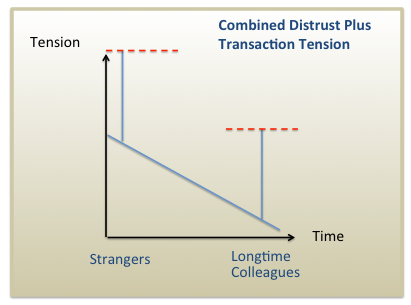
Here is another one of those Keys to Life (see May 28 post) that I have found exceedingly useful since I heard it sometime in the 20th century.  (I would attribute it but I have no idea who was the wise spirit who originated it.)   It is captured in a diagram which describes the potential states of a work relationship.

  1. The horizontal axis is Time. It measures how long the two people have known each other and interacted.
  2. The vertical axis is Tension. It measures the level of relationship Tension coming from two potential sources: Distrust and Transactions.

Distrust. When people first meet they don’t know what to expect from each other. Their level of trust is low. Accordingly the relationship tension is high. Over time, people get to know each other and, unless those interactions abound in deceit and treachery, the level of trust between them tends to increase: Logically, the level of distrust-driven tension goes down.

Transactions. Each time we want something from the other person or vice a versa we engage in a transaction, and each transaction creates some tension. If you have a small easy request to make of the other person, the tension created by that request will be very low. On the other hand, if you have a proposal that imposes a major cost on the other person (e.g., it conflicts with their plans, requires a lot of time or significantly inconveniences them) then the transaction-driven tension level created may be quite high.

So far so good.  Now here is the key:   Put these together and you will see why trying to do a major transaction with someone you barely know is so difficult.  The high distrust-driven tension coupled with the high transaction-driven tension adds up to a vertigo-evoking level of overall tension.  If instead, you attempt the same transaction with someone after you have established a relationship of trust, you have almost half the level of tension to deal with and the likelihood of success soars.

Ok, What To Do?

The take-away is:  Get down that distrust curve as fast as possible with all the key people with whom you need to collaborate or negotiate.  Important:  This is not a cynical tip meant to turn you into Machiavelli!  Groucho Marx said, “Sincerity is everything. If you can fake sincerity, you have it made.”  No, no, no.   We’re talking about effective communication and relationship building:

  • Seeking the person out
  • Listening to them
  • Being helpful when you can
  • Letting them know how you think and what drives you
  • Introducing them to your ideas early
  • Maintaining a dialogue

You get the picture.

Getting down that trust curve takes more time and effort than most of us think it does.  Which brings me back to the title of this post. Most people like to — and think they are paid to — work on the Create side of that ratio; that is where their passion is and they spend as much of their time as possible on it assuming/hoping that that will win the day.  So “Optimizing the Relate:Create ratio” usually requires shifting time spent on the substance behind those transactions to time spent on the relationships that will enable the real results.

You may be able to make that shift naturally just by being more aware of this. The rest of us mere mortals need to take a more structured approach, at least at first:  Picking key people with whom to deepen a relationship and then setting aside time explicitly for that.

As a manager this is a huge area of additional opportunities for creating an affective action culture and a high performance organization: I will cover these in my next post.

Input Welcome

  • Have you changed your Relate: Create ratio profitably?
  • Have you found ways to help your employees do this better?

Share this:

  • Email a link to a friend (Opens in new window) Email
  • Print (Opens in new window) Print
  • Share on Reddit (Opens in new window) Reddit
  • Share on Facebook (Opens in new window) Facebook
  • Share on Tumblr (Opens in new window) Tumblr
  • Share on X (Opens in new window) X
  • Share on Pinterest (Opens in new window) Pinterest
  • Share on LinkedIn (Opens in new window) LinkedIn
Like Loading...

How to Spark Innovative Thinking

June 13, 2012 · by Taia Ergueta

A process for innovative thinking sounds like an oxymoron, I know:   It veers dangerously close to Dilbert territory.  But it is risky to rely on individual brilliant ideas to surface at the right time and pace.  So catalyzing everyone’s informed intuition and creative genius is very worthwhile.  Free-thinkers and confirmed Analyticals alike can find something to like in this approach to coming up with innovations (something that is both new and useful).  Last week I heard Bill O’Connor, Corporate Strategy and Engagement at Autodesk, describe it.

The Core Concept

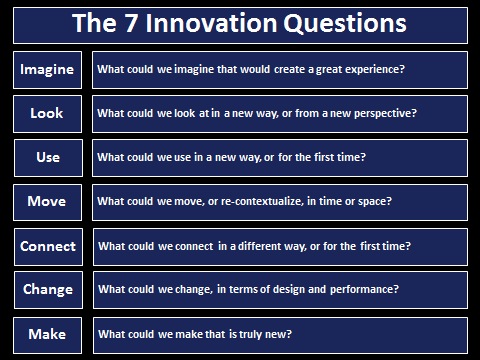
Bill leads the very snappily named “Innovation Genome Project’ which is working on reverse-engineering innovation by examining 1000 significant innovations throughout history.  (A cadre of MBAs may be harmed in the collection of this data, but that is the price of insight.)  They are examining what kind of change from the status quo is involved in each of those innovations:  So far, they have found that 7 kinds of changes account for most of the innovations.  Bill is graciously sharing his insights.  His team turned those 7 kinds of changes into  set of 7 questions that anyone can use to catalyze innovative ideas on any topic.

Since Satisfaction is the difference between Expectations and Experience, here are a few expectation-setting observations of my own about what this tool is and is not.

  1. Asking oneself these questions will not ensure good innovation ideas.  After all it is just a process; the quality of the ideas will depend on the people involved.  But it is a way to channel and spur people’s thinking in directions in which they might not normally go.
  2. It is a way to structure a discussion, which can be useful, particularly in groups. It prevents a discussion that is so broad-ranging that nobody builds on or works off each other’s ideas.  It provides focus while keeping each change domain (question area) is still large enough to evoke many different ideas.
  3. It is an aid for coming up with innovative ideas.  It does not claim to address the all-important implementation stage.
  4. It is a checklist to feel comfortable that you have not neglected a significant dimension of potential innovation.  Clearly, it is not a guarantee that you have actually considered all the potential innovations available to your business.

More detailed article by Bill O’Connor on this project and the questions can be found at:  http://www.innovationexcellence.com/blog/2012/01/09/the-innovation-genome-project/

An article by another Autodesk employee whose team came up with a successful innovative product/service using the tool can be found at:  http://www.fastcoexist.com/1679231/the-6-questions-that-lead-to-new-innovations

Retain and Develop Yourself / Your Employees

Inc. Magazine listed “Opportunities for Innovation”  as one of the top 10 things that employees want from job.  Founder Space lists “Feeling in on things” as #2 on the list of what employees say will make them happy at a job.  These facts highlight how important it is to engage all employees in innovation.  This is easy with naturally vocal and confidently creative people, or with those employees to like to start things rather than implement them.  But I’ve found that some of the best innovative ideas have come from very conservative and implementation-focused people once they perceived a commitment to following through on innovation and were given the opportunity to contribute.  A tool like the 7 Questions is a way to encourage and accommodate diverse employee participation in innovation at many levels.

Input Welcome

Would you use this approach?

Do you have better  or complementary approaches that have the same impact?

Share this:

  • Email a link to a friend (Opens in new window) Email
  • Print (Opens in new window) Print
  • Share on Reddit (Opens in new window) Reddit
  • Share on Facebook (Opens in new window) Facebook
  • Share on Tumblr (Opens in new window) Tumblr
  • Share on X (Opens in new window) X
  • Share on Pinterest (Opens in new window) Pinterest
  • Share on LinkedIn (Opens in new window) LinkedIn
Like Loading...

Ask This at the Outset of Any Initiative

June 8, 2012 · by Taia Ergueta

Preparing to launch an initiative?  Avoid common and costly errors by asking one question at the outset:  Process Task or Talent Task?  This is a simple way to make everyone more confident in the outcome.  I learned this from Peter Drucker and have used it often to troubleshoot how to address a problem.  I thought it would be good to share with you because it is effective and also boosts employee motivation in a subtle but important way.

The  Point

Drucker described that there are some problems/opportunities that can only be addressed by putting together a small team of people with specific talents:  This is a Talent Task.  He noted that there are other problems /opportunities -– usually those that where the answer must be implemented through lots of people at various levels of knowledge – where you need a process:  This is a Process Task.

Ok, this is logical and everyone is probably nodding or even nodding off at this point.  But wait.  The important insight is this:

When you try to solve a Talent Task with a process, or try to solve a Process Task with talent, you fail.  Aspirin is great, but not when what you really need is penicillin.

Example 1:  Strategic planning.  At HP in the 90’s strategic planning was a highly structured and well-documented process.  Each year, massive numbers of large meetings were held to ensure that everyone was involved and bought in to the strategy.  It was the “thundering herd” approach to strategy development.  Huts were leveled, large distances were covered, the process was followed, but the correctness of the end-point was, well, mixed.  Strategy is a Talent Task.  There is a need for information and engagement from many people and solid processes for that should exist.  But the critical framing of the strategic issues, the evaluation of alternatives, and the ultimate application of informed intuition to choose a truly strategic and competitive strategy should be done by a small set of people with those skills and responsibility.  Good strategies do not automatically pop out the end of a process.

Example 2:  Contract Review Team.  My company had decided to offer a new service:  Third party maintenance.  Since it would require new responsibilities in the field, management hired experienced field managers to review and approve contracts before we accepted them.  Soon, there was a bottleneck of contracts pending approval.  Why? The processes for delivering the new services were incomplete and there was no established way of building them, so the contract reviewers were not approving any for delivery.  The Talent applied was necessary but not sufficient.  The real problem was a Process Task:  Establish a process for building balanced sales and delivery capabilities to serve an increasing number of attractive contracts.

Watch for It

Once you start thinking in these terms you see the mismatches around you.  How many times have you seen a big, systemic problem addressed by the naming of one person who “will focus on it”?  One feels of them.  How many times have you seen a recurring problem tackled by successive internal task forces that clearly could use (or be replaced by) an injection of talent — someone who is a real expert on the matter?  As a colleague, Tom Redder, used to say “You don’t get wisdom by pooling ignorance”.

Which gets me to the Affective Action part of this.  I’ve noticed that employees intuitively understand this Talent Task vs. Process Task difference.  They are demoralized when opportunities and issues are not addressed with the right approach.  Their own careers or products and in the balance.  For this reason, employees buy in more readily and whole-heartedly if they see the right approach being used even if it means that they are not as directly involved.

Input Welcome

Are there other examples of cases where you have seen the Talent approach is better, but Process used – or vice a versa?

Share this:

  • Email a link to a friend (Opens in new window) Email
  • Print (Opens in new window) Print
  • Share on Reddit (Opens in new window) Reddit
  • Share on Facebook (Opens in new window) Facebook
  • Share on Tumblr (Opens in new window) Tumblr
  • Share on X (Opens in new window) X
  • Share on Pinterest (Opens in new window) Pinterest
  • Share on LinkedIn (Opens in new window) LinkedIn
Like Loading...

How (and Why) to Describe “Potential”

June 3, 2012 · by Taia Ergueta

Who advances in the business world often depends on management’s assessment of people’s “potential”.  But what constitutes potential is often not clearly described.  As a result, employees can’t work on it and managers can’t be consistent in their assessment of it.

The Cost

Managers often feel embarrassed about not being able to describe this rather intangible trait, so they act as if it is not a real evaluation criterion.  As a result, work is a game with rules that are posted and other rules that the judges actually use.  Very capable people can end up puzzled, pointing to their 100%-met hard metrics as others sail by them into higher positions based on this unspoken evaluation factor, potential.  Valuable people sometimes leave, seeking a company where the rules are clearer.  Others stay, but commit less to a system that does not seem to work for them.

The Upside

Getting specific about Potential and helping people to envision and become their best, highest potential selves is inspirational.  Just talking about it with employees is an affective action that is appreciated.  And just talking about it with specifics puts people in an energized and more confident state of mind.  People relax and outperform when the advancement criteria are real and understood.

A Tool

Here is a tool that I have refined over the years.  It is a list of Indicators of Individual Potential for exceptional contribution and for continued growth.

  • Personally develops valuable new proposals and ideas
  • Inclination and ability to interact effectively with the world outside of the Company
  • Generative: Sees next steps. Anticipates. Makes more out of things than others. 
  • Track record of Personal development & growth — eager to learn/grow
  • Proven to be able and willing to take on new roles
  • Demonstrated leadership of peers. Commands respect in the organization. Influential.
  • Able to mobilize an organization/team to effect change
  • Explicitly seeks out development opportunities: Actively learns from each experience
  • Takes initiative to perform beyond current task/job responsibilities
  • Willingly takes on greater responsibilities & broader assignments
  • Demonstrates creativity/initiative in problem solving, flexible, develops new approaches
  • Takes multiple perspectives. Is open. Is constructive
  • Sensitive to organizational dynamics required to get things done
  • Able to assess global, big-picture issues
  • Actively seeks opportunities to learn about industries, markets, technologies and trends relevant to the company
  • Able to work effectively across functions & organizational boundaries
  • Strong in many transferable skills (transferrable across roles or functions)
  • Clear adherence to a set of personal values
  • Proven track record of results
  • Demonstrates passion for the business.

For Employees

You do not have to exhibit all of these traits!  Here is my suggestion for how to sort this list and use it practically

1.  Identify which of these are most important.

I have marked the ones that I think are most universally important in green.  But I am not writing your evaluations.  (Too bad, because I am beginning to realize that you have unlimited potential!)  Find out which ones are most important to the people who are evaluating you and are in a position to propose you for rewards and promotions.  Use this list and ask them to pick their top criteria.  It is a great conversation to initiate since it is a high-potential act in itself:  You are showing ambition and dedication to growth, and you are contributing to the management toolset.  You are giving a professional gift while getting info that is critical to fueling your meteoric rise.

2.  Identify which of these  require your attention.

 If one of the indicators in green or one of the indicators that your managers have picked as very important is a real strength of yours, then develop at least 10 things you can do to make that strength have bigger impact on the business.  Read that again.  Notice that you start with your strengths, not your weaknesses.  I heard Peter Druker speak once – an intense experience — and he said that he managed his executives so that their strengths were so blinding that their weaknesses did not matter.  You could do a lot worse than adopting his management style for yourself.  The key is that those strengths will always be your strengths and consequently that is how you can make the biggest contributions.  Make sure you use your strengths fully instead of trying to do everything as well.

That being said, if one of the high important traits is an area of true weakness for you, then by all means develop a list of at least ten things that you can do to improve your performance and reputation in that area.  While that trait may never become what you are known for, you can make sure that that is not a big liability either.

Finally, you may already have these desired traits, but they may not be visible to the people that matter.  That is just like not having the trait.  No whining: Justice always needs your help.  As distasteful as it may seem to you, make a list of at least 10 things you could do to make your virtue visible.  Most of them should be things that you do as an ongoing part of your job.  A meeting with your boss that lays out your relevant past actions and accomplishments will be valuable ( See the May 6 post, “Thanks a Million, Kumar”), but you have to develop the skill of monitoring and managing your visibility on an ongoing basis.

To be sure that you are on the mark about your strengths and weaknesses, and also about how visible they are, you need input. Ask bosses, colleagues and friends.

3.  Implement at least 3 of the actions you came up with for a chosen indicator conscientiously for 4 months.  Look at them every week and assess whether you really did more of whatever you chose that week.   Re-up after 4 months or pick something new if you feel you have established desired habits around your first chosen indicator.

For Managers

Possible ways to use this list:

  • Edit it to show your priorities.
  • Share the list with your teams (edited or not).  It is a quick way to show support for their development.
  • Use this list at evaluation time to help you pinpoint and communicate specific behaviors to compliment or to suggest.

Input Welcome:

What do you think is the most important indicator of potential?

Do you have other behaviors that you look for when evaluating potential?

Share this:

  • Email a link to a friend (Opens in new window) Email
  • Print (Opens in new window) Print
  • Share on Reddit (Opens in new window) Reddit
  • Share on Facebook (Opens in new window) Facebook
  • Share on Tumblr (Opens in new window) Tumblr
  • Share on X (Opens in new window) X
  • Share on Pinterest (Opens in new window) Pinterest
  • Share on LinkedIn (Opens in new window) LinkedIn
Like Loading...

This Could Become Your Favorite Rule to Live By

May 28, 2012 · by Taia Ergueta

If you had to choose two key rules to live by and a classic movie star to have on a desert island with you, what/who would you choose?

May I suggest the Golden Rule, this one, and William Holden?  Regardless of what island, company or planet you inhabit, this post will help you change that world for the better.

The Core Idea

There are 4 “modes” of communication. Whenever we communicate we are doing so in one or more of the following :

    • The mode of Complaint
    • The mode of Information
    • The mode of Creation
    • The mode of Inspiration

Each has a different impact. If you learn those impacts and apply each mode correctly you can exceed your objectives dramatically with much less effort.

The Impact and Application of the Four Modes of Communication

1.  The mode of Complaint

      • Examples of things we communicate when using this Mode:  Our problems. Others’ failings. Past errors.
      • Impact:  Drains energy from the person communicating as well as his/her audience
      • Recommended Use:  None.  Avoid this like trans fats. Stop it when you see it.

2.  The mode of Information

      • Examples of things we communicate when using this Mode:  What we have done.  How we have done it.  Data.  Methodology.  Process.  Background.
      • Impact:  Provides valuable inputs but, on its own, doesn’t change anything
      • Recommended Use:   Do this off-line whenever possible. Summarize.  Do exception reporting. Draw or propose implications.

3.  The mode of Creation

      • Examples of things we communicate when using this Mode:  Joint problem-solving.  Options.  Evaluations.  Advocacy. Joint decision-making.
      • Impact:  Most productive mode because something is going to change as a result of the communication.
      • Recommended Use:  This is the mode in which you want to be as much of the time as possible, especially in meetings, because this is the mode that moves things forward.

4. The mode of Inspiration

      • Examples of things we communicate when using this Mode:  Big Goals.  Emotions/Passion.  Aspects of a desired future result.  Expressed confidence in ability to reach it.  Confidence in or admiration for people involved.
      • Impact: Expands people’s sense of the Possibilities. It leads to more than the expected happening.
      • Recommended Use: Build some element of this into all communications.

Putting it to Work

I’ve read and forgotten a boatload of teamwork/management stuff over the years and, in contrast, this 4 part communication rule has stayed with me.  It is the pasta of this space — easy, flexible and always hits the spot.  Here are a few application insights:

  • Moving information exchange out of meetings (e.g. shared electronically beforehand) ensures that scarce meeting time is used for the really productive modes of creation and inspiration.
  • Eliminating Complaint does not mean burying problems.  Anything that can be said in the mode of Complaint can be said in the mode of Creation:  Once you tune into that it is easy to make the shift without losing valuable candor and awareness of the issues.
  • When I first heard all this, the mode of Inspiration examples were President Kennedy’s Man on the Moon speech and Martin Luther King’s “I Have a Dream” speech.  This left me feeling that the mode of Inspiration was for monumental events and great orators, not for me.  But with more thought I realized that things such as expressing confidence in a colleague, team or employee, or reiterating the value of our goal provide inspiration.  And these things can be built into every communication.
  • I have occasionally shared this model with teams when a project is kicking off.  It seems to resonate and sets some efficient norms up front.

Input Welcome:  Do you think this model is useful?  Do you have other ideas for how to apply or improve on it?

Attribution: If I knew who originally came up with this modeI I would give full credit and send many accolades!  I was exposed to this at a company-wide management course at Agilent. Please write in if you know the source.

Share this:

  • Email a link to a friend (Opens in new window) Email
  • Print (Opens in new window) Print
  • Share on Reddit (Opens in new window) Reddit
  • Share on Facebook (Opens in new window) Facebook
  • Share on Tumblr (Opens in new window) Tumblr
  • Share on X (Opens in new window) X
  • Share on Pinterest (Opens in new window) Pinterest
  • Share on LinkedIn (Opens in new window) LinkedIn
Like Loading...

Artists & Activists

April 26, 2012 · by Taia Ergueta

Image: africa / FreeDigitalPhotos.net

View this document on Scribd

Share this:

  • Email a link to a friend (Opens in new window) Email
  • Print (Opens in new window) Print
  • Share on Reddit (Opens in new window) Reddit
  • Share on Facebook (Opens in new window) Facebook
  • Share on Tumblr (Opens in new window) Tumblr
  • Share on X (Opens in new window) X
  • Share on Pinterest (Opens in new window) Pinterest
  • Share on LinkedIn (Opens in new window) LinkedIn
Like Loading...
Page 1 of 2 1 2 Next »
  • Blog at WordPress.com.
  • Subscribe Subscribed
    • AffectiveAction
    • Join 41 other subscribers
    • Already have a WordPress.com account? Log in now.
    • AffectiveAction
    • Subscribe Subscribed
    • Sign up
    • Log in
    • Report this content
    • View site in Reader
    • Manage subscriptions
    • Collapse this bar
 

Loading Comments...
 

    %d