AffectiveAction

Because business has the heart to succeed

Menu

  • Home
  • Blog
  • General Management
  • Marketing
  • People Management
  • Innovation
  • Guest Bloggers
  • About
  • Enter your email address to follow this blog and receive notifications of new posts by email.

  • Recent Posts

    • Renewable Fuel for a Brilliant Life
    • How to Manage Women: Tips #2 and 3
    • How to Manage Women Tip # 1
    • Compassionate Capitalism
    • Stop That Focus Group!
    • To really change people’s behavior: Use the right word.
    • Is This the Coolest Company Ever?
  • Archive

  • Tags

    Affective Action B2B business business model career development career management cause marketing collaborate commercialization Conflict corporate responsibility customer networks demand generation Design Duarte Communications early sales Ecomagination effective communication Empathy employee engagement employee retention GE generative green marketing high performance high touch/low cost hiring HR human resources innovation innovative thinking Institute for the Future investment Jeff Immelt leadership lead generation management managing women market development marketing marketing automation marketing metrics motivation negotiate nurturing prospects outperform passion personalized marketing philanthropy philosophy philosophy and business Presentations product introductions project management project portfolio analysis project selection prospecting regulatory expansion results sales Santa Clara University social-media social entrepreneur social venture Social Venture incubator Strategy sustainability TEDx Presidio the buying process the customer view The Onion time to market time to ramp use case venture program
    • RSS - Posts
    • RSS - Comments
  • Subscribe in a reader

Browsing Tags innovation

To really change people’s behavior: Use the right word.

December 16, 2012 · by Taia Ergueta

geese flying 72 dpiYou are only leading if they are following — i.e., acting on your ideas.  Here is a surprising and extremely simple way to dramatically increase the actual behavior changes you effect.

In a study described in the Stanford University Center for Social Innovation, all  the people involved were asked to  perform the same task but some were told it would be impossible for the researchers to know “whether you are cheating,” while others were told it would be impossible to know “whether you’re a cheater”.  The first  group (who got the instructions referencing “cheating”) cheated far more than the latter  group ( who got the instructions referencing being a “cheater”).  Similarly, in the recent election season, appeals to citizens to “be a voter” had much more impact on behavior than did exhortations to “vote”.

The choice of wording makes all the difference in the resulting behavior!

woman shades hero sizeWhat these examples indicate:  We act on self-image.  In other words we all want to have a positive identity.  If you paint people a picture of a undesirable self, they are likely to stop doing the negative action as associated with it.  Similarly,  if you paint them a positive image of a person, they are likely to adopt the positive behaviors associated with that image.  In contrast, people are much less likely to change their behavior if you just describe the behavior in question.

Apply This Finding to be Help People be Fantastic 

When trying to influence a change in behavior, describe an identity (nouns), not actions (verbs).  For example:

  • Speak to people about “being an innovator”, not about innovating.
  • Remind someone preparing an important presentation to “be an inspirational speaker”, not to speak inspirationally.
  • Set a ground rule that everyone on a team will “be a punctual member”, not that everyone should be on time.
  • Tell yourself that today you will be “a paragon of focus”, not that you’ll really try to not be an email-slave

A Corollary

For many years I have used a related approach.  There’s no Stanford study behind this one, but here it is anyway:  I find that if you treat people as if they were their best selves, they shift their behavior more in that direction.   (As you can imagine, this definitely does not work on sociopaths.  Consequently,  it is a pretty good sociopath diagnostic.)

Have a great day.  And remember:  Be an Influencer!

Click here for the Article from the Center on Social Innovation.

Click here for the abstract of the actual “cheating/cheater” study.

Share this:

  • Email a link to a friend (Opens in new window) Email
  • Print (Opens in new window) Print
  • Share on Reddit (Opens in new window) Reddit
  • Share on Facebook (Opens in new window) Facebook
  • Share on Tumblr (Opens in new window) Tumblr
  • Share on X (Opens in new window) X
  • Share on Pinterest (Opens in new window) Pinterest
  • Share on LinkedIn (Opens in new window) LinkedIn
Like Loading...

Hewlett Packard

December 2, 2012 · by Taia Ergueta

greenhouse150cropThe nth self-inflicted injury (Autonomy) flings Hewlett-Packard into recovery mode once again.  I feel pained each time one of these poor decisions comes to light and takes its toll.  I loved that company.  You would have loved it too.  It was not just another business entity, it was one of the great institutions of Western Civilization.  David Packard and Bill Hewlett created a management system that was absolutely the best system for turning human capital into societal contribution.  Part of the evidence of this is that that system worked worldwide and across industries.

I speak of Hewlett Packard in the past tense not because I think they are doomed but because the company that now bears the name is a completely different company from the one I knew. I left HP in 1999 to join the spin-off, Agilent Technologies.  So I don’t pretend to know anything about the current situation there.  But I do know that the original HP’s formula for greatness is too important to allow it to be discredited by association with the current mess and too valuable to be forgotten.  There is so much to share with you about the very accessible magic of the HP that grew at a compounded annual growth rate (CAGR) of 23% for over 50 years. Today I think I will just share a story  and a summary description of the magic.

When I Realized Something Was Very Wrong

In the mid 1990’s the late Lew Platt was CEO of HP.  He and his CFO understandably worried that it would be increasingly difficult for HP to keep up the phenomenal record of 23% CAGR from 1942 to 1995.  In 1995 the company reached $31.5 B in annual revenues.  To grow even 15% in a year meant that the company would need to find $4.7B in new revenue.  So they asked the Corporate Development group to identify strategies that other companies had used to created growth.  I got the assignment.  It was a great project.  Since the General Managers of the businesses units were already thinking continuously about how to grow those existing businesses, I put particular emphasis on how companies got into new businesses.

I presented the findings to the executive team.  There was good discussion and questions.  Close to the end, one executive spoke assertively, saying in essence:  “This is all very interesting, but things are going pretty well.  Things have gone pretty well for us without doing any of those things, so maybe that means that we don’t need to do them.”  Though stated as a hypothesis, it was a conclusion.  The interesting thing is that he was wrong on two counts:

  1. First:  The company HAD done those things. Bill (Hewlett) and Dave (Packard) were intuitively new venture investors. The entered new businesses when the company did not NEED to do so.  They went into countries (like China in ) when  there was “no” market there yet.
  2. Second:  Financially things were going fine but that cadre of professional managers were focused on being careful stewards of their large businesses, not on creating high value new businesses. This paucity of internally generated growth encouraged later CEOs to plunge into a series of unfortunate acquisitions.

What Was Astoundingly Right Before So Much Went Wrong

I share this with you now because notwithstanding the many mistakes of the current HP, the important message of this post is that the key success factors of the original HP apply today.  Here is my summary of the HP success formula:

  • Beakers 4_3Products that made a big unique contribution
  • A system that built and unlocked human potential better than any other
  • Executives that used informed intuition to make bold moves that they then made successful
  • A commitment to customer success
  • Financial discipline

This formula does not seem to have been applied at the company with the HP name for some time but none of us should make the same mistake.

The original HP version of those elements create virtuous cycles of high expectation and high performance.  Those cycles, in turn create their own fuel of profit and goodwill.

More specifics on this in future posts.

For a personal discussion of how to apply the HP formula contact me.

Share this:

  • Email a link to a friend (Opens in new window) Email
  • Print (Opens in new window) Print
  • Share on Reddit (Opens in new window) Reddit
  • Share on Facebook (Opens in new window) Facebook
  • Share on Tumblr (Opens in new window) Tumblr
  • Share on X (Opens in new window) X
  • Share on Pinterest (Opens in new window) Pinterest
  • Share on LinkedIn (Opens in new window) LinkedIn
Like Loading...

Five Change Management Key Success Factors

November 24, 2012 · by Taia Ergueta

Who is NOT trying to make change happen faster? Managers want employees to take up the banner of [fill in the blank: More Innovation? Fewer missed deadlines?].  Employees want managers to take off the blinders and [fill in the blank: Call fewer meetings and reports? Stick to a set of priorities for more than a month?].   Regardless of your change agenda, I think you’ll come up with good change management ideas from this unusual source.

The Source

Unilever is taking sustainability seriously. A recent Triple Pundit article notes, “the company’s target is to halve its carbon footprint by 2020”. Fine, what is impressive is that their carbon footprint calculation includes the carbon usage by consumers of their products. In fact, they estimate that “68 percent of it comes from consumer use of Unilever’s products” and they are tackling the task of getting people to reduce that dramatically. First target:  Getting consumers to reduce food waste. This is a fascinating change management project and I encourage you to read more about it, but something that caught my attention was their use of “Five Levers of Change”. I think they apply regardless of the kind of change you are trying to drive.

Read More →

Share this:

  • Email a link to a friend (Opens in new window) Email
  • Print (Opens in new window) Print
  • Share on Reddit (Opens in new window) Reddit
  • Share on Facebook (Opens in new window) Facebook
  • Share on Tumblr (Opens in new window) Tumblr
  • Share on X (Opens in new window) X
  • Share on Pinterest (Opens in new window) Pinterest
  • Share on LinkedIn (Opens in new window) LinkedIn
Like Loading...

Fast Company on Big Ideas

November 17, 2012 · by Taia Ergueta

In the November issue of Fast Company you’ll find “Why, with so many businesses thinking small, the World Needs Big Ideas”.  I love big ideas and, as a manager, often saw proof of the Goethe quote:

“Dream no small dreams for they have no power to move the hearts of men.”

Big idea projects also raise fascinating challenges for entrepreneurs and business people.

First, a few examples of inspiring Big Ideas sited in the Fast Company article:

  • Sage Bionetworks:   Accelerate biomedical discoveries by creating a system for open sourcing biomedical research data — thereby giving researchers access to thousands of times more data than they could collect on their own.
  • Waste Enterprisers: Turning human waste in to biofuel, solving huge widespread cost, environmental, time and dignity issues.
  • Terrapower: Unlimited safe energy from depleted uranium.

Read More →

Share this:

  • Email a link to a friend (Opens in new window) Email
  • Print (Opens in new window) Print
  • Share on Reddit (Opens in new window) Reddit
  • Share on Facebook (Opens in new window) Facebook
  • Share on Tumblr (Opens in new window) Tumblr
  • Share on X (Opens in new window) X
  • Share on Pinterest (Opens in new window) Pinterest
  • Share on LinkedIn (Opens in new window) LinkedIn
Like Loading...

Getting Great Customer Feedback on a New Technology

October 10, 2012 · by Taia Ergueta

You’ve got very cool new technology that thousands of labs will love. The product is ready. Rev up the Introduction Machine and sell, right? Senova Systems, a company for which I am consulting, is taking a different approach. Just before the full launch they have launched an Early Access Program. I thought you would find the concept and their decisions useful.

Senova has a developed a revolutionary new technology for measuring pH that takes time, risk, aggravation and cost and out of doing this very common measurement. (For more on this see their site: SenovaSystems.com)  Their first product is a handheld pH scanner called the “pHit scanner”, They have been testing the product internally all along and further testing is part of the manufacturing scale up and beta sites. But instead of launching it immediately in to the broad market, they are taking the time to do an Early Access Program (EAP).

 Why an EAP?

The CEO, Lee Leonard,  is a serial entrepreneur. He knows that his market comprises highly diverse applications and that there is no way for his team to test the product in all the ways that customers will use it.  He also knows that as great as the technology may be,  the user experience is just as important.  To ensure that they launch with the kind of confidence that only comes from deep customer knowledge, he is taking the time to do the Early Access Program.

How Many Customers to Involve

I have been involved with Early Access Programs before. An Early Access Program can take various forms. It can involve a small number of customers early in the development program, getting their input at critical junctures in the process. It can simply be a way of ensuring key customers that they will have the first units. In this case, Senova’s key objectives are to understand customer use cases thoroughly and to find any unknown corner case situations that stress some aspect of the product. For these purposes, the EAP will include a large (50) but selected set of customers. By selected, I mean that they will have customers apply and will choose a set that represents the broad range of applications that use pH measurement.

Nuts and Bolts: The Terms

Here are the 2 key parts of an EAP and the example of how Senova chose to accomplish them:

  • Incentive:  Just getting the chance to be among the first in their company or field to get their hands on a pHit is a big incentive for some customers to participate. But to ensure that the participants are real customers (not just curious technology aficionados), the Senova program is structured as a discounted Try and Buy: Each customer selected to be an Early Access Program participant, gets to purchase a pHit scanner at a 50% discount on the retail price of $1,650.00. (To give time for the “Try”, EAP customers won’t be billed until 30 days after delivery). These customers also get a money-back guarantee; if they are not fully satisfied with the scanner, they simply return it.

In addition, participating organizations will be publicly acknowledged as key influencers. (Customers can opt out of this if they prefer anonymity.)

  • Required Input From the Customer:  You need to be very specific about what you expect from customers in an EAP. It is common for customers to be eager to participate and then get too busy to do their part ( use the product, write an app note, or whatever else you have asked of them).

In return for the above, Senova asks its EAP customers to commit to the following:

    • Use the product under their normal laboratory conditions for 30 days.
    • Provide Senova with feedback on the user experience and technical performance through structured conversations and documents.

If you want a more complete example of how to describe or document such a  program, click here to see the Senova description and FAQs.

How to Choose the Customers

If you want participation during product development, you cannot afford to involve too many customers, so pick just a few from the most important target market(s). Your closest customers may not be the best participants.  For example don’t involve the most demanding customers if you want a minimum viable product market entry.  The intent is toto make sure you are meeting the target market’s needs solidly.

If you want to give some customers the first units either to establish key influencers or simply as reward or for their ego gratification, then your top customer list will drive the number involved.

If, like Senova, you want to experience a diversity of application areas deeply,  involve enough customers to  get a good sample of the full range. For example, Senova is taking applications from interested parties and will choose 50 customers that cover as broad a set of use scenarios as possible.

Bottom Line

Yes, conducting an EAP will require significant effort and attention. You may even postpone some revenue. But it is an investment in customer insight that will yield extremely high returns.

The rewards:

  • Additional product testing that can validate yours or find weaknesses early, when they are least costly to fix.
  • Develop close relationships with participating customers, leading to ongoing customer insight, potential influencing of other customers and maybe even longer term loyalty!
  • Usage information that can reveal additional needs, opportunities to improve design and user experience, opportunities to integrate activities or products that are upstream or downstream from your current product.
  • Service and self-service content.
  • Faster time-to-ramp based on more effective commercialization and sales efforts.
  • A more engaged internal team that gains the confidence and inspiration that only comes from close customer exposure.

Input Welcome

Have you done Early Access Programs?  If so, what has been your positive or negative experience with them.  If you want assistance with an EAP contact me by clicking here.

Share this:

  • Email a link to a friend (Opens in new window) Email
  • Print (Opens in new window) Print
  • Share on Reddit (Opens in new window) Reddit
  • Share on Facebook (Opens in new window) Facebook
  • Share on Tumblr (Opens in new window) Tumblr
  • Share on X (Opens in new window) X
  • Share on Pinterest (Opens in new window) Pinterest
  • Share on LinkedIn (Opens in new window) LinkedIn
Like Loading...

What is Capitalism? The answer is changing.

September 12, 2012 · by Taia Ergueta

I attended the TEDx Presidio, where the real question that speakers illuminated was:  What is capitalism becoming?  The theme was Reinventing Capitalism.  I have posted before about social ventures, which form one broad new sector (See here).   Here are some additional ideas from TEDx that you may find interesting and useful as you think about how to evolve your business model.  You are thinking about that, aren’t you?

1.  Share Economy

Speaker:  Van Jones, Founder and President of Rebuild the Dream

Van noted that changes in capital are coming from the bottom up.  That has been the source of the new Share Economy—spurred by tight budgets and also by enjoyment (“Sharing:  If you have to do it, it sucks.  If you get to share, then it feels good.”).  Examples:

  • Sharable cars, sofas, equipment
  • Crowdsourcing
  • Kiva, Kickstart

He noted that some of these are trendy “lifestyle” ventures and that as the trend matures it needs to increasingly tie in and serve people with very real needs.

This may seem remote from your business. You may even think that it would be foolish to encourage shared use of your product.  But what if a research center could afford a massive investment in scientific instruments by starting a service business for other departments or institutions?  It is twist on the shared economy that has worked well around the world.  There are probably others. Read More →

Share this:

  • Email a link to a friend (Opens in new window) Email
  • Print (Opens in new window) Print
  • Share on Reddit (Opens in new window) Reddit
  • Share on Facebook (Opens in new window) Facebook
  • Share on Tumblr (Opens in new window) Tumblr
  • Share on X (Opens in new window) X
  • Share on Pinterest (Opens in new window) Pinterest
  • Share on LinkedIn (Opens in new window) LinkedIn
Like Loading...

Saving Customers Time Will Build Your Business

August 22, 2012 · by Taia Ergueta

The humor newspaper The Onion ran this front page headline: “Things Taking Entirely Too Long”. The accompanying photo showed a man staring at a microwave oven. Two minutes is the new Eternity.  People will put up with government gridlock, romantic betrayal and even cucumbers being put in their drinking water, but they will simply not tolerate having their time wasted. This all points to the big opportunity to distinguish yourself by saving your customers time.

The post “How to Spark Innovative Thinking” talked about many innovation directions.  Saving customers time is an exceptionally rich innovation strategy. Not only do customers value it but your sales people will love having a quantifiable personal benefit to offer. Have you thought of how you can do this? Here is a three-step process for finding the most innovative and profitable ideas.

Read More →

Share this:

  • Email a link to a friend (Opens in new window) Email
  • Print (Opens in new window) Print
  • Share on Reddit (Opens in new window) Reddit
  • Share on Facebook (Opens in new window) Facebook
  • Share on Tumblr (Opens in new window) Tumblr
  • Share on X (Opens in new window) X
  • Share on Pinterest (Opens in new window) Pinterest
  • Share on LinkedIn (Opens in new window) LinkedIn
Like Loading...

Winning Big Through Sustainability

August 12, 2012 · by Taia Ergueta

Opportunities Revealed

In the business world, “Sustainability” started out as Lunatic Fringe talk, then moved up to window-dressing for Corporate Responsibility sections of Annual Reports and subsequently got a new and sometimes tawdry life as a Green Marketing opportunity.  Now, setting a company’s sustainability agenda is one of the most important and valuable things that its executives must do.  And people at all levels can find great innovation ideas in sustainability.

Serious Business

I attended the Sustainable Brands conference in 2007 and it was a hive of excitement over the power of Green Marketing and adulation of cool campaigns and programs.  Just two years later, the same conference was astoundingly different:  It had become clear that both the issues and opportunities are much more fundamental and addressing them is no longer a matter of choice, it is an imperative.  Energy and water will be scarce and more expensive for everyone.  In addition, a combination of consumer awareness and regulatory expansion are making transparency – a lot of reporting of your sustainability practices – mandatory.   You can deal with these as burdens or you can try to find ways to create advantages for your company.  In addition to creating new obligations, these and related challenges are creating major opportunities for growth and effectiveness.

What to do? Read More →

Share this:

  • Email a link to a friend (Opens in new window) Email
  • Print (Opens in new window) Print
  • Share on Reddit (Opens in new window) Reddit
  • Share on Facebook (Opens in new window) Facebook
  • Share on Tumblr (Opens in new window) Tumblr
  • Share on X (Opens in new window) X
  • Share on Pinterest (Opens in new window) Pinterest
  • Share on LinkedIn (Opens in new window) LinkedIn
Like Loading...

Is Your Plan Bold Enough to be Safe?

June 24, 2012 · by Taia Ergueta

Careers and companies rise and fall based on being right about how much innovation to take on at any given time.  Reach too far and you risk ridicule, delays in time to market, and slow market development.  Not surprisingly, it often seemed safer to stick to the middle ground:  Investments in product enhancements or business extension for which there is strong supporting data.  But today, you shun the lunatic fringe at your own peril.  A small leap may not put you on firm ground.

 (The view straight down from High Bridge over Eagle Creek in the Columbia River Gorge)

A Case and Lessons Learned

I recently attended an EMBS talk on the latest scanning, parametrics, and 3-D printing developments.  The speaker was Scott Summit.  His company, Bespoke Innovations makes functionally and esthetically personalized prosthetic leg coverings.  For the coverings to achieve their first objective – restoring visual symmetry to the wearer’s body – they need an accurate digital scan of the person’s body.  What he recounted about the recent history of body scanning technology is a warning to all of us in any industry:

  • Approximately 3 years ago, to get a body scan he needed to take the customer to a lab that had a 1M machine and would provide scans at $800/scan.
  • Shortly thereafter, there were hand-held devices that cost $40,000 to $60,000 a piece and were very tricky to use.
  • Scott’s company developed their own scanner but it was soon overtaken in price/performance by…
  • A scanner that Microsoft developed. Shortly after that product became available…
  • Autodesk announced that anyone could download their 123D Catch software product for free. This enables anyone with a digital camera to take photos that the software then stitches together to create a 3-D model. For free.

Just hearing about this drop — from $1M to $0 in approximately 3 years —  is dizzying.  Can you imagine how each of those obviated product providers felt?  There are Five Stages of Grief, and I have seen Four Stages of Losing this kind of competitive fight:

  1. Denial:  “It’s a much less powerful product. “ “We only see them in Germany.”  “Our customers will never accept that.”
  2. More Enhancement:  “We will have better [fill in the blank: Specs? Bathrooms? You Tube videos?]”
  3. Capitulation:  “We have other more strategic businesses on which to focus”
  4. Rationalization:  “Sheila never invested enough in it.”  “Joe wasn’t the right person to lead it.”

The lessons that people take away from competitive failures are not always right.  Maybe there were other issues, but maybe the real lesson is this:  “We lost by playing it safe.  We did not target a big enough change; as a result, our investments went toward enhancements while others produced a much bigger leap in value for customers.”

There are definitely still situations that call for investments in minimally or moderately innovative projects.  But my point is that there are fewer of them now than before.  At the current pace of change and competition, many medium-impact projects simply do not make sense:  They will be rendered irrelevant soon or even before they are out the gate.

Implications:  How to Win in This Environment

  1. Become the voice, in your head and in your company, for the “Is it bold enough to be safe?” investment criterion.
  2. Become expert in  the techniques for evaluating bold ideas.  For every bold idea that is wildly successful there are 17 that turn out to be just wild.  More on this in future posts.
  3. Become expert in the techniques for implementing bold ideas in ways that manage risk.  More on this in future posts.

Input Welcome

Have you changed your project selection to match a faster pace of change?

How have you mitigated the higher risk associated with bigger leaps in contribution?

Share this:

  • Email a link to a friend (Opens in new window) Email
  • Print (Opens in new window) Print
  • Share on Reddit (Opens in new window) Reddit
  • Share on Facebook (Opens in new window) Facebook
  • Share on Tumblr (Opens in new window) Tumblr
  • Share on X (Opens in new window) X
  • Share on Pinterest (Opens in new window) Pinterest
  • Share on LinkedIn (Opens in new window) LinkedIn
Like Loading...

How to Spark Innovative Thinking

June 13, 2012 · by Taia Ergueta

A process for innovative thinking sounds like an oxymoron, I know:   It veers dangerously close to Dilbert territory.  But it is risky to rely on individual brilliant ideas to surface at the right time and pace.  So catalyzing everyone’s informed intuition and creative genius is very worthwhile.  Free-thinkers and confirmed Analyticals alike can find something to like in this approach to coming up with innovations (something that is both new and useful).  Last week I heard Bill O’Connor, Corporate Strategy and Engagement at Autodesk, describe it.

The Core Concept

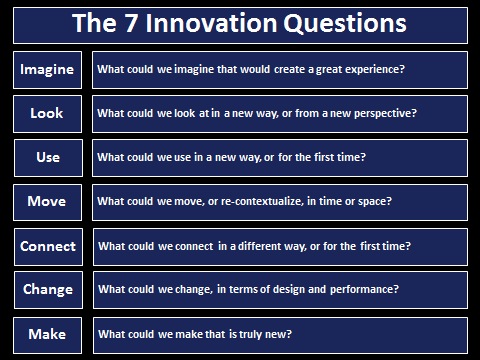
Bill leads the very snappily named “Innovation Genome Project’ which is working on reverse-engineering innovation by examining 1000 significant innovations throughout history.  (A cadre of MBAs may be harmed in the collection of this data, but that is the price of insight.)  They are examining what kind of change from the status quo is involved in each of those innovations:  So far, they have found that 7 kinds of changes account for most of the innovations.  Bill is graciously sharing his insights.  His team turned those 7 kinds of changes into  set of 7 questions that anyone can use to catalyze innovative ideas on any topic.

Since Satisfaction is the difference between Expectations and Experience, here are a few expectation-setting observations of my own about what this tool is and is not.

  1. Asking oneself these questions will not ensure good innovation ideas.  After all it is just a process; the quality of the ideas will depend on the people involved.  But it is a way to channel and spur people’s thinking in directions in which they might not normally go.
  2. It is a way to structure a discussion, which can be useful, particularly in groups. It prevents a discussion that is so broad-ranging that nobody builds on or works off each other’s ideas.  It provides focus while keeping each change domain (question area) is still large enough to evoke many different ideas.
  3. It is an aid for coming up with innovative ideas.  It does not claim to address the all-important implementation stage.
  4. It is a checklist to feel comfortable that you have not neglected a significant dimension of potential innovation.  Clearly, it is not a guarantee that you have actually considered all the potential innovations available to your business.

More detailed article by Bill O’Connor on this project and the questions can be found at:  http://www.innovationexcellence.com/blog/2012/01/09/the-innovation-genome-project/

An article by another Autodesk employee whose team came up with a successful innovative product/service using the tool can be found at:  http://www.fastcoexist.com/1679231/the-6-questions-that-lead-to-new-innovations

Retain and Develop Yourself / Your Employees

Inc. Magazine listed “Opportunities for Innovation”  as one of the top 10 things that employees want from job.  Founder Space lists “Feeling in on things” as #2 on the list of what employees say will make them happy at a job.  These facts highlight how important it is to engage all employees in innovation.  This is easy with naturally vocal and confidently creative people, or with those employees to like to start things rather than implement them.  But I’ve found that some of the best innovative ideas have come from very conservative and implementation-focused people once they perceived a commitment to following through on innovation and were given the opportunity to contribute.  A tool like the 7 Questions is a way to encourage and accommodate diverse employee participation in innovation at many levels.

Input Welcome

Would you use this approach?

Do you have better  or complementary approaches that have the same impact?

Share this:

  • Email a link to a friend (Opens in new window) Email
  • Print (Opens in new window) Print
  • Share on Reddit (Opens in new window) Reddit
  • Share on Facebook (Opens in new window) Facebook
  • Share on Tumblr (Opens in new window) Tumblr
  • Share on X (Opens in new window) X
  • Share on Pinterest (Opens in new window) Pinterest
  • Share on LinkedIn (Opens in new window) LinkedIn
Like Loading...
Page 1 of 2 1 2 Next »
  • Blog at WordPress.com.
  • Subscribe Subscribed
    • AffectiveAction
    • Join 41 other subscribers
    • Already have a WordPress.com account? Log in now.
    • AffectiveAction
    • Subscribe Subscribed
    • Sign up
    • Log in
    • Report this content
    • View site in Reader
    • Manage subscriptions
    • Collapse this bar
 

Loading Comments...
 

    %d