AffectiveAction

Because business has the heart to succeed

Menu

  • Home
  • Blog
  • General Management
  • Marketing
  • People Management
  • Innovation
  • Guest Bloggers
  • About
  • Enter your email address to follow this blog and receive notifications of new posts by email.

  • Recent Posts

    • Renewable Fuel for a Brilliant Life
    • How to Manage Women: Tips #2 and 3
    • How to Manage Women Tip # 1
    • Compassionate Capitalism
    • Stop That Focus Group!
    • To really change people’s behavior: Use the right word.
    • Is This the Coolest Company Ever?
  • Archive

  • Tags

    Affective Action B2B business business model career development career management cause marketing collaborate commercialization Conflict corporate responsibility customer networks demand generation Design Duarte Communications early sales Ecomagination effective communication Empathy employee engagement employee retention GE generative green marketing high performance high touch/low cost hiring HR human resources innovation innovative thinking Institute for the Future investment Jeff Immelt leadership lead generation management managing women market development marketing marketing automation marketing metrics motivation negotiate nurturing prospects outperform passion personalized marketing philanthropy philosophy philosophy and business Presentations product introductions project management project portfolio analysis project selection prospecting regulatory expansion results sales Santa Clara University social-media social entrepreneur social venture Social Venture incubator Strategy sustainability TEDx Presidio the buying process the customer view The Onion time to market time to ramp use case venture program
    • RSS - Posts
    • RSS - Comments
  • Subscribe in a reader

Browsing Tags passion

Five Change Management Key Success Factors

November 24, 2012 · by Taia Ergueta

Who is NOT trying to make change happen faster? Managers want employees to take up the banner of [fill in the blank: More Innovation? Fewer missed deadlines?].  Employees want managers to take off the blinders and [fill in the blank: Call fewer meetings and reports? Stick to a set of priorities for more than a month?].   Regardless of your change agenda, I think you’ll come up with good change management ideas from this unusual source.

The Source

Unilever is taking sustainability seriously. A recent Triple Pundit article notes, “the company’s target is to halve its carbon footprint by 2020”. Fine, what is impressive is that their carbon footprint calculation includes the carbon usage by consumers of their products. In fact, they estimate that “68 percent of it comes from consumer use of Unilever’s products” and they are tackling the task of getting people to reduce that dramatically. First target:  Getting consumers to reduce food waste. This is a fascinating change management project and I encourage you to read more about it, but something that caught my attention was their use of “Five Levers of Change”. I think they apply regardless of the kind of change you are trying to drive.

Read More →

Share this:

  • Email a link to a friend (Opens in new window) Email
  • Print (Opens in new window) Print
  • Share on Reddit (Opens in new window) Reddit
  • Share on Facebook (Opens in new window) Facebook
  • Share on Tumblr (Opens in new window) Tumblr
  • Share on X (Opens in new window) X
  • Share on Pinterest (Opens in new window) Pinterest
  • Share on LinkedIn (Opens in new window) LinkedIn
Like Loading...

How and Why to Optimize Your Relate:Create Ratio

July 2, 2012 · by Taia Ergueta

Can you think of anyone who succeeds by focusing exclusively on the subject matter of his/her work?  Yes, some artists who labor alone do achieve wild posthumous success, but I have yet to meet anyone with that as his/her goal.  Most of us recognize that we have to work with and through others.  This post is about turning that general awareness into a actions that will help your career development and your real results.

Why do it

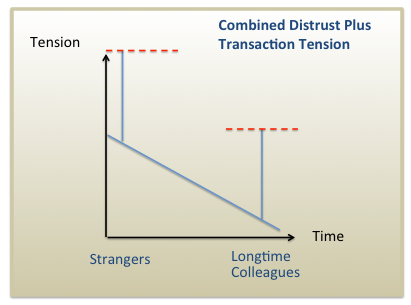
Here is another one of those Keys to Life (see May 28 post) that I have found exceedingly useful since I heard it sometime in the 20th century.  (I would attribute it but I have no idea who was the wise spirit who originated it.)   It is captured in a diagram which describes the potential states of a work relationship.

  1. The horizontal axis is Time. It measures how long the two people have known each other and interacted.
  2. The vertical axis is Tension. It measures the level of relationship Tension coming from two potential sources: Distrust and Transactions.

Distrust. When people first meet they don’t know what to expect from each other. Their level of trust is low. Accordingly the relationship tension is high. Over time, people get to know each other and, unless those interactions abound in deceit and treachery, the level of trust between them tends to increase: Logically, the level of distrust-driven tension goes down.

Transactions. Each time we want something from the other person or vice a versa we engage in a transaction, and each transaction creates some tension. If you have a small easy request to make of the other person, the tension created by that request will be very low. On the other hand, if you have a proposal that imposes a major cost on the other person (e.g., it conflicts with their plans, requires a lot of time or significantly inconveniences them) then the transaction-driven tension level created may be quite high.

So far so good.  Now here is the key:   Put these together and you will see why trying to do a major transaction with someone you barely know is so difficult.  The high distrust-driven tension coupled with the high transaction-driven tension adds up to a vertigo-evoking level of overall tension.  If instead, you attempt the same transaction with someone after you have established a relationship of trust, you have almost half the level of tension to deal with and the likelihood of success soars.

Ok, What To Do?

The take-away is:  Get down that distrust curve as fast as possible with all the key people with whom you need to collaborate or negotiate.  Important:  This is not a cynical tip meant to turn you into Machiavelli!  Groucho Marx said, “Sincerity is everything. If you can fake sincerity, you have it made.”  No, no, no.   We’re talking about effective communication and relationship building:

  • Seeking the person out
  • Listening to them
  • Being helpful when you can
  • Letting them know how you think and what drives you
  • Introducing them to your ideas early
  • Maintaining a dialogue

You get the picture.

Getting down that trust curve takes more time and effort than most of us think it does.  Which brings me back to the title of this post. Most people like to — and think they are paid to — work on the Create side of that ratio; that is where their passion is and they spend as much of their time as possible on it assuming/hoping that that will win the day.  So “Optimizing the Relate:Create ratio” usually requires shifting time spent on the substance behind those transactions to time spent on the relationships that will enable the real results.

You may be able to make that shift naturally just by being more aware of this. The rest of us mere mortals need to take a more structured approach, at least at first:  Picking key people with whom to deepen a relationship and then setting aside time explicitly for that.

As a manager this is a huge area of additional opportunities for creating an affective action culture and a high performance organization: I will cover these in my next post.

Input Welcome

  • Have you changed your Relate: Create ratio profitably?
  • Have you found ways to help your employees do this better?

Share this:

  • Email a link to a friend (Opens in new window) Email
  • Print (Opens in new window) Print
  • Share on Reddit (Opens in new window) Reddit
  • Share on Facebook (Opens in new window) Facebook
  • Share on Tumblr (Opens in new window) Tumblr
  • Share on X (Opens in new window) X
  • Share on Pinterest (Opens in new window) Pinterest
  • Share on LinkedIn (Opens in new window) LinkedIn
Like Loading...

The 60 Second Pitch that Will Get you 2-3 Minutes of Attention: Maybe more!

June 18, 2012 · by Taia Ergueta

People decide in 30-60 seconds whether they will pay the slightest bit of attention to you. If you slay that dragon, and they decide to tune in, you get ~3 minutes (their attention span) to possibly earn an additional smidgen of their interest.

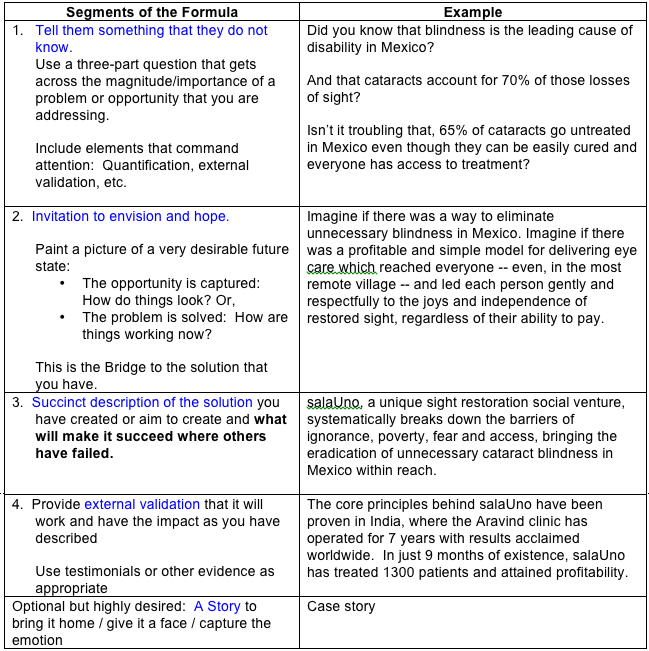
This is a “formula” for the 30-60 seconds. I will not do it justice. Its creator is communication expert, Sam Horn (http://www.intrigueagency.com/). She is extraordinary and I strongly recommend that you to try to hear her talk or buy her materials. In any case, I willshare my paraphrase of her ingenious and flexible formula for describing anything to anyone.

The power of the formula is that it engages the listener, tells your differentiation in that context, and gives the listener reasons to believe you. You are still You, just more Interesting. I think you’ll like You this way.

The Specifics and An Example

I will use the example of a startup company that I am mentoring, named salaUno. It is a Mexican eye clinic. Not excited by that description? Read on.

As Sam notes: This formula works whether you are answering the question, “What do you do?” at a cocktail party, or pitching your company at the biggest funding opportunity of your life.

What to Remember if You Don’t Remember the Formula

The formula works because it conforms to the human nature of the listener rather than the knowledge and ego of the speaker:

  • Our self-absorption halts briefly in response to new, surprising information.
  • Injecting an inspirational vision engages a different and valuable part of the brain. Factual small ideas may inform but they won’t attract or motivate.
  • The impact of a thing is always more interesting than the thing itself.
  • Dude, it’s not that you aren’t credible, but, well, bring external validation.

Input Welcome

          • Have you tried this with success? Send an example
          • Do you have suggested additions or modifications to this approach?

Share this:

  • Email a link to a friend (Opens in new window) Email
  • Print (Opens in new window) Print
  • Share on Reddit (Opens in new window) Reddit
  • Share on Facebook (Opens in new window) Facebook
  • Share on Tumblr (Opens in new window) Tumblr
  • Share on X (Opens in new window) X
  • Share on Pinterest (Opens in new window) Pinterest
  • Share on LinkedIn (Opens in new window) LinkedIn
Like Loading...

How (and Why) to Describe “Potential”

June 3, 2012 · by Taia Ergueta

Who advances in the business world often depends on management’s assessment of people’s “potential”.  But what constitutes potential is often not clearly described.  As a result, employees can’t work on it and managers can’t be consistent in their assessment of it.

The Cost

Managers often feel embarrassed about not being able to describe this rather intangible trait, so they act as if it is not a real evaluation criterion.  As a result, work is a game with rules that are posted and other rules that the judges actually use.  Very capable people can end up puzzled, pointing to their 100%-met hard metrics as others sail by them into higher positions based on this unspoken evaluation factor, potential.  Valuable people sometimes leave, seeking a company where the rules are clearer.  Others stay, but commit less to a system that does not seem to work for them.

The Upside

Getting specific about Potential and helping people to envision and become their best, highest potential selves is inspirational.  Just talking about it with employees is an affective action that is appreciated.  And just talking about it with specifics puts people in an energized and more confident state of mind.  People relax and outperform when the advancement criteria are real and understood.

A Tool

Here is a tool that I have refined over the years.  It is a list of Indicators of Individual Potential for exceptional contribution and for continued growth.

  • Personally develops valuable new proposals and ideas
  • Inclination and ability to interact effectively with the world outside of the Company
  • Generative: Sees next steps. Anticipates. Makes more out of things than others. 
  • Track record of Personal development & growth — eager to learn/grow
  • Proven to be able and willing to take on new roles
  • Demonstrated leadership of peers. Commands respect in the organization. Influential.
  • Able to mobilize an organization/team to effect change
  • Explicitly seeks out development opportunities: Actively learns from each experience
  • Takes initiative to perform beyond current task/job responsibilities
  • Willingly takes on greater responsibilities & broader assignments
  • Demonstrates creativity/initiative in problem solving, flexible, develops new approaches
  • Takes multiple perspectives. Is open. Is constructive
  • Sensitive to organizational dynamics required to get things done
  • Able to assess global, big-picture issues
  • Actively seeks opportunities to learn about industries, markets, technologies and trends relevant to the company
  • Able to work effectively across functions & organizational boundaries
  • Strong in many transferable skills (transferrable across roles or functions)
  • Clear adherence to a set of personal values
  • Proven track record of results
  • Demonstrates passion for the business.

For Employees

You do not have to exhibit all of these traits!  Here is my suggestion for how to sort this list and use it practically

1.  Identify which of these are most important.

I have marked the ones that I think are most universally important in green.  But I am not writing your evaluations.  (Too bad, because I am beginning to realize that you have unlimited potential!)  Find out which ones are most important to the people who are evaluating you and are in a position to propose you for rewards and promotions.  Use this list and ask them to pick their top criteria.  It is a great conversation to initiate since it is a high-potential act in itself:  You are showing ambition and dedication to growth, and you are contributing to the management toolset.  You are giving a professional gift while getting info that is critical to fueling your meteoric rise.

2.  Identify which of these  require your attention.

 If one of the indicators in green or one of the indicators that your managers have picked as very important is a real strength of yours, then develop at least 10 things you can do to make that strength have bigger impact on the business.  Read that again.  Notice that you start with your strengths, not your weaknesses.  I heard Peter Druker speak once – an intense experience — and he said that he managed his executives so that their strengths were so blinding that their weaknesses did not matter.  You could do a lot worse than adopting his management style for yourself.  The key is that those strengths will always be your strengths and consequently that is how you can make the biggest contributions.  Make sure you use your strengths fully instead of trying to do everything as well.

That being said, if one of the high important traits is an area of true weakness for you, then by all means develop a list of at least ten things that you can do to improve your performance and reputation in that area.  While that trait may never become what you are known for, you can make sure that that is not a big liability either.

Finally, you may already have these desired traits, but they may not be visible to the people that matter.  That is just like not having the trait.  No whining: Justice always needs your help.  As distasteful as it may seem to you, make a list of at least 10 things you could do to make your virtue visible.  Most of them should be things that you do as an ongoing part of your job.  A meeting with your boss that lays out your relevant past actions and accomplishments will be valuable ( See the May 6 post, “Thanks a Million, Kumar”), but you have to develop the skill of monitoring and managing your visibility on an ongoing basis.

To be sure that you are on the mark about your strengths and weaknesses, and also about how visible they are, you need input. Ask bosses, colleagues and friends.

3.  Implement at least 3 of the actions you came up with for a chosen indicator conscientiously for 4 months.  Look at them every week and assess whether you really did more of whatever you chose that week.   Re-up after 4 months or pick something new if you feel you have established desired habits around your first chosen indicator.

For Managers

Possible ways to use this list:

  • Edit it to show your priorities.
  • Share the list with your teams (edited or not).  It is a quick way to show support for their development.
  • Use this list at evaluation time to help you pinpoint and communicate specific behaviors to compliment or to suggest.

Input Welcome:

What do you think is the most important indicator of potential?

Do you have other behaviors that you look for when evaluating potential?

Share this:

  • Email a link to a friend (Opens in new window) Email
  • Print (Opens in new window) Print
  • Share on Reddit (Opens in new window) Reddit
  • Share on Facebook (Opens in new window) Facebook
  • Share on Tumblr (Opens in new window) Tumblr
  • Share on X (Opens in new window) X
  • Share on Pinterest (Opens in new window) Pinterest
  • Share on LinkedIn (Opens in new window) LinkedIn
Like Loading...

This Could Become Your Favorite Rule to Live By

May 28, 2012 · by Taia Ergueta

If you had to choose two key rules to live by and a classic movie star to have on a desert island with you, what/who would you choose?

May I suggest the Golden Rule, this one, and William Holden?  Regardless of what island, company or planet you inhabit, this post will help you change that world for the better.

The Core Idea

There are 4 “modes” of communication. Whenever we communicate we are doing so in one or more of the following :

    • The mode of Complaint
    • The mode of Information
    • The mode of Creation
    • The mode of Inspiration

Each has a different impact. If you learn those impacts and apply each mode correctly you can exceed your objectives dramatically with much less effort.

The Impact and Application of the Four Modes of Communication

1.  The mode of Complaint

      • Examples of things we communicate when using this Mode:  Our problems. Others’ failings. Past errors.
      • Impact:  Drains energy from the person communicating as well as his/her audience
      • Recommended Use:  None.  Avoid this like trans fats. Stop it when you see it.

2.  The mode of Information

      • Examples of things we communicate when using this Mode:  What we have done.  How we have done it.  Data.  Methodology.  Process.  Background.
      • Impact:  Provides valuable inputs but, on its own, doesn’t change anything
      • Recommended Use:   Do this off-line whenever possible. Summarize.  Do exception reporting. Draw or propose implications.

3.  The mode of Creation

      • Examples of things we communicate when using this Mode:  Joint problem-solving.  Options.  Evaluations.  Advocacy. Joint decision-making.
      • Impact:  Most productive mode because something is going to change as a result of the communication.
      • Recommended Use:  This is the mode in which you want to be as much of the time as possible, especially in meetings, because this is the mode that moves things forward.

4. The mode of Inspiration

      • Examples of things we communicate when using this Mode:  Big Goals.  Emotions/Passion.  Aspects of a desired future result.  Expressed confidence in ability to reach it.  Confidence in or admiration for people involved.
      • Impact: Expands people’s sense of the Possibilities. It leads to more than the expected happening.
      • Recommended Use: Build some element of this into all communications.

Putting it to Work

I’ve read and forgotten a boatload of teamwork/management stuff over the years and, in contrast, this 4 part communication rule has stayed with me.  It is the pasta of this space — easy, flexible and always hits the spot.  Here are a few application insights:

  • Moving information exchange out of meetings (e.g. shared electronically beforehand) ensures that scarce meeting time is used for the really productive modes of creation and inspiration.
  • Eliminating Complaint does not mean burying problems.  Anything that can be said in the mode of Complaint can be said in the mode of Creation:  Once you tune into that it is easy to make the shift without losing valuable candor and awareness of the issues.
  • When I first heard all this, the mode of Inspiration examples were President Kennedy’s Man on the Moon speech and Martin Luther King’s “I Have a Dream” speech.  This left me feeling that the mode of Inspiration was for monumental events and great orators, not for me.  But with more thought I realized that things such as expressing confidence in a colleague, team or employee, or reiterating the value of our goal provide inspiration.  And these things can be built into every communication.
  • I have occasionally shared this model with teams when a project is kicking off.  It seems to resonate and sets some efficient norms up front.

Input Welcome:  Do you think this model is useful?  Do you have other ideas for how to apply or improve on it?

Attribution: If I knew who originally came up with this modeI I would give full credit and send many accolades!  I was exposed to this at a company-wide management course at Agilent. Please write in if you know the source.

Share this:

  • Email a link to a friend (Opens in new window) Email
  • Print (Opens in new window) Print
  • Share on Reddit (Opens in new window) Reddit
  • Share on Facebook (Opens in new window) Facebook
  • Share on Tumblr (Opens in new window) Tumblr
  • Share on X (Opens in new window) X
  • Share on Pinterest (Opens in new window) Pinterest
  • Share on LinkedIn (Opens in new window) LinkedIn
Like Loading...

Artists & Activists

April 26, 2012 · by Taia Ergueta

Image: africa / FreeDigitalPhotos.net

View this document on Scribd

Share this:

  • Email a link to a friend (Opens in new window) Email
  • Print (Opens in new window) Print
  • Share on Reddit (Opens in new window) Reddit
  • Share on Facebook (Opens in new window) Facebook
  • Share on Tumblr (Opens in new window) Tumblr
  • Share on X (Opens in new window) X
  • Share on Pinterest (Opens in new window) Pinterest
  • Share on LinkedIn (Opens in new window) LinkedIn
Like Loading...
  • Blog at WordPress.com.
  • Subscribe Subscribed
    • AffectiveAction
    • Join 41 other subscribers
    • Already have a WordPress.com account? Log in now.
    • AffectiveAction
    • Subscribe Subscribed
    • Sign up
    • Log in
    • Report this content
    • View site in Reader
    • Manage subscriptions
    • Collapse this bar
 

Loading Comments...
 

    %d