AffectiveAction

Because business has the heart to succeed

Menu

  • Home
  • Blog
  • General Management
  • Marketing
  • People Management
  • Innovation
  • Guest Bloggers
  • About
  • Enter your email address to follow this blog and receive notifications of new posts by email.

  • Recent Posts

    • Renewable Fuel for a Brilliant Life
    • How to Manage Women: Tips #2 and 3
    • How to Manage Women Tip # 1
    • Compassionate Capitalism
    • Stop That Focus Group!
    • To really change people’s behavior: Use the right word.
    • Is This the Coolest Company Ever?
  • Archive

  • Tags

    Affective Action B2B business business model career development career management cause marketing collaborate commercialization Conflict corporate responsibility customer networks demand generation Design Duarte Communications early sales Ecomagination effective communication Empathy employee engagement employee retention GE generative green marketing high performance high touch/low cost hiring HR human resources innovation innovative thinking Institute for the Future investment Jeff Immelt leadership lead generation management managing women market development marketing marketing automation marketing metrics motivation negotiate nurturing prospects outperform passion personalized marketing philanthropy philosophy philosophy and business Presentations product introductions project management project portfolio analysis project selection prospecting regulatory expansion results sales Santa Clara University social-media social entrepreneur social venture Social Venture incubator Strategy sustainability TEDx Presidio the buying process the customer view The Onion time to market time to ramp use case venture program
    • RSS - Posts
    • RSS - Comments
  • Subscribe in a reader

Browsing Tags Strategy

Hewlett Packard

December 2, 2012 · by Taia Ergueta

greenhouse150cropThe nth self-inflicted injury (Autonomy) flings Hewlett-Packard into recovery mode once again.  I feel pained each time one of these poor decisions comes to light and takes its toll.  I loved that company.  You would have loved it too.  It was not just another business entity, it was one of the great institutions of Western Civilization.  David Packard and Bill Hewlett created a management system that was absolutely the best system for turning human capital into societal contribution.  Part of the evidence of this is that that system worked worldwide and across industries.

I speak of Hewlett Packard in the past tense not because I think they are doomed but because the company that now bears the name is a completely different company from the one I knew. I left HP in 1999 to join the spin-off, Agilent Technologies.  So I don’t pretend to know anything about the current situation there.  But I do know that the original HP’s formula for greatness is too important to allow it to be discredited by association with the current mess and too valuable to be forgotten.  There is so much to share with you about the very accessible magic of the HP that grew at a compounded annual growth rate (CAGR) of 23% for over 50 years. Today I think I will just share a story  and a summary description of the magic.

When I Realized Something Was Very Wrong

In the mid 1990’s the late Lew Platt was CEO of HP.  He and his CFO understandably worried that it would be increasingly difficult for HP to keep up the phenomenal record of 23% CAGR from 1942 to 1995.  In 1995 the company reached $31.5 B in annual revenues.  To grow even 15% in a year meant that the company would need to find $4.7B in new revenue.  So they asked the Corporate Development group to identify strategies that other companies had used to created growth.  I got the assignment.  It was a great project.  Since the General Managers of the businesses units were already thinking continuously about how to grow those existing businesses, I put particular emphasis on how companies got into new businesses.

I presented the findings to the executive team.  There was good discussion and questions.  Close to the end, one executive spoke assertively, saying in essence:  “This is all very interesting, but things are going pretty well.  Things have gone pretty well for us without doing any of those things, so maybe that means that we don’t need to do them.”  Though stated as a hypothesis, it was a conclusion.  The interesting thing is that he was wrong on two counts:

  1. First:  The company HAD done those things. Bill (Hewlett) and Dave (Packard) were intuitively new venture investors. The entered new businesses when the company did not NEED to do so.  They went into countries (like China in ) when  there was “no” market there yet.
  2. Second:  Financially things were going fine but that cadre of professional managers were focused on being careful stewards of their large businesses, not on creating high value new businesses. This paucity of internally generated growth encouraged later CEOs to plunge into a series of unfortunate acquisitions.

What Was Astoundingly Right Before So Much Went Wrong

I share this with you now because notwithstanding the many mistakes of the current HP, the important message of this post is that the key success factors of the original HP apply today.  Here is my summary of the HP success formula:

  • Beakers 4_3Products that made a big unique contribution
  • A system that built and unlocked human potential better than any other
  • Executives that used informed intuition to make bold moves that they then made successful
  • A commitment to customer success
  • Financial discipline

This formula does not seem to have been applied at the company with the HP name for some time but none of us should make the same mistake.

The original HP version of those elements create virtuous cycles of high expectation and high performance.  Those cycles, in turn create their own fuel of profit and goodwill.

More specifics on this in future posts.

For a personal discussion of how to apply the HP formula contact me.

Share this:

  • Email a link to a friend (Opens in new window) Email
  • Print (Opens in new window) Print
  • Share on Reddit (Opens in new window) Reddit
  • Share on Facebook (Opens in new window) Facebook
  • Share on Tumblr (Opens in new window) Tumblr
  • Share on X (Opens in new window) X
  • Share on Pinterest (Opens in new window) Pinterest
  • Share on LinkedIn (Opens in new window) LinkedIn
Like Loading...

Fast Company on Big Ideas

November 17, 2012 · by Taia Ergueta

In the November issue of Fast Company you’ll find “Why, with so many businesses thinking small, the World Needs Big Ideas”.  I love big ideas and, as a manager, often saw proof of the Goethe quote:

“Dream no small dreams for they have no power to move the hearts of men.”

Big idea projects also raise fascinating challenges for entrepreneurs and business people.

First, a few examples of inspiring Big Ideas sited in the Fast Company article:

  • Sage Bionetworks:   Accelerate biomedical discoveries by creating a system for open sourcing biomedical research data — thereby giving researchers access to thousands of times more data than they could collect on their own.
  • Waste Enterprisers: Turning human waste in to biofuel, solving huge widespread cost, environmental, time and dignity issues.
  • Terrapower: Unlimited safe energy from depleted uranium.

Read More →

Share this:

  • Email a link to a friend (Opens in new window) Email
  • Print (Opens in new window) Print
  • Share on Reddit (Opens in new window) Reddit
  • Share on Facebook (Opens in new window) Facebook
  • Share on Tumblr (Opens in new window) Tumblr
  • Share on X (Opens in new window) X
  • Share on Pinterest (Opens in new window) Pinterest
  • Share on LinkedIn (Opens in new window) LinkedIn
Like Loading...

Best Simple Operational Plan– Part 2

October 24, 2012 · by Taia Ergueta

The fun does not stop once the strategy summary is distributed and the initiatives list is complete!  Here is the second and last section of the Taia Ergueta Minimum Pain-Maximum Gain Operating Planning System.

This time the focus is on the last two parts:

  1. One Page Strategy Summary
  2. Operating Plan Initiatives List
  3. Operating Action Plans
  4. One Page Review Template

Step 3:  Operating Action Plans

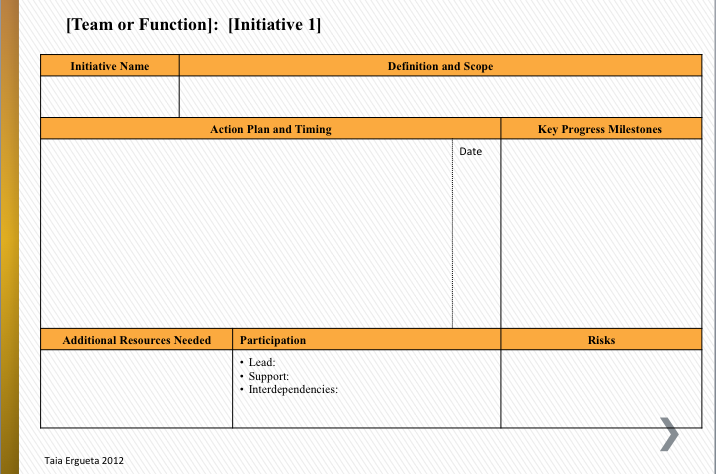
This is where the functional or project teams lay out what they will actually do.  There will be groaning, but persevere.  Writing it down gives you a prayer of a chance that everyone is mobilized around a scope, a pace, and interim milestones that will actually achieve the desired outcomes.  Without this, it is really easy to go forward with all good intentions, have 3 quarters of highly upbeat review meetings at which actions taken are reported proudly, and then, in the 4th quarter, notice that we are not actually going to produce the results.  Explanations for the gap will abound.  The fact is, if you teams can’t describe at least one way to accomplish the objectives and let everyone see and critique that, your expected results have  a high chance of being road-kill.

Here is a simple template for the action planning.  Each function or team fills one out for each major initiative.  The dates and milestones associated with the actions are the items that are reviewed at the progress review meetings.

Step 4.  One Page Review Template

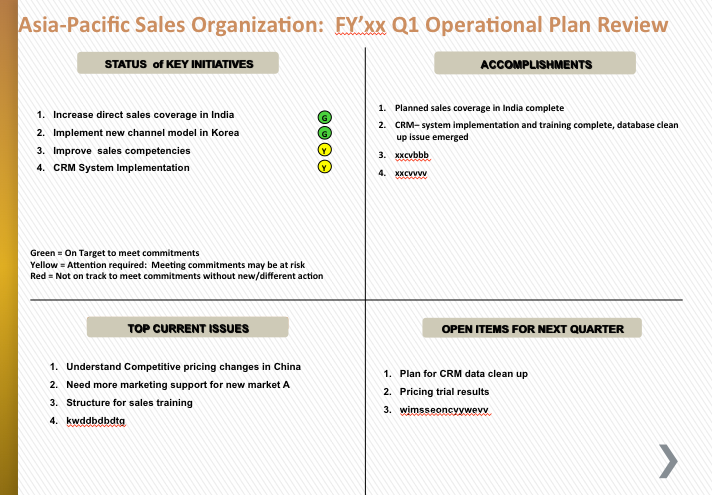
That which gets measured gets done.  So you need to monitor the execution.  Quarterly is fine for the whole plan by the whole leadership team.  (Other reviews of key projects should happen with the right set of people as they go along and reach milestones.)  KEY POINT:  The operational plan reviews will be mind-numbing, time-wasting, and pretty much useless if you do not make them Exception-Reporting-based!  By this I mean, talk only about things that are at risk or off-track.  Do not make the reviews a show and tell about what is going fine.  Does this sound harsh?  Employees will actually be more engaged if they see that issues are surfaced and dealt with.  Just remember to be inspirational in the process and not to kill too many messengers.  ( See my other post on how to make all other communications more productive too.)

Here is a one page template for reviewing a function, or team operational plan.

The top left quadrant simply shows what is on track or off-track.  The top right gives highlights of what has actually been accomplished.  The bottom left indicates what issues are being addressed.  This should be a rich part of the discussion including troubleshooting what the team is doing to correct the problems, requests for assistance, etc.  The bottom right is a place for the team to note key things that will come up in the next quarter and/or the next review.

That is it.  

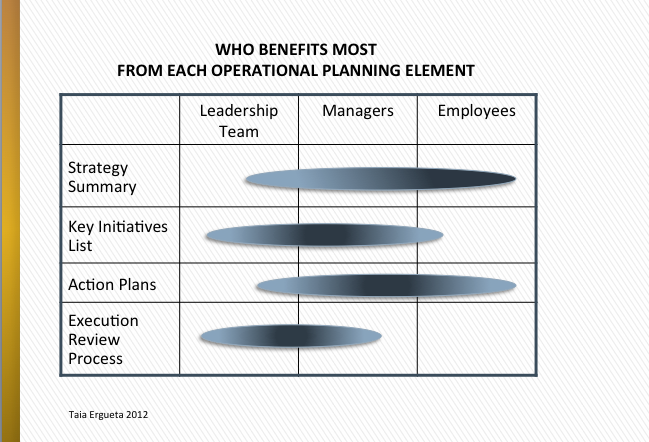
Who Benefits?

Here is how the 4 parts of the TEMPMGOPS serve different parts of your team.  The darker the shading, the more important the benefit.

Happy planning.

If you would like help with any of this, contact me at http://www.hourandawhiteboard.com

Share this:

  • Email a link to a friend (Opens in new window) Email
  • Print (Opens in new window) Print
  • Share on Reddit (Opens in new window) Reddit
  • Share on Facebook (Opens in new window) Facebook
  • Share on Tumblr (Opens in new window) Tumblr
  • Share on X (Opens in new window) X
  • Share on Pinterest (Opens in new window) Pinterest
  • Share on LinkedIn (Opens in new window) LinkedIn
Like Loading...

Best Simple Operational Planning –Just 4 Slides

October 21, 2012 · by Taia Ergueta

QZBJGG9HWXMN Everyone has a reason to hate operational planning. It takes too long. Worse, it takes all that time to do and is often forgotten. It gets confusing (“Isn’t this more of a strategy than an objective?” Argghhh!). And even when everyone manages to drag themselves through all that, reporting on and reviewing the execution of those plans gets so boring you wish you were the ones being executed.

These problems come to mind now because I am advising a small, but fast-growing company doing its first round of real planning.  The benefits are high. It is worth trying to reduce the costs.  So here it is, the Taia Ergueta Minimum Pain-Maximum Gain Operating Planning System.

The pieces:

  1. One Page Strategy Summary
  2. Operating Plan Initiatives List
  3. Operating Action Plans
  4. One Page Review Template

1. The One Page Strategy Summary

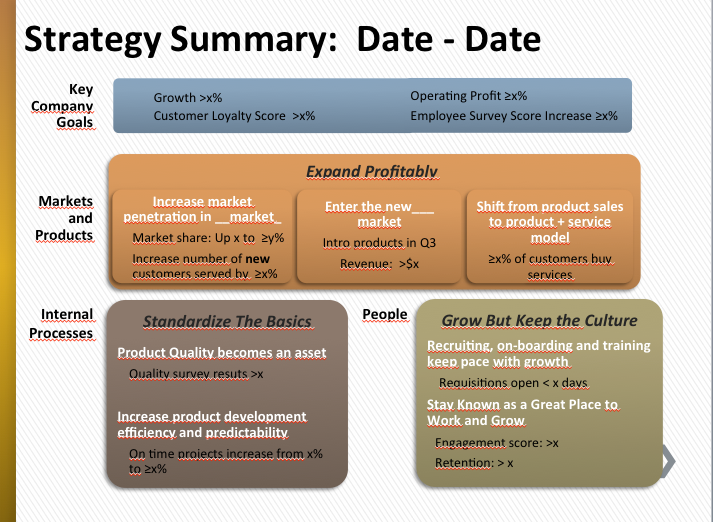
This assumes that you have done the strategy development already. If so, you have a ton of documents with options, analyses, dreams, obfuscations, spider diagrams, and assumption-laden spreadsheets to show for it. Now you just need all of that exquisitely distilled into one page. “Impossible!”, you say? We aren’t exactly talking Shakespeare here; it can be done. And it really has to be done.  Give every employee a single, digestible page that shows what needs to change and by how much and you dramatically increase your chances of accomplishing and exceeding that.

Here is an example of a 1 page strategy summary:

To be clear, it is not just about fitting stuff on one page.  The requirements for an effective one page strategy summary are:

1.  Whole Entity Goals. There should not be more than 6 of these. These should indicate the actual numeric goal that the entity will achieve by the end of the planning period (a year, or half year if you are in the midst of massive change). In this case I have suggested:

    • A growth goal
    • A profit goal
    • A customer satisfaction or loyalty goal, and
    • Some version of an employee satisfaction or engagement goal

2. Strategic Intent Blocks

No more than 5 strategy areas. In the example above I have 4 strategy blocks:

      • Markets and Products
      • Processes
      • Employees/Culture
      • Finance and Admin

Each one has:

      • A description of the key strategic intent. This is a pithy phrase that captures the key CHANGE that you will effect. If there is no change word (“increase” “eliminate”, “accelerate”, etc.), try again.  (Remember, these are not meant to cover everything that the organization will do.  They are the areas which require extra focus and will produce big impacts.)
      • The main tactical initiative areas.  Keep these broad enough and phrased as objectives; let your teams figure out how to accomplish them.  They will be more engaged, develop more, and are likely to do great things you would not have thought of!
      • The very few key metrics — and associated specific goals– that indicate the size of the change needed and that will tell if you accomplished the strategy.  Nota Bene:  Always define the goals as a minimum (i.e., “at least” or “less than”) rather than as a specific value.  Reseach shows that people will just meet a specific goal, but will consistently outperform that when the goal is open-ended.  Go figure.  Now you know how to increase your organizations output by 15% simply by learning how to type “<” and “>”.

2. Operating Plan Initiatives List

Once the strategy is clear, your teams or functional groups can go off and develop action plans. Warning, warning!:  This is where the strategy can get undermined if people pursue all the projects they like and fit the strategic initiatives in edgewise.  Negotiating to a 1-2 page list of all the major initiatives and their owners helps the management team drive focus and make clear trade offs.  You’ll end up with a succinct initiative list for each function or group that contains:

  • Initiatives directly in support of the strategies: These are the highest priority.
  • Initiatives for some ongoing obligations: Some of these are essential and some may need to be examined for potential dropping over time.
  • Other initiatives: If there are a lot of additional initiatives, it is worth checking to see if they are justified and if they can be done without jeopardizing the strategic items.

A simple slide like this can capture the key elements across all the entities involved.

Well, that’s enough for now.  The TEMPMGOPS, like wild boar, is best digested when consumed slowly.  In the next post I’ll give you the final 2 templates.

  • Operating Action Plans
  • Operational Plan Review Template

Cheers!

Inquiries and Comments Welcome.

If you would like help with your planning, contact me by clicking here.

Share this:

  • Email a link to a friend (Opens in new window) Email
  • Print (Opens in new window) Print
  • Share on Reddit (Opens in new window) Reddit
  • Share on Facebook (Opens in new window) Facebook
  • Share on Tumblr (Opens in new window) Tumblr
  • Share on X (Opens in new window) X
  • Share on Pinterest (Opens in new window) Pinterest
  • Share on LinkedIn (Opens in new window) LinkedIn
Like Loading...

Saving Customers Time Will Build Your Business

August 22, 2012 · by Taia Ergueta

The humor newspaper The Onion ran this front page headline: “Things Taking Entirely Too Long”. The accompanying photo showed a man staring at a microwave oven. Two minutes is the new Eternity.  People will put up with government gridlock, romantic betrayal and even cucumbers being put in their drinking water, but they will simply not tolerate having their time wasted. This all points to the big opportunity to distinguish yourself by saving your customers time.

The post “How to Spark Innovative Thinking” talked about many innovation directions.  Saving customers time is an exceptionally rich innovation strategy. Not only do customers value it but your sales people will love having a quantifiable personal benefit to offer. Have you thought of how you can do this? Here is a three-step process for finding the most innovative and profitable ideas.

Read More →

Share this:

  • Email a link to a friend (Opens in new window) Email
  • Print (Opens in new window) Print
  • Share on Reddit (Opens in new window) Reddit
  • Share on Facebook (Opens in new window) Facebook
  • Share on Tumblr (Opens in new window) Tumblr
  • Share on X (Opens in new window) X
  • Share on Pinterest (Opens in new window) Pinterest
  • Share on LinkedIn (Opens in new window) LinkedIn
Like Loading...

Winning Big Through Sustainability

August 12, 2012 · by Taia Ergueta

Opportunities Revealed

In the business world, “Sustainability” started out as Lunatic Fringe talk, then moved up to window-dressing for Corporate Responsibility sections of Annual Reports and subsequently got a new and sometimes tawdry life as a Green Marketing opportunity.  Now, setting a company’s sustainability agenda is one of the most important and valuable things that its executives must do.  And people at all levels can find great innovation ideas in sustainability.

Serious Business

I attended the Sustainable Brands conference in 2007 and it was a hive of excitement over the power of Green Marketing and adulation of cool campaigns and programs.  Just two years later, the same conference was astoundingly different:  It had become clear that both the issues and opportunities are much more fundamental and addressing them is no longer a matter of choice, it is an imperative.  Energy and water will be scarce and more expensive for everyone.  In addition, a combination of consumer awareness and regulatory expansion are making transparency – a lot of reporting of your sustainability practices – mandatory.   You can deal with these as burdens or you can try to find ways to create advantages for your company.  In addition to creating new obligations, these and related challenges are creating major opportunities for growth and effectiveness.

What to do? Read More →

Share this:

  • Email a link to a friend (Opens in new window) Email
  • Print (Opens in new window) Print
  • Share on Reddit (Opens in new window) Reddit
  • Share on Facebook (Opens in new window) Facebook
  • Share on Tumblr (Opens in new window) Tumblr
  • Share on X (Opens in new window) X
  • Share on Pinterest (Opens in new window) Pinterest
  • Share on LinkedIn (Opens in new window) LinkedIn
Like Loading...

Defusing Difficult Conversations

July 10, 2012 · by Taia Ergueta

Second post in the “Thanks A Million” series on great things that I have learned from employees or colleagues.

I was on the Board of Directors of an excellent job training non-profit, JobTrain,some years ago. At one point, the Director, a fellow Board member and I were discussing the need to address a staff member’s performance problem. The Director anticipated that the person might react negatively. My fellow board member was Roy Clay. I already knew how accomplished and respected he is in Silicon Valley (more on Roy below). I then learned how wise he is.

Roy asserted that there would be no problem as a result of addressing the performance matter with the employee. It was a matter or how the message was delivered.  I remember he said:

“ You can say anything to anyone, if you say it with love”.

His words have come to mind countless times since then,  and led me to find better ways to deal with a range of tough situations. It is the epitome of applied Affective Action– combining an understanding of how people feel as well as how they think, to achieve higher outcomes, employee engagement and management effectiveness.

Here are three examples:

1.  Performance management.

I used to hate giving corrective feedback to my employees.  Even though I rarely get headaches, I would always get one on those days. Using Roy’s maxim I changed how I prepared for those discussions.  I still made sure that I could be clear about the issue and what needed to change.  But instead of preparing to deliver unwelcome news I prepared to help the employee increase their success and pride.  An expression of a deficit became an expression of caring.

The results?  Impressive:

    •  The employees left aware and motivated
    •  Our relationship seemed strengthened instead of strained
    • I was left feeling confident that change would happen and … remarkably headache-free before, during and after!

Just a small shift in my own definition of my intent changed the dynamic and outcomes.  Here’s my dissection of why it works:

    • Instead of sensing the manager’s tension, the employee senses goodwill. This puts him/her in a receptive rather than defensive mode.
    • Since the conversation is about enabling them to perform at their potential it is much more likely to be a collaborative dialogue.  This  produces better ideas about how to make progress and leads to more ownership by the employee.
    • For the same reason, it is also a discussion that the employee looks forward to continue having.  This is huge since giving them more feedback over time is much more likely to produce the desired result than a one-time one-way issue dump.

2.  Communicating Budget Decisions.

As General Manager or team manager you frequently have to make tough resource allocation trade-offs.  There are many legitimate needs that affect your people acutely that simply are not as critical as other needs.  The problem is that you need high performance from people on both the winning and losing parts of the budget.  When communicating the funding decisions, you can talk about the fact that fiscal discipline is key, that business is about tough choices, blah, blah, blah. But that does nothing to keep the people on the losing parts of the budget from feeling disaffected.  Heck, it leaves even the budget “winners” feeling like they are part of an under-resourced family.  I found that “saying it with love” works here too but means something different.

    • Communicate Acknowledgement and Empathy.  People will accept a decision if they feel that their need was understood and not just ignored.  And let there be no mistake:  They will assume that you did not understand or consider their need unless you actually express that you do/did.  Remember, parents and managers are always judged to be clueless until proven otherwise.

Even if you show that you know everything about the thing that you are not funding, you may miss a key point:  People want to know that you recognize their “pain” and feel bad about the negative impact they are bearing. Astoundingly, the quarterly “I know you are all working very hard” statement and the “THANKS!” slide aren’t enough.  But if you can mention specific areas that are tight or unavoidably understaffed and how people are making do, you reach hearts, which are far more open than minds.

    • Communicate the Tie to the Shared Underlying Strategy.  Ok, if there is no strategy or if it is not already shared, there is work to be done.  But when you do have one, reiterating it lets people know why the investments are being directed as they are and what the team expects to get “in exchange” for their sacrifice.  People know or can imagine (or hope) that they will benefit if the strategy gets successfully implemented and the whole business does well.

3. Conflict.

Do you have a hypercompetitive colleague? Is another group not collaborating with one of your teams?  Let’s face it, there are endless sources of conflict at work.  I expanded on Roy’s maxim to deal with these. Here is what I advised people to do:

a. Think about what makes your adversary lovable.  I know: this sounds truly weird. But you can’t act ‘with love” if you do not see them as a lovable person. Think now. Somebody must love them; what could have inspired that? Once you identify something, really appreciate that about them–no matter what you think of their other traits.

b. Before meeting with him/her, bring that sense of the person to mind. Once again, this sounds weird. But it works – though perhaps not the way you anticipate. Mentally bestowing your goodwill on them makes you feel powerful and benevolent. Your body language will unavoidably communicate this feeling. More than likely, you will be calmer, more in control and more influential. At best, the other person senses all this and it puts your conversation on a different course and plane. If nothing else, it confuses them. ☺

I have tried to make this practical and a bit humorous because I know that, in the business world, it is easy to dismiss anything involving the word “love” as incompatible with being serious-minded. But it is the most powerful force driving humans, trumping even the drive for self-preservation.  Not harnessing it in business is serious mismanagement.

Input Welcome

– Have you used similar approaches?

– Are there other situations in which you think this works?

FYI: Silicon Valley Engineering Council Bio of Roy Clay

Share this:

  • Email a link to a friend (Opens in new window) Email
  • Print (Opens in new window) Print
  • Share on Reddit (Opens in new window) Reddit
  • Share on Facebook (Opens in new window) Facebook
  • Share on Tumblr (Opens in new window) Tumblr
  • Share on X (Opens in new window) X
  • Share on Pinterest (Opens in new window) Pinterest
  • Share on LinkedIn (Opens in new window) LinkedIn
Like Loading...

Is Your Plan Bold Enough to be Safe?

June 24, 2012 · by Taia Ergueta

Careers and companies rise and fall based on being right about how much innovation to take on at any given time.  Reach too far and you risk ridicule, delays in time to market, and slow market development.  Not surprisingly, it often seemed safer to stick to the middle ground:  Investments in product enhancements or business extension for which there is strong supporting data.  But today, you shun the lunatic fringe at your own peril.  A small leap may not put you on firm ground.

 (The view straight down from High Bridge over Eagle Creek in the Columbia River Gorge)

A Case and Lessons Learned

I recently attended an EMBS talk on the latest scanning, parametrics, and 3-D printing developments.  The speaker was Scott Summit.  His company, Bespoke Innovations makes functionally and esthetically personalized prosthetic leg coverings.  For the coverings to achieve their first objective – restoring visual symmetry to the wearer’s body – they need an accurate digital scan of the person’s body.  What he recounted about the recent history of body scanning technology is a warning to all of us in any industry:

  • Approximately 3 years ago, to get a body scan he needed to take the customer to a lab that had a 1M machine and would provide scans at $800/scan.
  • Shortly thereafter, there were hand-held devices that cost $40,000 to $60,000 a piece and were very tricky to use.
  • Scott’s company developed their own scanner but it was soon overtaken in price/performance by…
  • A scanner that Microsoft developed. Shortly after that product became available…
  • Autodesk announced that anyone could download their 123D Catch software product for free. This enables anyone with a digital camera to take photos that the software then stitches together to create a 3-D model. For free.

Just hearing about this drop — from $1M to $0 in approximately 3 years —  is dizzying.  Can you imagine how each of those obviated product providers felt?  There are Five Stages of Grief, and I have seen Four Stages of Losing this kind of competitive fight:

  1. Denial:  “It’s a much less powerful product. “ “We only see them in Germany.”  “Our customers will never accept that.”
  2. More Enhancement:  “We will have better [fill in the blank: Specs? Bathrooms? You Tube videos?]”
  3. Capitulation:  “We have other more strategic businesses on which to focus”
  4. Rationalization:  “Sheila never invested enough in it.”  “Joe wasn’t the right person to lead it.”

The lessons that people take away from competitive failures are not always right.  Maybe there were other issues, but maybe the real lesson is this:  “We lost by playing it safe.  We did not target a big enough change; as a result, our investments went toward enhancements while others produced a much bigger leap in value for customers.”

There are definitely still situations that call for investments in minimally or moderately innovative projects.  But my point is that there are fewer of them now than before.  At the current pace of change and competition, many medium-impact projects simply do not make sense:  They will be rendered irrelevant soon or even before they are out the gate.

Implications:  How to Win in This Environment

  1. Become the voice, in your head and in your company, for the “Is it bold enough to be safe?” investment criterion.
  2. Become expert in  the techniques for evaluating bold ideas.  For every bold idea that is wildly successful there are 17 that turn out to be just wild.  More on this in future posts.
  3. Become expert in the techniques for implementing bold ideas in ways that manage risk.  More on this in future posts.

Input Welcome

Have you changed your project selection to match a faster pace of change?

How have you mitigated the higher risk associated with bigger leaps in contribution?

Share this:

  • Email a link to a friend (Opens in new window) Email
  • Print (Opens in new window) Print
  • Share on Reddit (Opens in new window) Reddit
  • Share on Facebook (Opens in new window) Facebook
  • Share on Tumblr (Opens in new window) Tumblr
  • Share on X (Opens in new window) X
  • Share on Pinterest (Opens in new window) Pinterest
  • Share on LinkedIn (Opens in new window) LinkedIn
Like Loading...
  • Blog at WordPress.com.
  • Subscribe Subscribed
    • AffectiveAction
    • Join 41 other subscribers
    • Already have a WordPress.com account? Log in now.
    • AffectiveAction
    • Subscribe Subscribed
    • Sign up
    • Log in
    • Report this content
    • View site in Reader
    • Manage subscriptions
    • Collapse this bar
 

Loading Comments...
 

    %d